Skip to content

The best drill press for woodworking

Motor power is rarely the limit when drilling wood. Quill stroke is, and it is the number most often missing from a listing.

Always clamp the work

A bit breaking through the far side of a board bites suddenly, and a workpiece held by hand becomes a spinning lever. One of the presses in this guide arrives with a machine vice; for the others, buy one.

The depth stop is what makes it a machine

Shelf pin holes, dowel holes and hinge recesses need the same depth repeated dozens of times. A depth stop turns that from a careful operation into a mechanical one.

Which saw fits your shop?

You want repeatable perpendicular holes
That is the machine's whole purpose, and even a modest one does it far better than a handheld drill.
You bore large holes with forstner bits
Low speed and a stable table matter more than power.
Space is short
A benchtop model covers most woodworking, and the floor model earns its place only on tall work.
You drill metal too
The speed range needs to go lower, and the table needs to take a vice.

Picking by the cut you need

Perpendicular holes

The core reason to own one. It removes the wandering and the angle error of freehand drilling.

Large flat-bottomed holes

Forstner bits in hardwood need slow speed and steady feed. This is where a drill press is not optional.

Repeat drilling

With a fence and a stop, dozens of identical holes become straightforward. That is a real production capability.

Sanding and light shaping

With a drum sander in the chuck. It works, and it demands a table with a hole or a sacrificial insert.

What matters once the blade is turning

Runout at the chuck
A spindle or chuck that wobbles will not drill a clean hole whatever you do. It is the specification that decides quality of result.
Speed range, especially the low end
Large bits in hardwood need low speed. A press whose slowest speed is still fast cannot use big forstner bits properly.
Quill travel
How deep you can drill in one stroke. Short travel means repositioning mid-hole, which spoils the hole.
Table size and adjustability
Woodworking tables are usually too small. A wooden auxiliary table with a fence is the standard first upgrade.
Column rigidity
A press that deflects under feed pressure drills a hole that is not quite square to the table, which defeats the point.

Which figure for which cut

What you drillWhat mattersWhat does not
Small holes in woodLow runoutMotor power
Large forstner holesLow speed and rigidityMaximum speed
Deep holesQuill travelTable size
Repeat positionsA fence and stopThe machine itself

Where it goes wrong in the shop

Drilling large holes at high speed
Big bits burn and grab at speed. Slow speed and firm, steady feed is what gives a clean hole in hardwood.
Not clamping the work
A bit breaking through catches the workpiece and spins it. On a drill press this happens with real force and the piece becomes a weapon.
Drilling without a backing board
Breakout on the underside ruins the face you were going to show. A sacrificial board under the work removes it entirely.
Using a chuck key and leaving it in
A key left in the chuck is thrown at switch-on. It is an old warning because it is an old accident.

By the woodworker you are

The general woodworker
A benchtop press with low runout and a wooden auxiliary table. That combination covers almost everything.
The large-hole user
Low speed and rigidity above all, because forstner work exposes both.
The mixed shop
A wider speed range and a table that accepts a vice, for wood and metal on the same machine.

Blades, alignment and working life

A drill press needs very little, and what it does need is a clean, rust-free column and table so the head and table move where they are set. A chuck full of dust also stops gripping properly, and that shows up as runout.

  • Keep the column clean and lightly waxed so the table raises smoothly.
  • Clean the chuck jaws: dust in the jaws mimics runout.
  • Check belt tension where the drive is belt-driven; a slipping belt loses speed under load.
  • Wax the cast table to keep rust off and let the work slide.

Safety

A machine that turns a workpiece into a spinning object when a bit catches.

  • Clamp the workpiece or hold it against a fence; never rely on hand grip alone.
  • Remove the chuck key before switching on, every single time.
  • Tie back long hair and remove sleeves and gloves near a rotating spindle.
  • Reduce speed for large bits and let the bit clear its waste rather than forcing it.

Our picks, and the case for each

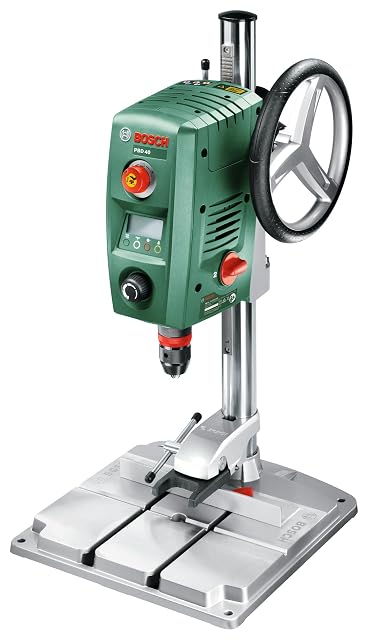
  1. Bosch PBD 40

    710 W · 90 mm (3.54 in) quill · 40 mm (1.57 in) in wood

    The longest stroke of the European bench drills here — 90 mm (3.54 in) — and the only one that states its capacity in wood as well as steel.

    Best for: Deep holes and large Forstner bits — the work the cheaper presses cannot reach
    7.8/10

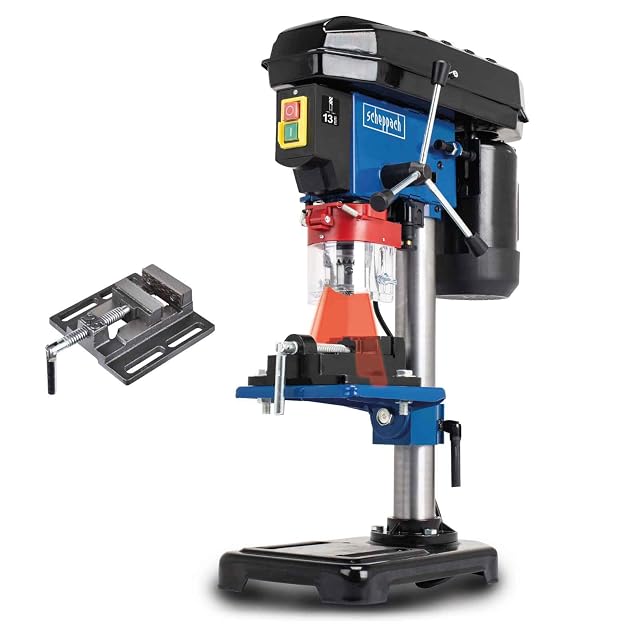
  2. Scheppach DP16VLS

    1,5–13 mm (0.06 to 0.51 in) chuck · 50 mm (1.97 in) quill · vice included

    A bench drill press with a machine vice in the box for €99 — and a 50 mm (1.97 in) quill stroke that tells you what it is for.

    Best for: Accurate shallow holes — hardware, dowels, shelf pins — on a small bench

    7.8/10

What comes up most often

What quill stroke do I need?

50 mm (1.97 in) covers furniture hardware, dowels and shelf pins. 90 mm (3.54 in) bores through thick stock in one plunge and takes large Forstner bits — which is where a drill press stops being a hardware tool and becomes a joinery one.

Do I need a mortising attachment?

Rarely. They put side load on a quill designed for axial load, and a dedicated mortiser or a router and jig usually does the job better.

Benchtop or floor standing?

For most woodworking, benchtop is enough and takes far less room. Floor models earn their place on tall work and deeper throats.

What speed for a large forstner bit?

Low. Rim speed rises with diameter, and a large bit at high speed burns and grabs rather than cutting.

Why is my hole not round?

Usually runout at the chuck or a dirty chuck, sometimes a bent bit. It rarely has anything to do with motor power.

Do I need a bigger table?

Almost certainly. A wooden auxiliary table with a fence and a sacrificial insert is the standard first improvement to any drill press.

How do I stop breakout underneath?

Drill into a backing board clamped under the work. It supports the fibers at the exit and removes the problem entirely.

Can I use it as a mortiser?

With a proper attachment on presses designed to take one. Improvising mortising on a press not built for the side loads is not advisable.

Each saw, and the cut it was bought for

Bosch PBD 40

For cutting: Deep holes and large Forstner bits — the work the cheaper presses cannot reach
Where it shines: 90 mm (3.54 in) of quill stroke — nearly double the Scheppach DP16VLS

Where it disappoints: Not sold on amazon.com

Read the full review →

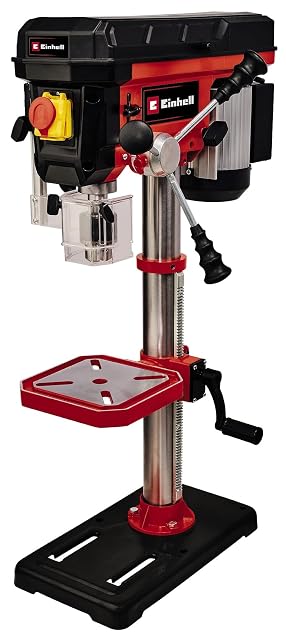
Einhell TC-BD 630/1

For cutting: Repeat drilling to a set depth — shelf pins, dowel holes, hardware

Where it shines: Publishes drilling depth, bit capacity and the depth stop

Where it disappoints: Not sold on amazon.com

Read the full review →

Scheppach DP16VLS

For cutting: Accurate shallow holes — hardware, dowels, shelf pins — on a small bench

Where it shines: A machine vice included, which is a genuine accessory rather than packaging

Where it disappoints: 50 mm (1.97 in) of quill stroke limits you to shallow holes in one plunge

Read the full review →

What each band of spend cuts

What divides one band from the next: Motor — Entry level 2.5 · Mid range 6.2 · Upper range 550

What else the cut needs

Blades, inserts and spares from the same aisle, at the price we recorded. Check they fit the saw you pick before ordering: it depends on the bore and the part number, which the listing states.

The quick cut

Pairings that settle the choice

Saw against saw, where the comparison already exists in this guide or this aisle.

How this selection was built

The saws above are drawn from the catalog of this site. Specifications are the published ones, from the maker and from the Amazon product page; prices are the Keepa figure for the date below, and both shift. Ranking uses declared specifications, the balance of stated strengths and stated limits, and price. No machine here has cut wood for us, and the page claims nothing else.

Last checked on

Prices quoted in these summaries are dated readings. The live price is shown next to each product.

The tool we use ourselves

Chosen your machine? Now buy it at the right price.

Table saws and planers swing by a hundred dollars or more across the year, and the biggest "discounts" often land at prices the same model sold for six weeks earlier. UniverTrack tracks the real price history across retailers, spots fake reductions, and alerts you when it is genuinely the moment to buy.

Real price historyBuy-now alertsAI buying assistant
Try free for 14 days →
No commitment · Cancel in one click · 5 languages