Every figure below names its source. Each one is a manufacturer
specification read off the listing itself. The judgments are ours.
Five point nine inches
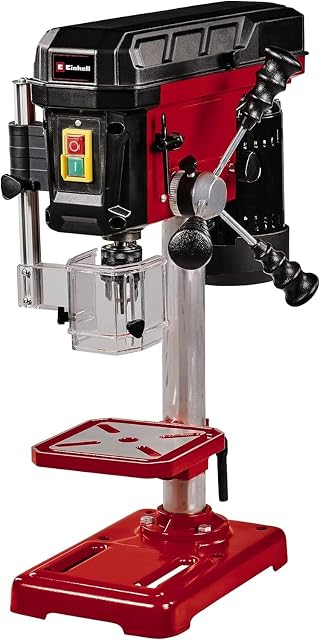
A hundred and fifty millimeters of quill travel, published, on an eight-inch
benchtop press.
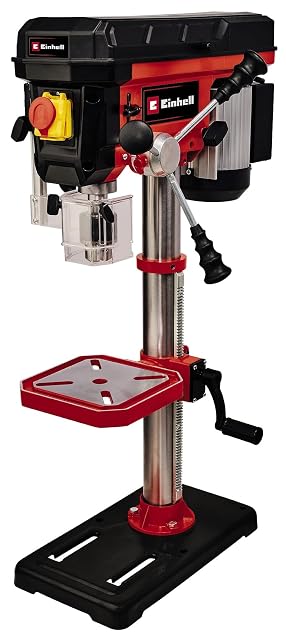
That is more than the 127 mm (5 in) the floor-standing JET on this shelf states. It is
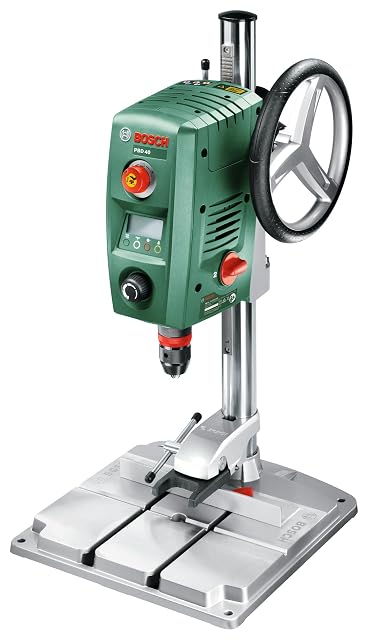
more than the 90 mm (3.54 in) the published Bosch PBD 40 here is praised for — a figure
bounded the same day to the European machines on this shelf, because of this
page and the JET.
It would make the smallest and least expensive machine of fourteen the
deepest-drilling one.
Quill travel comes from the quill housing and the rack, not from the swing, so a
long stroke on a small head is not impossible. It is unusual enough to confirm
with the seller, and this page cannot confirm it.
A drill press is bought for holes square to the face. What decides how deep
those holes can be is the quill travel — how far the spindle comes down in one
pull of the lever.
Run out of travel and the work has to be lifted on packing and the hole
restarted, which is where accuracy goes. Fifty millimeters is shallow-hole
territory: shelf pins, dowels, hardware. Eighty to ninety reaches most Forstner
work. Past a hundred, a drill press starts to be a boring machine.
It is also the figure that is left out most often. Three of the seven European
listings on this shelf publish it; the published Scheppach DP60 page names its
absence as the one number that defines a drill press.
What eight inches of swing does limit
How far from the column the hole can be, and nothing about depth changes it.
Swing is twice the throat: eight inches means a hole center four inches from the
column, so the widest board drillable on its centreline is eight inches.
That is the real constraint on a machine this size. The JET here publishes
seventeen, which is why it stands on the floor.
Six hundred and twenty to three thousand one hundred
Five speeds, by moving the belt, and the five are not named.
Six hundred and twenty at the bottom is the second-lowest on the American half
of this shelf and genuinely useful — a 13 mm (0.51 in) bit in hardwood is happy there, and
so is a small Forstner.
The VEVOR 8 inch beside it publishes all five of its steps. This one publishes
the two ends.
A targeting beam
The listing’s words. The word laser does not appear on the page.
Whatever it is, it does what the laser does on four other machines here: puts a
mark on the work where the bit will land.
Two of those four publish a class and a radiant power. Two name a system and
stop. This one avoids the category word, and for a feature whose only risk is
looking into it, the class is the specification.
Numbered one to five
The five published features begin “1.”, “2.”, “3.”, “4.” and “5.”.
It is a listing written as a list of its own bullet points, and it is printed
here as it stands.
Availability
Read on the day this page was built: $97 at the American Amazon shop.
Read from Keepa on the day this page was last revised; stock and price both move without notice.
Prices quoted in this text were read on 2026-10-07. The live price is at the top of the page.