Every figure below names its source. Each one is a manufacturer
specification read off the listing itself. The judgments are ours.
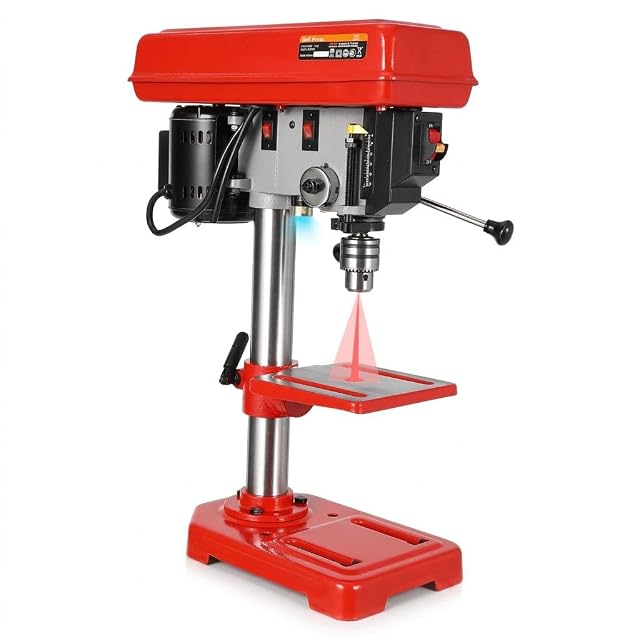
Nought point eight three of a milliwatt
Published, in a bullet and again in the description — the only class II laser on
this shelf.
Class II is a visible beam at or below one milliwatt, where the blink reflex is
taken as protection. Class IIIA may exceed one and reach five; the two WEN
presses here publish 2.5 mW.
For marking a drill center on timber, 0.83 mW is ample. The brighter beam is
easier to see across a lit shop and less forgiving of a glance.
Of the five laser-equipped machines on the American half of this shelf, two
publish a class. This is one, and it publishes it twice.
A drill press is bought for holes square to the face. What decides how deep
those holes can be is the quill travel — how far the spindle comes down in one
pull of the lever.
Run out of travel and the work has to be lifted on packing and the hole
restarted, which is where accuracy goes. Fifty millimeters is shallow-hole
territory: shelf pins, dowels, hardware. Eighty to ninety reaches most Forstner
work. Past a hundred, a drill press starts to be a boring machine.
It is also the figure that is left out most often. Three of the seven European
listings on this shelf publish it; the published Scheppach DP60 page names its
absence as the one number that defines a drill press.
And this page does not publish it
Nor the chuck capacity.
So the two questions a buyer brings to a drill press — how deep, and will my bit
fit — cannot be answered from the listing.
The published Scheppach DP60 page on this shelf has exactly the same gap, and
puts it in one line: no published quill stroke, which is the specification that
matters most.
Five speeds, unnamed
Six hundred and ten to 2,800 rpm, in five steps, and the steps are not listed.
A stepped machine is returned to a setting by counting belt positions, which is
repeatable in a way a lever is not. That is a real advantage over the variable
WEN presses here — provided the numbers are known.
The VEVOR 8 inch on this shelf publishes all five of its steps: 750, 1140, 1740,
2340, 3200. That is the usable version of this specification.
Two thousand eight hundred
The lowest top speed on this shelf, and the least important number on the page.
A high top speed is for small bits in soft material. Nothing in a woodworking
shop needs more than about 3,000 rpm, and plenty needs 500.
Six hundred and ten at the bottom is the figure that earns its place here.
Availability
Read on the day this page was built: $199 at the American Amazon shop.
Read from Keepa on the day this page was last revised; stock and price both move without notice.
Prices quoted in this text were read on 2026-10-07. The live price is at the top of the page.