Every figure below names its source. Each one is a manufacturer
specification read off the listing itself. The judgments are ours.
The same page, two sizes down
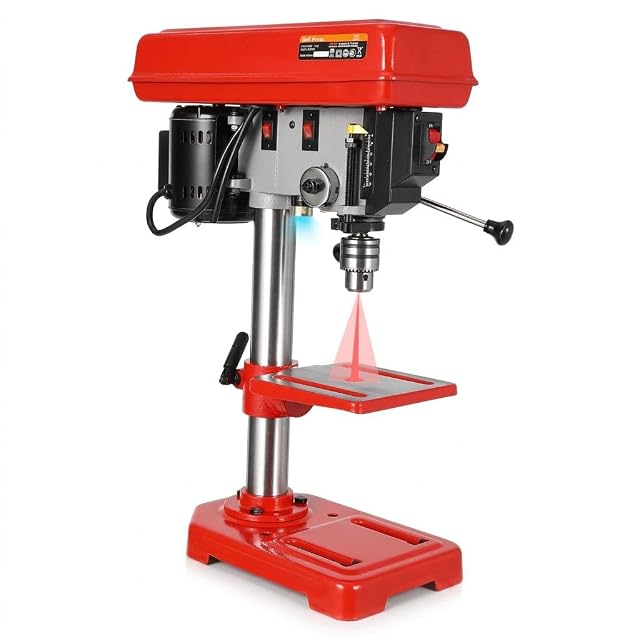
Six point two amps, a digital readout, a class IIIA laser, a bevelling table, a
stated two-year warranty — and a published weight and overall size.
The maker’s 12 inch press on this shelf publishes the identical list. What
differs is three numbers: ten inches of swing instead of twelve, two inches of
travel instead of three and an eighth, and a 1/2 inch chuck instead of 5/8.
And fifty-seven pounds instead of eighty-five, which is the difference between
one person and two.
A drill press is bought for holes square to the face. What decides how deep
those holes can be is the quill travel — how far the spindle comes down in one
pull of the lever.
Run out of travel and the work has to be lifted on packing and the hole
restarted, which is where accuracy goes. Fifty millimeters is shallow-hole
territory: shelf pins, dowels, hardware. Eighty to ninety reaches most Forstner
work. Past a hundred, a drill press starts to be a boring machine.
It is also the figure that is left out most often. Three of the seven European
listings on this shelf publish it; the published Scheppach DP60 page names its
absence as the one number that defines a drill press.
Two inches
Fifty-one millimeters, which is the shallowest on the American half of this
shelf.
It covers shelf pins, dowel holes, hinge cups, hardware — most of what a small
shop drills. It does not cover a 25 mm (0.98 in) hole through a 60 mm (2.36 in) leg, or a mortise
drilled as overlapping holes in thick stock.
The published Scheppach DP16VLS and Einhell TC-BD 450 here both publish 50 mm (1.97 in)
and say the same thing in the same words: shallow holes in one plunge.
Half an inch of chuck
Thirteen millimeters, which is the other limit and the less obvious one.
A 35 mm (1.38 in) Forstner bit has a shank, and on cheaper bits that shank is 8 or 10 mm (0.39 in) —
fine. A large hole saw arbor is often 1/2 inch exactly, and a 16 mm (0.63 in) shank is not
unusual on better Forstner sets.
The maker’s 12 inch press takes 5/8. The published Einhell TC-BD 630/1 on this
shelf has 16 mm (0.63 in), and its page names the same ceiling: a 16 mm (0.63 in) chuck capacity
limits large Forstner bits.
Fifty-three decagrams of speed
Five hundred and thirty revolutions a minute at the bottom, against 580 on the
larger press.
The bottom of the range is the half that matters. A 35 mm (1.38 in) Forstner in oak wants
to be near 500; a hole saw wants less. The top end — 3,100 on both — is for small
bits in soft material and is rarely the constraint.
It is also the figure most of this shelf leaves out. Five of fourteen listings
publish a range at all.
Availability
Read on the day this page was built: $240 at the American Amazon shop.
Read from Keepa on the day this page was last revised; stock and price both move without notice.
Prices quoted in this text were read on 2026-10-07. The live price is at the top of the page.