Every figure below names its source. Each one is a manufacturer
specification read off the listing itself. The judgments are ours.
Seven hundred and thirteen in, seven hundred and forty-six out
Both numbers are on the page.
Six point two amps at 115 volts is about 713 watts drawn from the wall. One
horsepower is 746 watts delivered at the spindle.
A motor cannot deliver more than it draws. An induction motor of this size is
perhaps seventy to eighty per cent efficient, so 713 watts in is 500 to 570
watts out — about 0.7 HP.
The two WEN presses on this shelf publish the same 6.2 A and claim no horsepower
at all. The JET publishes 3/4 HP and no amperage. This page publishes both.
What that is worth knowing for
Not the drilling. Whatever the label says, the machine draws what it draws, and
6.2 A is enough for a 1/2 inch bit in hardwood all day.
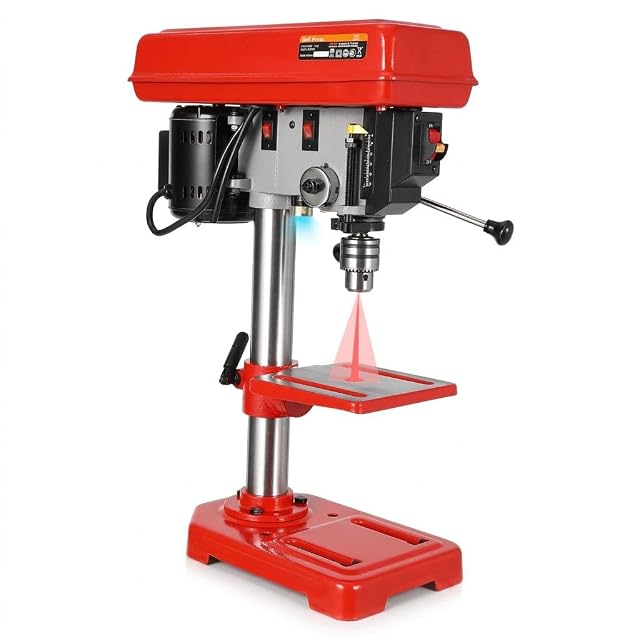
It is worth knowing because of what else is on the page: a high-accuracy spindle
with no runout figure, an X-laser with no class, a reinforced table with no
size.
One contradiction in two published numbers is the cheapest test a listing can
fail, and this one fails it.
A drill press is bought for holes square to the face. What decides how deep
those holes can be is the quill travel — how far the spindle comes down in one
pull of the lever.
Run out of travel and the work has to be lifted on packing and the hole
restarted, which is where accuracy goes. Fifty millimeters is shallow-hole
territory: shelf pins, dowels, hardware. Eighty to ninety reaches most Forstner
work. Past a hundred, a drill press starts to be a boring machine.
It is also the figure that is left out most often. Three of the seven European
listings on this shelf publish it; the published Scheppach DP60 page names its
absence as the one number that defines a drill press.
And it is not published here
Nor the chuck capacity.
Twelve inches of swing says how far from the column a hole can be. It says
nothing about how deep, and nothing about what bit will fit.
Five hundred and thirty, variable, with a readout
The best specification on this page.
The bottom of the range is the half that matters: a 35 mm (1.38 in) Forstner in oak wants
to be near 500, and a machine that cannot go below 900 will burn it. Five
hundred and thirty is low enough.
Variable rather than stepped, with a digital readout, so the setting is a number.
Three machines on the American half of this shelf have that; two of them are
WEN.
Forty-five degrees, either way
Published, and more useful than it sounds.
Many cheap tables tilt one way only, so an angled hole in the wrong-handed part
needs the work turned over — which on an asymmetric piece cannot be done.
The published Einhell TC-BD 450 on this shelf adds rotation to 90 degrees as
well. The WEN tables here are called bevelling, with a size and no angle.
Availability
Read on the day this page was built: $320 at the American Amazon shop.
Read from Keepa on the day this page was last revised; stock and price both move without notice.
Prices quoted in this text were read on 2026-10-07. The live price is at the top of the page.