Every figure below names its source. Each one is a manufacturer
specification read off the listing itself. The judgments are ours.
Swing, quill travel, speed range, chuck capacity, weight, overall size.
That is more than any other listing on either half of this shelf publishes, and
it is the reason to start here. A drill press is a small number of
measurements, and most listings give two of them.
The published Scheppach DP16VLS page on this shelf makes the point from the
other side: it publishes the chuck range and the quill stroke and nothing else,
and is praised for the second of those.
A drill press is bought for holes square to the face. What decides how deep
those holes can be is the quill travel — how far the spindle comes down in one
pull of the lever.
Run out of travel and the work has to be lifted on packing and the hole
restarted, which is where accuracy goes. Fifty millimeters is shallow-hole
territory: shelf pins, dowels, hardware. Eighty to ninety reaches most Forstner
work. Past a hundred, a drill press starts to be a boring machine.
It is also the figure that is left out most often. Three of the seven European
listings on this shelf publish it; the published Scheppach DP60 page names its
absence as the one number that defines a drill press.
Seventy-nine millimeters of it
Three and an eighth inches, published.
That reaches most Forstner work — a 35 mm (1.38 in) hinge cup, a 25 mm (0.98 in) dowel hole through
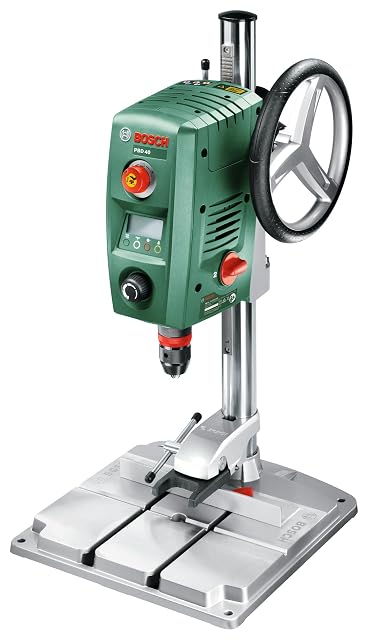
a thick leg — in one pull. It does not reach the 90 mm (3.54 in) of the published Bosch
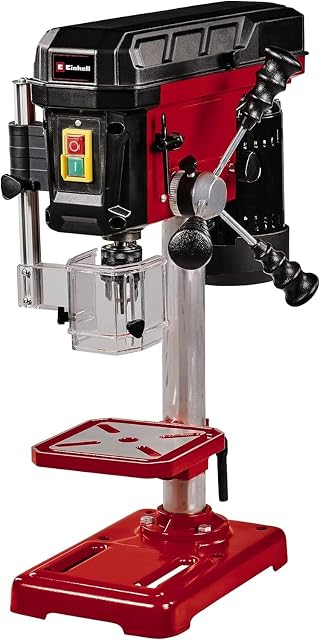
PBD 40 here, and it is a long way past the 50 mm (1.97 in) of the two cheapest European
machines on this shelf.
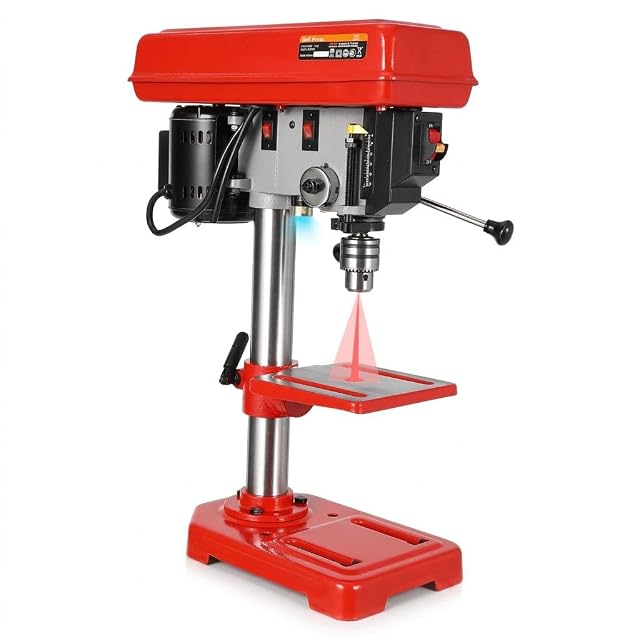
Class IIIA, two and a half milliwatts
Published, which three of the five laser-equipped machines on the American half
of this shelf do not manage.
Class IIIA is a visible beam that may exceed one milliwatt and not five: bright
enough to see on timber under shop lights, bright enough that looking into it
matters.
The SKIL on this shelf publishes class II at 0.83 mW — weaker, and safer. The
JET calls its system Xacta-X and stops. The EcoSummer avoids the word laser and
says targeting beam.
Eighty-five pounds
Thirty-eight and a half kilograms, published, which is the figure that decides
where this machine lives.
It is a benchtop press that two people put on a bench once. The published
Holzmann on this shelf is floor-standing at 1,630 mm (64.2 in) tall and needs
three-phase; this is the other way of getting mass under a spindle.
Cast iron is what keeps a drill press accurate, and mass is how cast iron shows
up on a specification.
And no runout
The shelf’s own intro compares quill travel, spindle runout, table adjustment
and speed range.
This page publishes three of the four. Across all fourteen listings on this
shelf, exactly one mentions runout — the VEVOR 8 inch — and it gives no figure.
So the criterion the shelf names second is, on every page here, unmeasured.
Availability
Read on the day this page was built: $314 at the American Amazon shop.
Read from Keepa on the day this page was last revised; stock and price both move without notice.
Prices quoted in this text were read on 2026-10-07. The live price is at the top of the page.