Every figure below names its source. Each one is a manufacturer
specification read off the listing itself. The judgments are ours.
Five inches of quill
A hundred and twenty-seven millimeters, stated as a full five inches.
That is past where a drill press stops being a hole machine and starts being a
boring one: a 25 mm (0.98 in) hole through a 100 mm (3.94 in) leg in one pull, or a stopped mortise
drilled as a row of overlapping holes without repacking the work.
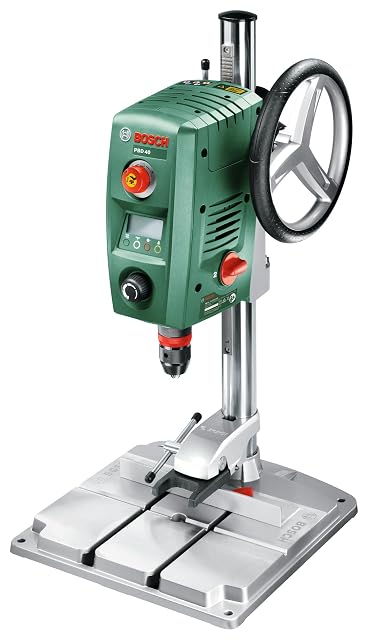
The published Bosch PBD 40 on this shelf publishes 90 mm (3.54 in) and its page calls that
the longest of the European machines here. This is thirty-seven millimeters
more.
A drill press is bought for holes square to the face. What decides how deep
those holes can be is the quill travel — how far the spindle comes down in one
pull of the lever.
Run out of travel and the work has to be lifted on packing and the hole
restarted, which is where accuracy goes. Fifty millimeters is shallow-hole
territory: shelf pins, dowels, hardware. Eighty to ninety reaches most Forstner
work. Past a hundred, a drill press starts to be a boring machine.
It is also the figure that is left out most often. Three of the seven European
listings on this shelf publish it; the published Scheppach DP60 page names its
absence as the one number that defines a drill press.
A table that can be bolted to
Fourteen by nineteen inches of precision-ground cast iron, with twin T-slots and
four table slots.
That is the difference between work that is held and work that is rested. A
plain table has a hole in the middle and nothing to clamp to, so the workpiece
is held by hand — and a bit that grabs spins it, which is how a drill press
hurts somebody.
T-slots take clamps, a fence, a vice, a jig. Four bolt slots take the table
down.
Nothing else on either half of this shelf publishes a clamping provision.
Totally enclosed, fan cooled
The windings sealed from the air, a fan on the shaft blowing over the casing.
An open motor pulls sawdust through itself. A motor packed with fine dust runs
hot and eventually stops, and in a woodworking shop that is not a hypothetical.
It is a machine-tool specification rather than a consumer one, and it is the
only enclosed motor published here. The published Holzmann on this shelf is the
other machine-shop entry, and what it publishes instead is 400 V three-phase.
Sixteen speeds, and no numbers
Sixteen steps from a poly-V belt, with one-handed tensioning so a change is a
lever rather than a wrench.
That is three times the spread of most machines on this shelf. What is missing
is where the spread sits: a machine whose slowest step is 200 rpm is a different
tool from one whose slowest is 600, and this page publishes neither end.
A paddle, and a key
A large paddle-style off button, and a safety key in the switch.
The paddle is hit with a hip or a forearm when both hands are occupied. The key
comes out and the machine cannot be started by a child.
Both are published, and on all fourteen listings on this shelf this is the only
page that mentions the switch at all.
Availability
Read on the day this page was built: $1649 at the American Amazon shop.
Read from Keepa on the day this page was last revised; stock and price both move without notice.
Prices quoted in this text were read on 2026-10-07. The live price is at the top of the page.