The end of it The more capable of the seven European drill presses here, on a page that cannot keep its own numbers straight.
Every figure is a manufacturer specification, read off the
listing itself, and the judgments are ours — drawn from how the
specification behaves in this class of machine and from what long-term
owners consistently report. Where a figure is missing, we say so rather
than fill it in.
What the specification says
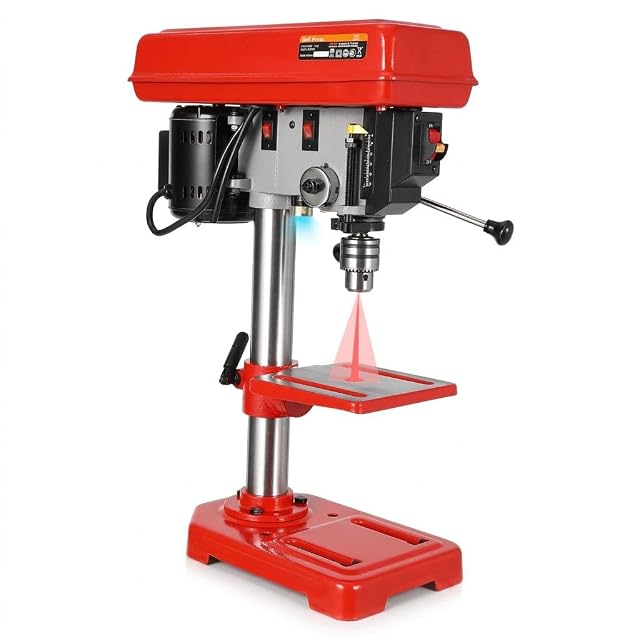
550 W, cast-iron construction, 80 mm (3.15 in) drilling depth, a keyless chuck taking 1 to
16 mm (0.63 in), continuously variable speed, a table extension with a support roller, a
position laser and an LED work light. Part number 5906807901.
The contradiction
The listing title gives the speed range as 440 to 2,850 min⁻¹. The manufacturer
feature list on the same page gives 440 to 2,580 min⁻¹. Those are different
machines’ worth of difference at the top end, and one of the two fields is
simply wrong.
We are publishing it rather than quietly picking one, because a page that
disagrees with itself is a fact about the page. Here the practical consequence is
small — neither figure changes what the drill will do for most work — but the
same kind of error on a capacity figure is how a wrong machine gets delivered.
Stroke and depth are the numbers to read first
A drill press exists to make a hole perpendicular, and to make the same
hole again. The specification that decides what it can do is how far the
spindle travels in one plunge: that is the thickness you can drill
through without moving the work, and every time you raise the table and
re-enter a hole you risk the alignment the machine was bought for.
The second number is the chuck range. It caps the shank you can hold
rather than the hole you can bore — large Forstner bits are commonly
made with reduced shanks for exactly this reason.
80 mm (3.15 in) and a 16 mm (0.63 in) chuck put this machine a class above the Einhell above on both
counts, and the 16 mm (0.63 in) capacity in particular means fewer reduced-shank
compromises with large Forstner bits.
The keyless chuck
A chuck key is the part of a drill press that goes missing, and leaving one in
a chuck that then starts under power turns a piece of steel into a projectile.
Keyless removes both problems at some cost in ultimate grip on a large bit.
The good side, and the catch
Strengths
80 mm (3.15 in) of drilling depth, against 50 mm (1.97 in) on the Einhell above
A 16 mm (0.63 in) keyless chuck, so large shanks fit and there is no key to lose
Cast-iron construction, which is what keeps a drill press accurate
Continuously variable speed rather than belt steps
Compromises
The listing contradicts itself on top speed: 2,850 min⁻¹ in the title, 2,580 min⁻¹ in the features
No price on the British store
A position laser adds little on a drill press
Specifications
Motor
550 W
Drilling depth
80 mm (3.15 in)
Chuck capacity
1 to 16 mm (0.04 to 0.63 in), keyless
Speed range
440 to 2,850 min⁻¹ in the title; 440 to 2,580 min⁻¹ in the feature list
Construction
Cast iron
Also fitted
Table extension with support roller, position laser, LED light
Part number
5906807901
Amazon reference
B0746J5FP5 (identical on 6 markets)
EAN
4046664045328
What comes up most often
Which top speed is right?
We cannot tell you. The title says 440 to 2,850 min⁻¹ and the manufacturer feature list on the same page says 440 to 2,580 min⁻¹. One of the two fields is wrong and from outside there is no way to know which. It is unlikely to change your buying decision — both figures are high enough for small bits in steel — but a listing that disagrees with itself is worth flagging.
What does 80 mm (3.15 in) of depth let you do?
Drill through a 75 mm (2.95 in) post in one plunge, or bore a deep hole without resetting the workpiece. It is the difference between a machine for hardware holes and one that can be used for joinery.
Is the laser worth anything?
Less than on a mitre saw. The bit is already visible above the mark and the table can be nudged; the laser helps with rough positioning before the final adjustment. It is neither a reason to choose this machine nor a reason to avoid it.
Where this model is listed
A listing is not an offer: the reference exists on these stores, availability changes daily.
France
Germany
Italy
Spain
United Kingdom
United States
Our score
7.8/ 10
The more capable of the seven European drill presses here, on a page that cannot keep its own numbers straight.
Against the closest woodworking machines on price
Between woodworking machines of the same category and nearby price. Shown: what they all state. A half-filled column says nothing.
6.2 A and 1.0 HP, both published · 6.2 A at 115 V is about 713 W of input; 1 HP is 746 W of output
Not published by the maker.
Where the models diverge, in woodworking machines
If price decides: VEVOR 1216BVS, 12 in benchtop, at $320.
Who buys this one, among woodworking machines
Deeper holes and larger bits than a small bench press will take
Sources
Specifications: the manufacturer sheet for woodworking machines and the matching Amazon product page. Prices and availability: Keepa. Every figure on this page names its source.