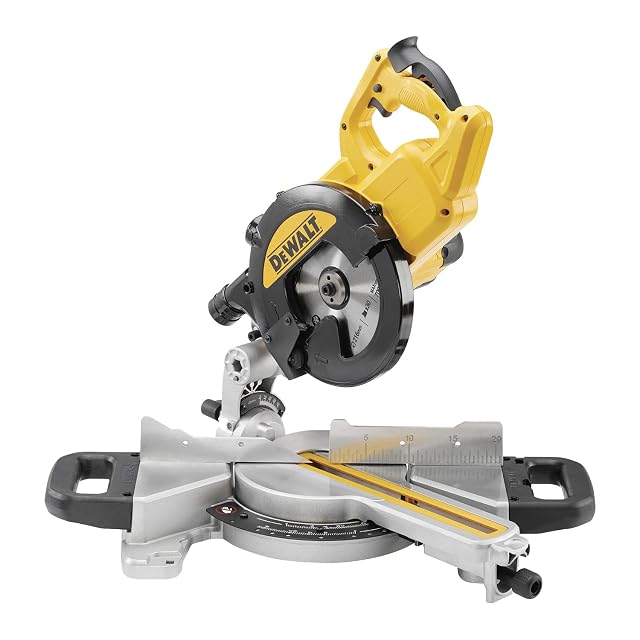
DeWalt DWS774
216 mm (8.50 in) · XPS shadow line · 1,400 W
The cheapest way onto DeWalt's XPS shadow line, which is the feature that changes how a mitre saw is used.
Best for: Anyone who wants an accurate cut line and does not need the bigger motor
Mitre saws
Two things decide a mitre saw for interior work: how wide it crosscuts, and whether you can see where the blade will land. The second is where the money should go.
A laser is a separate part aimed at where the blade is supposed to be: it needs calibrating, and it drifts. A shadow line puts an LED behind the blade and lets the blade cast its own shadow, so the line is the kerf and moves when you change the blade.
That is the feature to pay for, and the DeWalt DWS774 at €294 is the cheapest way onto it here.
Almost every mitre saw ships with a 24-tooth framing blade. It rips through studs and tears anything you intend to paint. A 60-tooth negative rake blade changes the machine — and the rake angle matters more than the tooth count, because a positive-rake blade on a chop saw self-feeds and snatches.
The core job. Compound angles and a fence that holds the piece square are what matter.
Repetitive crosscuts to a stop. Accuracy matters less than consistency here, and a good stop gives consistency.
Capacity and power, with less demand for a fine finish. A coarser blade suits it better.
Where dust extraction stops being a workshop nicety and becomes a condition of being allowed to work.
| Your work | What to look for | The trap |
|---|---|---|
| Skirting on edge | A tall fence | A fence too low to support it |
| Wide boards | A slide | No clearance behind |
| Repeat lengths | A stop system | Measuring every piece |
| Finished rooms | Extraction and a shroud | Believing capture is total |
A mitre saw drifts through its detents and its fence rather than its motor. Dust packed under the turntable is what makes an angle read right and cut wrong, and it accumulates unseen.
A large blade descending at the operator's hand height.
Prices quoted in this text were read on 2026-08-12. The live price is at the top of the page.
216 mm (8.50 in) · XPS shadow line · 1,400 W
The cheapest way onto DeWalt's XPS shadow line, which is the feature that changes how a mitre saw is used.
Best for: Anyone who wants an accurate cut line and does not need the bigger motor
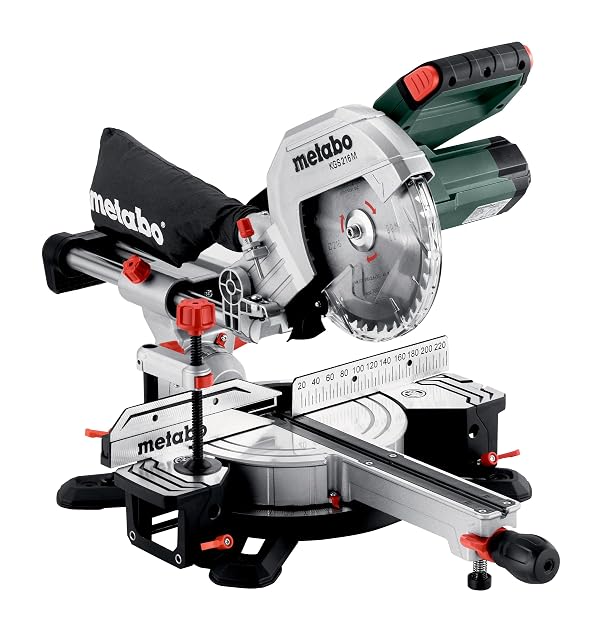
216 mm (8.50 in) · sliding · six markets
The cheapest saw on this page that is sold under one reference on all six Amazon stores — and the one we would put in a small workshop.
Best for: A small workshop that wants a saw from a serious brand without paying for a professional one
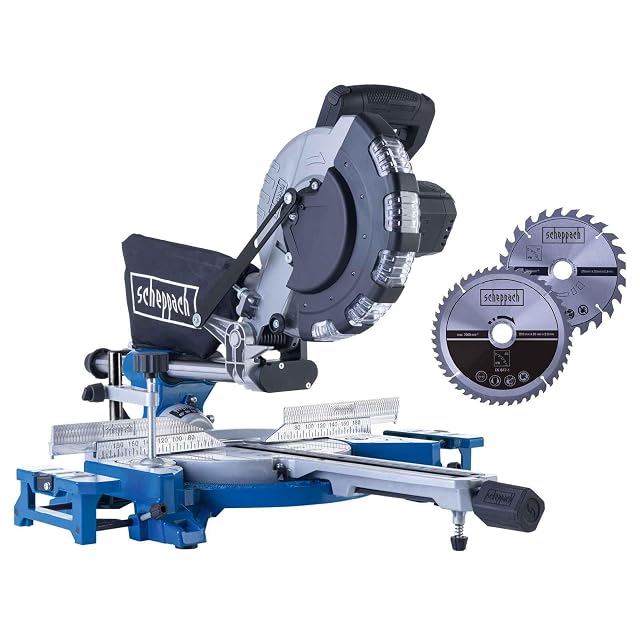
216 mm (8.50 in) · 340 mm (13.4 in) crosscut · 2,000 W
The cheapest saw here that states its crosscut width — 340 mm (13.4 in) — and the widest on this page below €200.
Best for: Trim, flooring and framing where the budget is the constraint and the cuts are not tall
For anything wider than about 150 mm (5.91 in), yes. A fixed-head saw crosscuts a little more than the blade radius; a slider adds its carriage travel, which takes a 216 mm (8.50 in) saw to around 300 mm (11.8 in). Most interior trim needs 250 to 300 mm (9.84 to 11.8 in).
Around 300 mm (11.8 in) handles almost all interior trim and most floorboards. Going to a 305 mm (12 in) blade buys depth for skirting on edge and costs several kilos.
A slide gives width capacity and needs clearance behind the saw. For narrow trim a fixed head is lighter, cheaper and often enough.
Usually a detent that is fractionally out, a fence not square, or the workpiece not held flat against the fence. Test cuts on scrap find it quickly.
Useful for rough positioning and never a substitute for a test cut. Lasers drift, and the kerf plate tells you more.
Less than most people expect. A shroud and an extractor help considerably, but a mitre saw indoors always needs more than the bag.
A high tooth count with a grind suited to faced boards. Blade choice changes chipping far more than the saw does.
Almost always because the head was lifted before the blade stopped. It is the commonest and most avoidable event on this machine.
For cutting: Anyone who wants an accurate cut line and does not need the bigger motor
Where it shines: XPS shadow line — no calibration, ever, and it follows the blade you fit
Where it disappoints: 1,400 W against the DWS777's 1,800 W
For cutting: A small workshop that wants a saw from a serious brand without paying for a professional one
Where it shines: Available on all six markets we checked, under one reference and one EAN
Where it disappoints: The listing publishes almost no dimensional specification
For cutting: Trim, flooring and framing where the budget is the constraint and the cuts are not tall
Where it shines: 340 mm (13.4 in) of crosscut, stated on the listing rather than left to guesswork
Where it disappoints: Laser rather than shadow line — one more thing to keep aligned
Blades, inserts and spares from the same aisle, at the price we recorded. Check they fit the saw you pick before ordering: it depends on the bore and the part number, which the listing states.
Saw against saw, where the comparison already exists in this guide or this aisle.
The saws above are drawn from the catalog of this site. Specifications are the published ones, from the maker and from the Amazon product page; prices are the Keepa figure for the date below, and both shift. Ranking uses declared specifications, the balance of stated strengths and stated limits, and price. No machine here has cut wood for us, and the page claims nothing else.
Last checked on
Table saws and planers swing by a hundred dollars or more across the year, and the biggest "discounts" often land at prices the same model sold for six weeks earlier. UniverTrack tracks the real price history across retailers, spots fake reductions, and alerts you when it is genuinely the moment to buy.