Mini saw · 24T and 40T
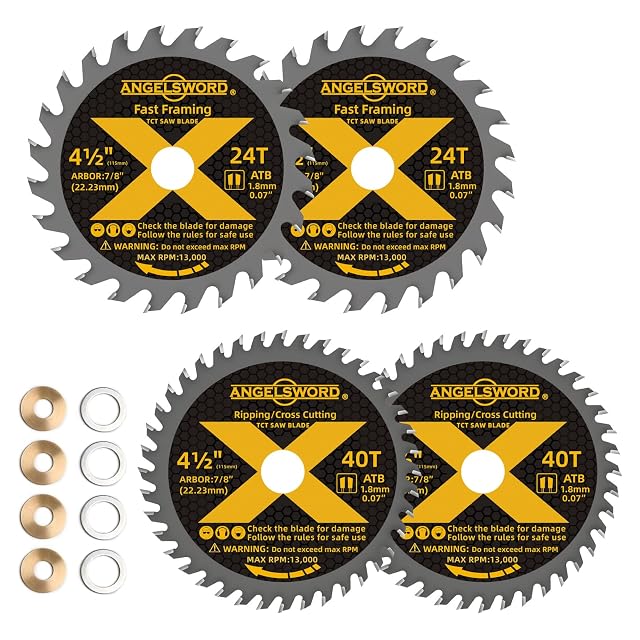
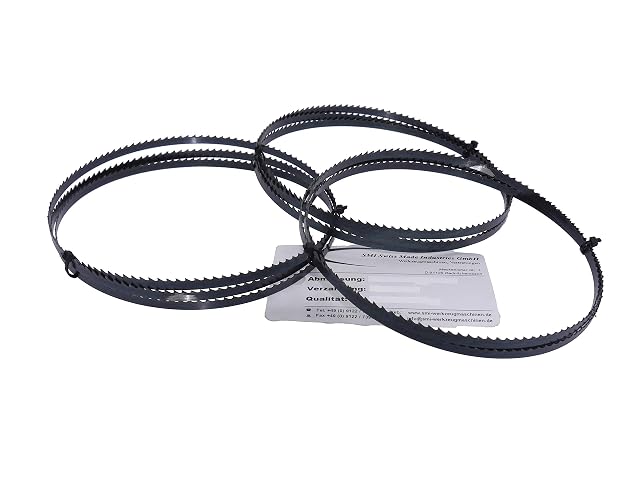
ANGELSWORD 114 mm, 24T and 40T, 4 pack
The thinnest kerf on this shelf at 1.8 mm (0.07 in), on the smallest blade — with two reducer bushings in the packet.
Every figure below names its source. Each one is a manufacturer
specification read off the listing itself. The judgments are ours.
One point eight millimeters
The thinnest kerf on either half of this shelf, and on the smallest blade — which
is where it matters most.
A 4-1/2 inch saw has perhaps a quarter of the power of a 254 mm (10 in) table saw, and
the kerf is what that motor has to clear. Every millimeter of kerf is timber
turned into dust.
One point eight against the 2.4 of the WEN blades here is a quarter less
material removed, which on a small saw is the difference between cutting and
stalling.
It also wastes less, which matters on expensive stock and not on a stud.
Bore before diameter
The diameter decides whether the blade clears the guard. The bore decides
whether it goes onto the shaft at all.
Thirty millimeters is the European standard, and every European blade on this
shelf publishes 30 or 20. The American standard is 5/8 of an inch — 15.88 mm —
and on small saws 7/8, which is 22.23. Those are not the same hole, and no
adapter makes a shaft bigger.
Reducer rings step a large bore down onto a smaller shaft and never the other way
round. A ring that is a loose fit lets the blade run slightly off center, which
arrives as vibration and a cut that wanders.
Seven eighths, with two rings
Twenty-two point two three millimeters of bore, and bushings down to 5/8 and
3/8 in the packet.
So one blade goes on a 22.23 mm (0.88 in) arbor, a 15.88 mm (0.63 in) one or a 9.5 mm (0.37 in) one.
The published 190 mm (7.48 in) blade on the European half of this shelf does the same and
its page says why it earns a mention: reducer rings in the box, so one blade
serves two bore sizes.
What rings cannot do is go the other way. None of these reaches a 30 mm (1.18 in)
European arbor.
Four blades, two counts, no split
Twenty-four teeth and forty, mixed across four blades, and the listing never says
how many of each.
Two of each is a sensible assortment. Three coarse and one fine is not, and a
buyer cannot tell which arrives.
The abrasives shelf in this catalog has the identical gap on a sixteen-piece
pad set. The published sanding-sleeve set there publishes its split — three of
each diameter — which is the version that can be relied on.
And no speed rating
Which on a small, fast saw is the figure that matters most.
A 254 mm (10 in) blade turns at 4,000 to 5,000 rpm. A 114 mm (4.49 in) blade on a mini saw can see
8,000 or more, because the tip speed is what matters and a small blade has to
turn faster to reach it.
The two WEN blades on this shelf publish 6,000 rpm. This one, on the machine that
spins fastest, publishes nothing.
Availability
Read on the day this page was built: $18 at the American Amazon shop.
Read from Keepa on the day this page was last revised; stock and price both move without notice.
Prices quoted in this text were read on 2026-10-07. The live price is at the top of the page.