Skip to content

Bosch Expert for Multi Material 305 × 30, 96T

Ninety-six teeth on a 305 mm (12 in) blade, aimed at aluminum and plastic profiles — and larger than any machine reviewed here can take.

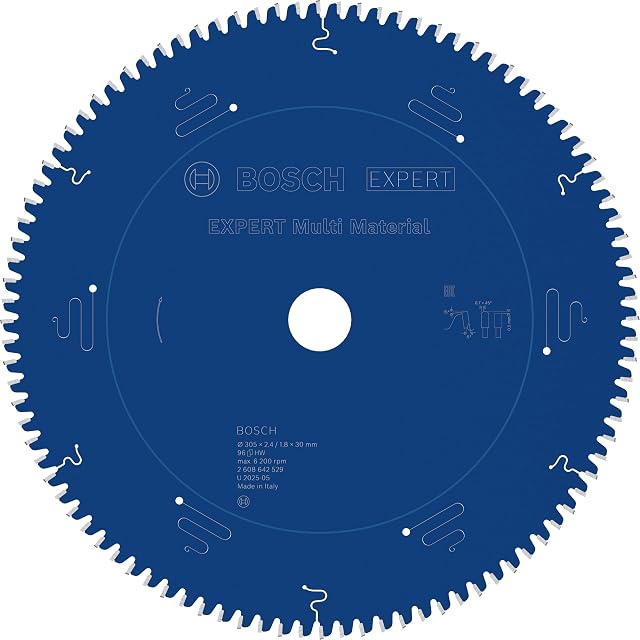
Bosch Expert for Multi Material 305 mm circular saw blade, product photograph

Bosch Expert for Multi Material 305 × 30, 96T

Ninety-six teeth on a 305 mm (12 in) blade, aimed at aluminum and plastic profiles — and larger than any machine reviewed here can take.

Diameter
305 mm (12 in)
Bore
30 mm (1.18 in)
Kerf
2.4 mm (0.09 in)
Teeth
96
Materials
Non-ferrous metals, aluminum, plastics and wood
Flange
Works with or without reducer rings
Part number
2608642529
Amazon reference
B008HRGQXI (identical on 5 markets)
EAN
3165140650113
  • 96 teeth at 305 mm (12 in) leaves a burr-free edge on aluminum profile
  • One reference and one EAN across five European markets
  • No machine reviewed here takes a 305 mm (12 in) blade

Best for: A 305 mm (12 in) chop saw used on aluminum and plastic window profile
Search Amazon for this model

Specifications

Diameter
305 mm (12 in)
Bore
30 mm (1.18 in)
Kerf
2.4 mm (0.09 in)
Teeth
96
Materials
Non-ferrous metals, aluminum, plastics and wood
Flange
Works with or without reducer rings
Part number
2608642529
Amazon reference
B008HRGQXI (identical on 5 markets)
EAN
3165140650113

Every figure below is a manufacturer specification read off the listing itself. The judgments are ours.

What the specification says

Ø 305 × 30 × 2.4 mm (12 × 1.18 × 0.09 in), 96 teeth, part number 2608642529. Bosch names non-ferrous metals, aluminum, plastics and wood, and points at window fabrication as the intended setting.

Bore before diameter

The diameter decides whether the blade clears the guard; the bore decides whether it goes onto the shaft at all. Thirty millimeters is the European standard, and reducer rings step a large bore down onto a smaller shaft — never the other way round. A ring that is a loose fit lets the blade run slightly off center, which shows up as vibration and a cut that wanders rather than as an obvious fault.

Read both figures off the machine rather than off the blade you are replacing, which may itself have been the wrong one.

Ninety-six teeth is a profile blade

A very high tooth count on a large blade means a very small bite per tooth. That is what a thin-walled aluminum extrusion needs: take too much and the tooth catches the wall and tears it. On solid timber the same blade would have nowhere to put the waste and would burn, which is why this is a specialist purchase rather than an upgrade.

What comes up most often

Can I cut aluminum on a wood mitre saw?

Sometimes, and it is not a decision to take from the blade alone. The tooth geometry here is made for it, but the saw has to run at a suitable speed, the work has to be clamped rather than held, and hot chips come off in every direction. A saw with a plastic guard and no chip control is the wrong host for this blade.

What does "with or without reducer rings" mean?

The mounting flange is machined so the blade seats correctly on a 30 mm (1.18 in) shaft directly, and rings are only needed for smaller shafts. It is a small convenience that matters on a shared workshop saw, where the rings are the part that goes missing.

All saw blades