Skip to content

S&S-Shop HM 190 × 30 mm, 40T

Fourteen euros for a carbide blade with reducer rings in the box — and no machine reviewed here takes a 190 mm (7.48 in) blade.

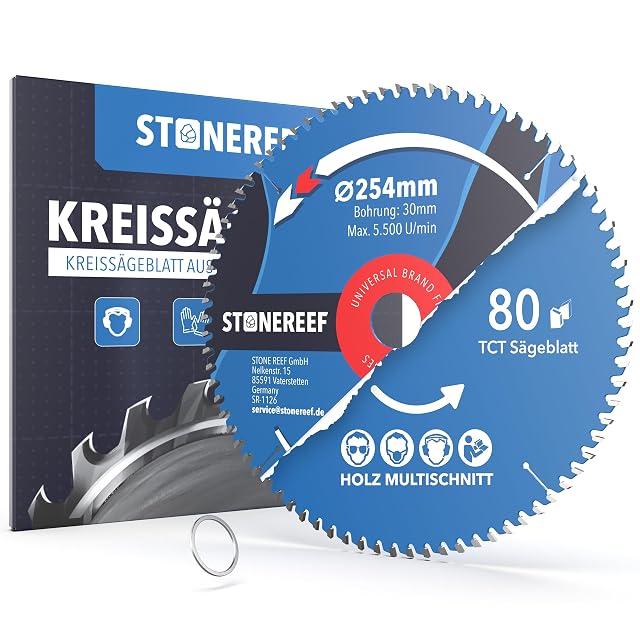
Carbide-tipped 190 mm circular saw blade with reducer rings, product photograph

S&S-Shop HM 190 × 30 mm, 40T

Fourteen euros for a carbide blade with reducer rings in the box — and no machine reviewed here takes a 190 mm (7.48 in) blade.

Diameter
190 mm (7.48 in)
Bore
30 mm (1.18 in)
Teeth
40
Tipping
Carbide
Supplied with
Reducer rings
Part number
Not published
Amazon reference
B07BM9MF1K (identical on 5 markets)
EAN
4018959066851
  • Reducer rings in the box, so one blade serves two bore sizes
  • One reference across five European markets
  • No machine reviewed on this site takes a 190 mm (7.48 in) blade

Best for: A 190 mm (7.48 in) hand-held circular saw used for site work and sheet breakdown
Search Amazon for this model

Specifications

Diameter
190 mm (7.48 in)
Bore
30 mm (1.18 in)
Teeth
40
Tipping
Carbide
Supplied with
Reducer rings
Part number
Not published
Amazon reference
B07BM9MF1K (identical on 5 markets)
EAN
4018959066851

Every figure below is a manufacturer specification read off the listing itself. The judgments are ours.

What the specification says

Ø 190 × 30 mm (7.48 × 1.18 in), 40 carbide-tipped teeth, supplied with reducer rings. No part number and no kerf on the listing.

Bore before diameter

The diameter decides whether the blade clears the guard; the bore decides whether it goes onto the shaft at all. Thirty millimeters is the European standard, and reducer rings step a large bore down onto a smaller shaft — never the other way round. A ring that is a loose fit lets the blade run slightly off center, which shows up as vibration and a cut that wanders rather than as an obvious fault.

Read both figures off the machine rather than off the blade you are replacing, which may itself have been the wrong one.

Forty teeth is the middle setting

Forty teeth on a 190 mm (7.48 in) blade is the general-purpose choice: fast enough to break down chipboard and clean enough that the edge does not need planing. The manufacturer names solid timber, chipboard, plastic and cable trunking, which is the honest range for a blade at this tooth count.

What comes up most often

Why is 190 mm (7.48 in) an awkward size here?

Because it sits between the two sizes the European market settled on. Cordless and corded hand-held saws use 165 mm (6.50 in) and 190 mm (7.48 in); mitre saws and site table saws use 216 mm (8.50 in) and 254 mm (10 in). Every machine reviewed on this site is in the second group, so this blade fits none of them — which is not a fault in the blade, only in the match.

Are the reducer rings any use?

They are, and they are the reason a cheap blade can serve two machines. Rings step the 30 mm (1.18 in) bore down to whatever smaller shaft you have. What they cannot do is go the other way: a 30 mm (1.18 in) bore will never fit a shaft larger than 30 mm (1.18 in), and a ring that rattles is worse than no ring at all.

All saw blades

Prices quoted in these summaries are dated readings. The live price is shown next to each product.