Every figure below is a manufacturer
specification read off the listing itself. The judgments are ours.
What the specification says
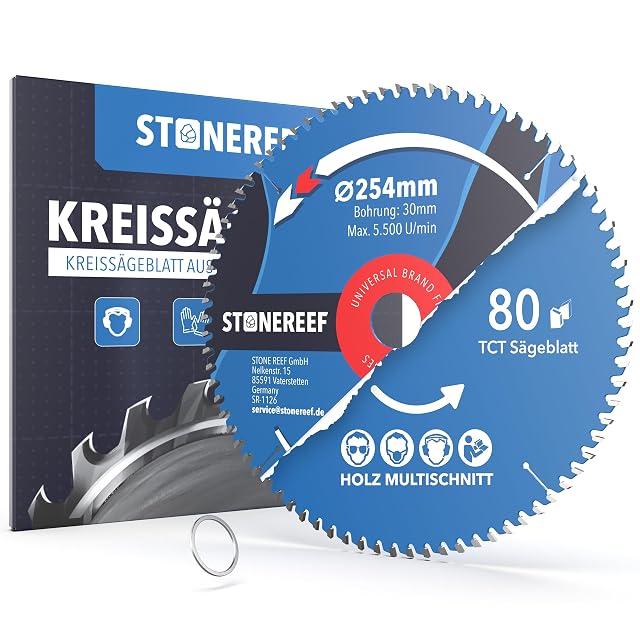
Ø 254 × 30 mm (10 × 1.18 in), 80 carbide-tipped teeth on an alloy steel body, 716 g (25.3 oz), supplied
with rings down to 25.4, 22.23, 20 and 16 mm (0.63 in). The part number field contains
the digit 1.
Bore before diameter
The diameter decides whether the blade clears the guard; the bore decides
whether it goes onto the shaft at all. Thirty millimeters is the European
standard, and reducer rings step a large bore down onto a smaller shaft —
never the other way round. A ring that is a loose fit lets the blade run
slightly off center, which shows up as vibration and a cut that wanders
rather than as an obvious fault.
Read both figures off the machine rather than off the blade you are
replacing, which may itself have been the wrong one.
The kerf is the missing number
This blade turned up under a search for a thin-kerf blade, and the listing
never states a kerf. That is the whole point of the category: a narrow kerf
wastes less timber and asks less of a small motor. Without the figure there is
no way to tell whether this qualifies, and the honest position is that it is an
80-tooth crosscut blade of unstated thickness.
Yes. A blade slightly smaller than the machine rating fits and simply loses a millimeter of depth of cut; a blade larger than the rating does not fit the guard and must never be forced. 254 and 255 mm (10 in) are used interchangeably across European saws, and the bore matters far more than the last millimeter of diameter.
Why do four reducer rings matter?
Because they turn one blade into a blade for two machines. A 30 mm (1.18 in) bore with rings down to 25.4, 22.23, 20 and 16 mm (0.63 in) covers most European and most imported shafts. The catch is fit: a ring that has any play lets the blade run off center, and the symptom is vibration rather than an obvious failure.
Three insert shapes with their dimensions published — and a Rockwell hardness that cannot be on the scale it names.
Contents
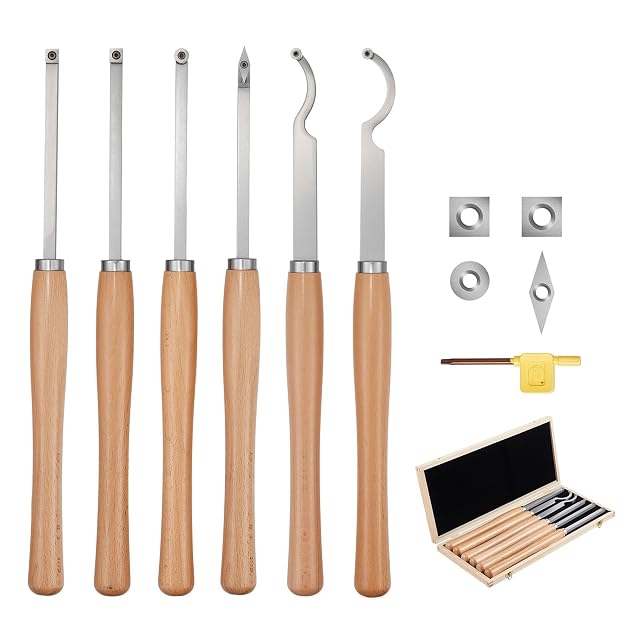
Six: three with round inserts of Ø 12 × 2.5 mm (0.47 × 0.10 in), two with square inserts of 11 × 11 mm (0.43 × 0.43 in), and one with a diamond insert of 10 × 30 mm (0.39 × 1.18 in)
Insert type
Replaceable carbide, stated to need no sharpening and pre-sharpened before shipment
Hardness
Stated a Rockwell hardness rating of 80 to 90 · The Rockwell C scale ends near 70, and carbide is conventionally measured on the A scale, where it reads 88 to 93 HRA · The HURRICANE set on this shelf publishes HRC 56 to 63 for high-speed steel, which is the right scale for that material
Handles
Wooden, with a metal collar tightening the joint, stated against loosening · No length published
Case
A wooden box
Insert compatibility
The published square inserts on this shelf are 14 × 14 × 2.0 mm (0.55 × 0.55 × 0.08 in) · These are 11 × 11 mm (0.43 × 0.43 in), so the two are not interchangeable
Part number
Not published by the maker. · The listing title is used as the reference
Amazon reference
B0FD514LBJ
EAN
0197988154167
Publishes the dimensions of all three insert shapes
Three shapes covers roughing, finishing and detailing in one set
A Rockwell figure of 80 to 90 does not exist on the scale it implies
Best for: A first set of turning tools for somebody who does not own a grinder