Carbide · 6 tools
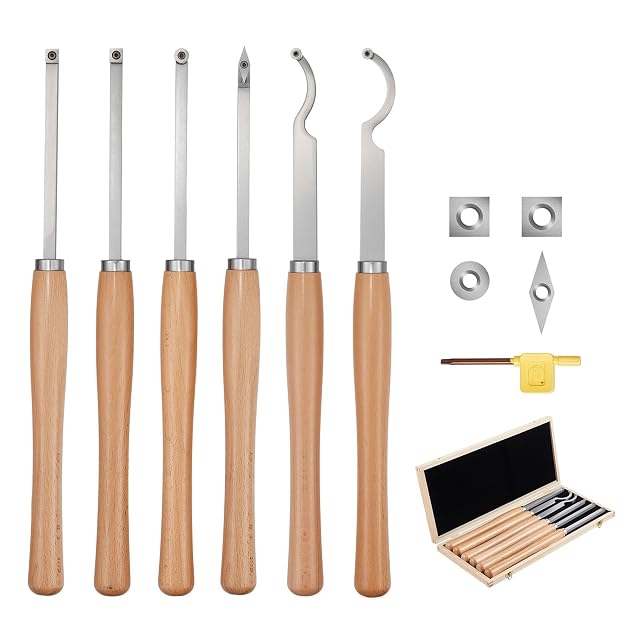
VEVOR 6-piece carbide set
Three insert shapes with their dimensions published — and a Rockwell hardness that cannot be on the scale it names.
Every figure below names its source. Each one is a manufacturer
specification read off the listing itself. The judgments are ours.
Eighty to ninety Rockwell
Not on any scale that fits the material.
Rockwell C, the scale for hardened steel, tops out near 70 — a file is about 65.
Carbide is too hard for it and is measured on Rockwell A, where tungsten carbide
reads about 88 to 93 HRA; or in Vickers, at 1,300 to 1,800 HV.
So 80 to 90 is most likely an HRA figure with the letter dropped, which would be
correct and unremarkable.
The number is above as published. The HURRICANE set on this shelf publishes HRC
56-63 for high-speed steel, and that one is unambiguous.
Eleven millimeters, not fourteen
The published square carbide inserts on this shelf are 14 × 14 × 2.0 mm (0.55 × 0.55 × 0.08 in). These
are 11 × 11.
An insert sits in a milled seat and is held by one screw, so the seat size, the
screw thread and the thickness all have to match.
The published inserts’ page names the same gap from its side: the screw thread
and the seat geometry are not published, and both decide fitment.
Buying a carbide tool is buying an insert supply. That supply is what to check
before the tool.
Round, square, diamond
Three jobs, and three published sizes.
The round insert — Ø 12 × 2.5 mm (0.47 × 0.10 in), three of the six — hollows and sweeps curves. It
cuts on any part of its edge, so it never catches on a corner.
The square — 11 × 11 mm (0.43 × 0.43 in), two of them — is the rougher. A straight edge with four
usable corners, for taking a blank down fast.
The diamond — 10 × 30 mm (0.39 × 1.18 in) — is the detailer, for a corner a round insert cannot
reach.
The published European carbide set on this shelf never states which shapes it
contains.
Two schools, and they are not the same hobby
A traditional turning tool is ground steel on a long handle. It is presented to
the wood at an angle so the bevel rubs and the edge slices, which leaves a
surface that needs almost no sanding — and it has to be sharpened, which means a
grinder, a jig and a skill.
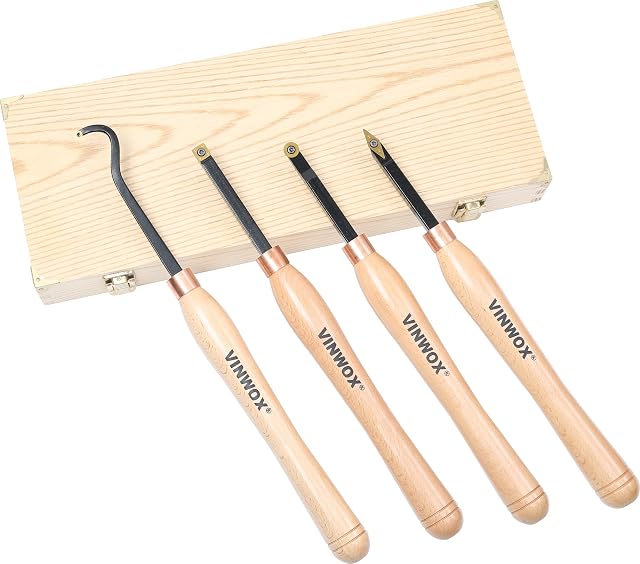
A carbide tool is a square or round plate screwed to a bar. It is held flat and
scrapes. It never needs grinding: when an edge dulls, the plate is rotated to the
next corner and eventually replaced.
The published pages on this shelf put both sides of it. The carbide set’s page:
removes the grinder and the sharpening jig from a beginner’s shopping list — and
carbide scrapes where a gouge slices, so the surface off the tool needs more
sanding. That is the whole choice.
Availability
Read on the day this page was built: $80 at the American Amazon shop.
Read from Keepa on the day this page was last revised; stock and price both move without notice.
Prices quoted in this text were read on 2026-10-07. The live price is at the top of the page.