Skip to content

The best workshop sander for curves and small parts

Three shapes of sander, three different jobs. The specification to check is not the motor: it is the size of the abrasive it eats.

Oscillation is worth paying for

A sleeve that only spins wears in one band and burnishes the timber there. One that also moves up and down spreads the wear over its whole length, runs cooler and lasts several times longer. The price gap is small; the difference in consumables is not.

The grit progression

Never skip more than one step. Going 80 straight to 180 leaves 80-grit scratches that the finish makes obvious under a raking light — and the only fix is to start again at 80.

Which saw fits your shop?

You sand outside curves
A disc or belt gives control and speed on convex shapes.
You sand inside curves
An oscillating spindle sander is the tool, and nothing else does it as cleanly.
You do both
Combination machines exist and compromise on both, which is often the right choice in a small shop.
You sand small parts
Look at the table and how the part is supported: the sanding surface is rarely the limit.

Picking by the cut you need

Inside curves

The spindle sander's job. Oscillation is what stops it burning and glazing the paper in one place.

Outside curves and edges

A disc sander with a table, worked against the downward-moving side. Fast and easy to control.

Squaring small ends

A disc with a mitre gauge trims and squares small parts more accurately than a saw.

Fairing a shape

A belt with a flat platen gives a straight reference that a disc cannot.

What matters once the blade is turning

Oscillation, not just rotation
Oscillating spreads wear along the sleeve and stops burning. Without it, a spindle sander glazes its paper in one band and stops cutting.
Spindle sizes supplied
The smallest spindle sets the tightest inside curve you can sand. A machine supplied with only large drums limits what you can shape.
Table tilt and squareness
A table that is not square to the drum sands a bevel you did not want. Adjustability matters more than tilt range.
Dust extraction at the table
Sanding dust is the finest of all workshop dust. Extraction under the table is what keeps it out of the air.
Sleeve and disc availability
These are consumables in constant use. A machine on an unusual size becomes expensive to feed.

Which figure for which cut

The shapeThe toolWhy
Inside curveOscillating spindleNothing else fits the radius
Outside curveDisc sanderFast and controllable
Straight edgeBelt with platenA flat reference
Small partsTable and mitre gaugeSupport, not abrasive

Where it goes wrong in the shop

Sanding on the wrong side of a disc
Work goes against the side where the disc moves downward, so the machine pushes it into the table. The other side lifts it.
Pressing hard
Pressure burns wood and clogs abrasive without removing more material. Light contact and patience cut faster.
Running a glazed sleeve
Clogged abrasive burns rather than cuts, and burnt end grain is hard to remove afterwards. Sleeves are cheap; burnt parts are not.
Sanding small parts unsupported
A small piece snatched by an abrasive travels fast. A backing block or a jig keeps fingers away from the drum.

By the woodworker you are

The curve worker
An oscillating spindle sander with a range of drums. It is the machine that changes what shapes are practical.
The small shop
A combination belt and disc unit: two useful surfaces in one footprint, at the cost of ultimate capability in each.
The occasional need
A drum in a drill press works for light use, with the caveat that it does not oscillate and will burn if left in one place.

Blades, alignment and working life

Sanding machines are maintained through their abrasive and their extraction. A glazed sleeve does nothing but burn, and dust packed under a table finds its way into bearings and into the workshop air.

  • Change sleeves and discs when they stop cutting rather than persevering.
  • Clean abrasive with a rubber cleaning stick to extend its useful life.
  • Vacuum the table and the port: sanding dust packs everywhere.
  • Check the table remains square to the drum after any knock.

Safety

Fine dust and abrasives that grab small parts.

  • Wear respiratory protection: sanding dust is the finest produced in a workshop.
  • Work on the downward-moving side of a disc so the machine holds the work down.
  • Support small parts with a block or jig rather than fingers.
  • Keep extraction running: it is a health measure, not a tidiness one.

Our picks, and the case for each

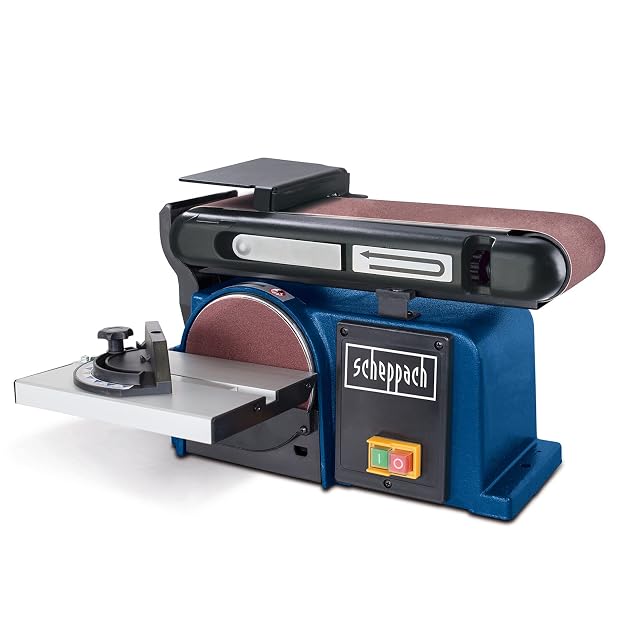
  1. Scheppach BTS800

    370 W · belt 915 × 100 mm (36 × 3.94 in) · disc Ø 150 mm (5.91 in)

    The belt-and-disc sander that publishes its consumable sizes — which is the only specification on a sander that really matters.

    Best for: Small parts, bevels and cleaning up band saw curves

    7.5/10

    ≈ $425

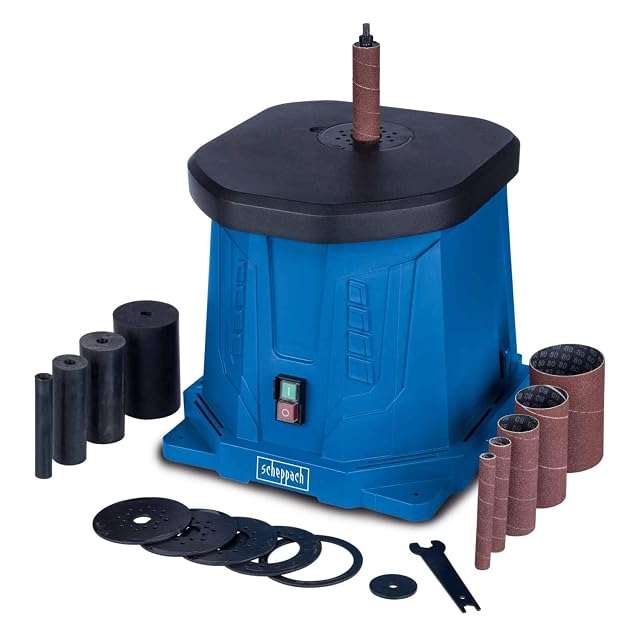
  2. Scheppach OSM100

    450 W oscillating spindle · 6 sleeves included

    An oscillating spindle sander with six sleeve sizes in the box — the machine that makes an inside curve as clean as an outside one.

    Best for: Cleaning up the inside of every curve a band saw or jigsaw has cut

    7.5/10

    ≈ $445

What comes up most often

Belt, disc or spindle?

Disc for outside curves and quick removal; belt for flats and gentle inside curves over the end roller; spindle for tight inside curves. A belt-and-disc combination plus a spindle sander covers everything.

Why does the belt size matter?

Because you buy the machine once and the abrasive forever. 915 × 100 mm (36 × 3.94 in) is the common size — cheap, available in every grit, from every maker.

Why does an oscillating sander matter?

Oscillation spreads wear along the sleeve and prevents burning. Without it, the abrasive glazes in one band and stops cutting.

Which side of the disc do I use?

The side where the disc travels downward, so the machine presses the work into the table. The other side lifts the workpiece.

Why is my wood burning?

Usually a glazed abrasive or too much pressure. Fresh abrasive and lighter contact cut faster and cooler.

Can I use a drum in my drill press instead?

For light work, yes. It does not oscillate, so it will glaze and burn if held in one place, and the table is rarely suitable.

How do I sand small parts safely?

Hold them against a backing block or in a simple jig, never with fingers close to the abrasive. Small parts are snatched fast.

Do I need extraction on a sander?

More than on almost any other machine: sanding produces the finest dust, which stays airborne longest and is the most important to capture.

Each saw, and the cut it was bought for

Scheppach BTS800 · $425

For cutting: Small parts, bevels and cleaning up band saw curves

Where it shines: Publishes both consumable sizes, and both are the common ones

Where it disappoints: 370 W is modest — this is a finishing machine, not a stock-removal one

Read the full review →

Scheppach OSM100 · $445

For cutting: Cleaning up the inside of every curve a band saw or jigsaw has cut

Where it shines: Oscillating — the sleeve moves up and down as well as turning

Where it disappoints: Does one job — inside curves — and does not replace a belt sander

Read the full review →

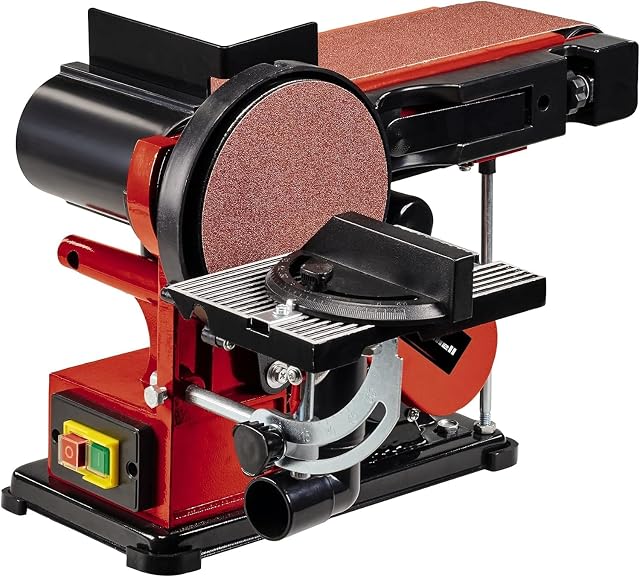
Einhell TC-US 380 · $360

For cutting: Sanding to a line on small parts, where hand sanding is slow and imprecise

Where it shines: One reference and one EAN across all six markets

Where it disappoints: The listing publishes no motor rating, belt size or disc diameter

Read the full review →

What each band of spend cuts

What else the cut needs

Blades, inserts and spares from the same aisle, at the price we recorded. Check they fit the saw you pick before ordering: it depends on the bore and the part number, which the listing states.

The quick cut

Pairings that settle the choice

Saw against saw, where the comparison already exists in this guide or this aisle.

How this selection was built

The saws above are drawn from the catalog of this site. Specifications are the published ones, from the maker and from the Amazon product page; prices are the Keepa figure for the date below, and both shift. Ranking uses declared specifications, the balance of stated strengths and stated limits, and price. No machine here has cut wood for us, and the page claims nothing else.

Last checked on

Prices quoted in these summaries are dated readings. The live price is shown next to each product.

The tool we use ourselves

Chosen your machine? Now buy it at the right price.

Table saws and planers swing by a hundred dollars or more across the year, and the biggest "discounts" often land at prices the same model sold for six weeks earlier. UniverTrack tracks the real price history across retailers, spots fake reductions, and alerts you when it is genuinely the moment to buy.

Real price historyBuy-now alertsAI buying assistant
Try free for 14 days →
No commitment · Cancel in one click · 5 languages