The end of it The right choice in this class, on the strength of two numbers everyone else omits.
Every figure is a manufacturer specification, read off the
listing itself, and the judgments are ours — drawn from how the
specification behaves in this class of machine and from what long-term
owners consistently report. Where a figure is missing, we say so rather
than fill it in.
What the specification says
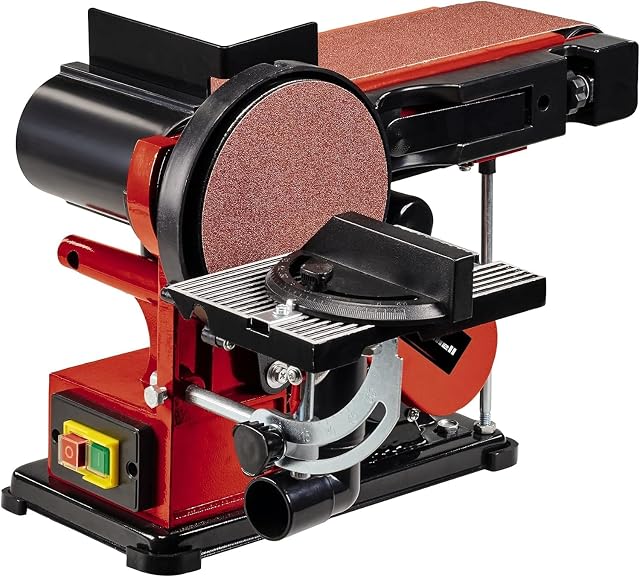
370 W, a 915 × 100 mm (36 × 3.94 in) sanding belt, a 150 mm (5.91 in) disc, and a table that tilts from 0
to 45°. Part number 4903302901-9930.
Why we lead on the belt size
Because it is the number that decides the running cost, and it is the number
almost every listing in this category leaves out. 915 × 100 mm (36 × 3.94 in) is the standard
size for a bench belt sander: every abrasive maker produces it, in every grit,
in aluminum oxide, zirconia and ceramic, and it is cheap.
A machine with an unusual belt is not cheaper to buy and is considerably more
expensive to feed.
The grit progression, and why skipping costs more than it saves
Each grit removes the scratches of the one before it. Skip a step — 80
straight to 180 — and the 180 paper polishes the 80-grit scratches
instead of removing them. They are invisible on bare timber and obvious
the moment a finish goes on, under a raking light, at which point the
only fix is to start again at 80.
The progression costs one extra sheet. The mistake costs the panel.
The 370 W limit
This is a shaping and finishing machine. It will true an edge, sand a curve to a
line and put a clean bevel on a small part. It will not hog material off a
tabletop, and no machine at this price will.
Availability
Read on the day this page was built: $425 at the American Amazon shop.
Read from Keepa on the day this page was last revised; stock and price both move without notice.
Prices quoted in this text were read on 2026-08-12. The live price is at the top of the page.
The good side, and the catch
Strengths
Publishes both consumable sizes, and both are the common ones
915 × 100 mm (36 × 3.94 in) belts are sold by everyone, cheaply
Table tilts to 45°, so bevels can be sanded square to a line
Compromises
370 W is modest — this is a finishing machine, not a stock-removal one
Not sold on the Spanish store
Specifications
Motor
370 W
Sanding belt
915 × 100 mm (36 × 3.94 in)
Sanding disc
Ø 150 mm (5.91 in)
Table
Tilts 0–45°
Part number
4903302901-9930
Amazon reference
B0077S1VQA (identical on 5 markets)
EAN
4014915082095
What comes up most often
Why do the consumable sizes matter more than the motor?
Because you buy the machine once and the abrasive forever. A common belt size — and 915 × 100 mm (36 × 3.94 in) is the most common in this class — means a choice of grits, materials and suppliers at competitive prices. An unusual size means one supplier, their prices, and a machine that becomes useless when they stop making it.
What does the tilting table give you?
A bevel sanded to a known angle rather than an eyeballed one. With the table at 45° and the workpiece flat on it, the disc cuts a true 45° face — which is how you fit a mitre that has gone slightly wrong without recutting it.
Where this model is listed
A listing is not an offer: the reference exists on these stores, availability changes daily.
France
Germany
Italy
United Kingdom
United States
Our score
7.5/ 10
The right choice in this class, on the strength of two numbers everyone else omits.
Who buys this one, among woodworking machines
Small parts, bevels and cleaning up band saw curves
Specifications: the manufacturer sheet for woodworking machines and the matching Amazon product page. Prices and availability: Keepa. Every figure on this page names its source.