Every figure below names its source. Each one is a manufacturer
specification read off the listing itself. The judgments are ours.
Eight to twelve thousand orbits a minute
Published, variable — and it is half of what characterizes a random orbit sander.
The other half is the orbit diameter, and this page does not have it. Nor does
any other listing on either half of this shelf.
A 2.4 mm (0.09 in) orbit cuts fast and leaves a coarser scratch pattern. A 1.5 mm (0.06 in) orbit is
slower and finishes finer. Both can run at twelve thousand.
So the most important distinction between two random orbit sanders cannot be made
on this site from the makers’ own pages.
A separate counterweight
Which cancels the wobble.
An offset pad pulls the tool sideways once per revolution — twelve thousand times
a minute, arriving in the hand as numbness after twenty minutes.
Every random orbit sander has a counterweight. Publishing it as a separate design
is a claim about how well it is balanced, not whether it is.
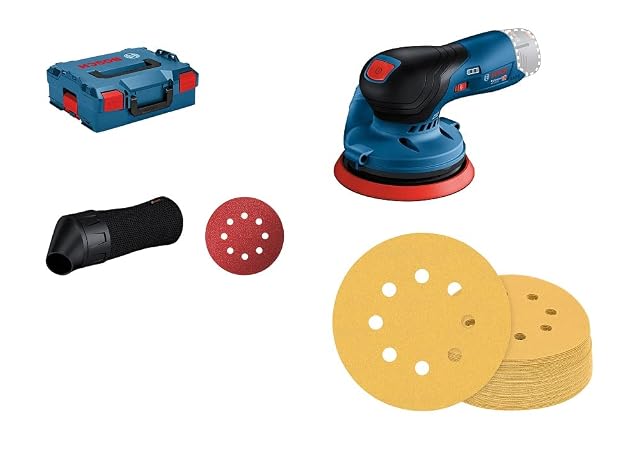
The published Bosch GEX on this shelf publishes nothing at all, and its own page
says why: no price, no barcode, nothing here to buy.
A dust-sealed switch
The part that fails on a sander.
Fine dust gets into a trigger switch and the contacts stop making. It is the
commonest death of a cheap sander, and sealing it is a cheap fix nobody
advertises.
Two listings on this shelf publish it. Both are American, and the other is the
SKIL detail sander.
Two collectors, named
The DWV010 and the DWV012, fitting directly.
For an owner of one of them that is complete; for anybody else it is nothing,
because the port diameter is not published.
The extraction-fittings shelf in this catalog is thirty pages about why the
diameter is the thing that matters. A port of unstated size and two model
numbers is a port a buyer has to measure.
The abrasive is the running cost
A sanding machine is bought once and fed for years.
So the size of the belt, the disc or the sleeve it takes is a bigger decision
than the motor: a common size is sold everywhere and cheaply, and an odd one ties
the machine to one supplier at whatever price that supplier charges.
The published Scheppach BTS800 page on this shelf is recommended on exactly that
ground — it publishes both consumable sizes, and both are the common ones — and the
abrasives shelf in this catalog is where the arithmetic lands.
Availability
Read on the day this page was built: $79 at the American Amazon shop.
Read from Keepa on the day this page was last revised; stock and price both move without notice.
Prices quoted in this text were read on 2026-10-07. The live price is at the top of the page.