Every figure below names its source. Each one is a manufacturer
specification read off the listing itself. The judgments are ours.
The abrasive is the running cost
A sanding machine is bought once and fed for years.
So the size of the belt, the disc or the sleeve it takes is a bigger decision
than the motor: a common size is sold everywhere and cheaply, and an odd one ties
the machine to one supplier at whatever price that supplier charges.
The published Scheppach BTS800 page on this shelf is recommended on exactly that
ground — it publishes both consumable sizes, and both are the common ones — and the
abrasives shelf in this catalog is where the arithmetic lands.
And these are the same consumables
Four by thirty-six inches is 101.6 by 914.4 millimeters. The published Scheppach
machines on this shelf take 915 by 100.
Six inches of disc is 152.4 millimeters. They take 150.
Belt sanders tolerate a millimeter of length because the tension arm takes it up,
and 100 against 101.6 of width is inside the tracking adjustment.
So the twelve-belt set on the abrasives shelf in this catalog feeds this machine
as well. Across two halves of one shelf, that is an unusual thing to be able to
say.
Zero to ninety degrees
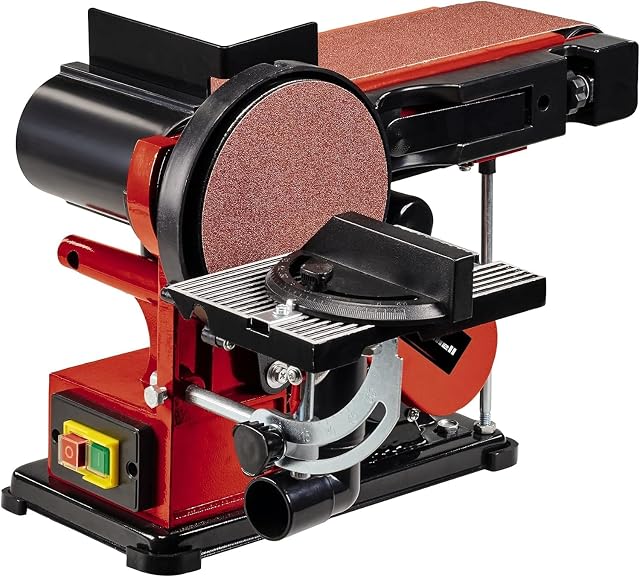
The belt tilts the whole way to vertical, and this is the only American machine
here that publishes it.
Flat, a belt sander dresses a face. Vertical, the same belt squares an end or a
mitre against the table — the work is held down instead of pushed along, which is
a different and more accurate operation.
The published Scheppach BTS900 page on this shelf is credited for the same thing
in its own words: a belt arm that swings from horizontal to vertical, doubling
what it can hold.
Cast iron
Which is what keeps a small machine still.
The published BTS900 page names it as its first merit — cast-iron housing, which is
what keeps a small machine still — and the reason is mass: a 4 × 36 belt at 3,600
rpm puts a vibration into the bench, and a casting absorbs what a folded steel
pressing passes on.
Four point three amps
About 495 watts going in, which is the same class as the 370 W the two published
Scheppach machines state.
Both of their pages carry the same caveat, and it applies here: modest, a
finishing machine rather than a stock-removal one.
It will take a band saw curve down to a line. It will not thickness a board.
No size, and no tilt angle.
Both published Scheppach pages on this shelf publish a table tilt — 45 degrees —
and the BTS800 page names what it is for: bevels can be sanded square to a line.
The belt here tilts. Whether the table does, this page does not say.
Availability
Read on the day this page was built: $110 at the American Amazon shop.
Read from Keepa on the day this page was last revised; stock and price both move without notice.
Prices quoted in this text were read on 2026-10-07. The live price is at the top of the page.