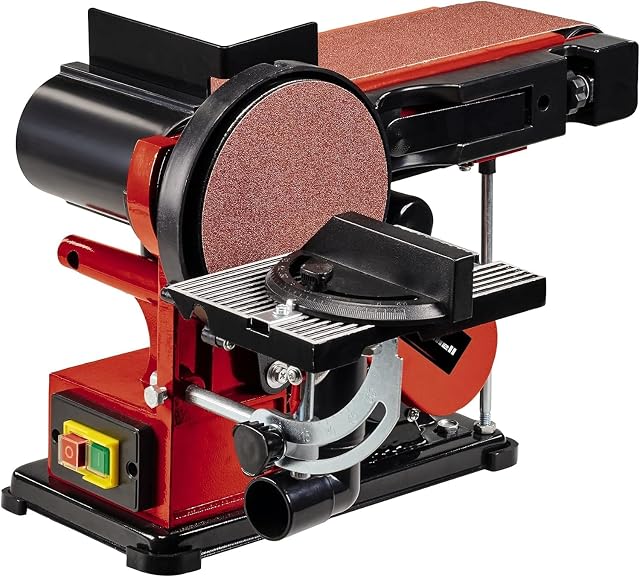
The end of it The specialist that earns its bench space the first time you sand an inside curve properly.
Every figure is a manufacturer specification, read off the
listing itself, and the judgments are ours — drawn from how the
specification behaves in this class of machine and from what long-term
owners consistently report. Where a figure is missing, we say so rather
than fill it in.
What the specification says
450 W, oscillating spindle, six sanding sleeves with matching drums and table
inserts, part number 4903401901.
The job it does that nothing else does
An inside curve. A belt sander reaches an inside curve only over its end roller,
at one radius; a disc sander cannot reach it at all. A spindle sander presents a
cylinder of the right diameter, square to the table, and follows the curve
exactly.
Anyone who cuts shapes on a band saw discovers this within a week: the sawn edge
needs cleaning up, and hand-sanding a concave curve fairly is slow and rarely
fair.
The grit progression, and why skipping costs more than it saves
Each grit removes the scratches of the one before it. Skip a step — 80
straight to 180 — and the 180 paper polishes the 80-grit scratches
instead of removing them. They are invisible on bare timber and obvious
the moment a finish goes on, under a raking light, at which point the
only fix is to start again at 80.
The progression costs one extra sheet. The mistake costs the panel.
The matching table inserts are not padding
Each drum diameter needs its own table opening, otherwise the workpiece
overhangs the gap and dips at the start of the cut. Machines that ship one
insert for all drums produce exactly that fault. Six drums and six inserts is
the complete set.
Availability
Read on the day this page was built: $445 at the American Amazon shop.
Read from Keepa on the day this page was last revised; stock and price both move without notice.
Prices quoted in this text were read on 2026-08-12. The live price is at the top of the page.
The good side, and the catch
Strengths
Oscillating — the sleeve moves up and down as well as turning
Six sleeve sizes, drums and matching table inserts included
Compromises
Does one job — inside curves — and does not replace a belt sander
No price on the Italian or Spanish store when we checked
Sleeves are a recurring cost and clog on resinous timber
Specifications
Motor
450 W
Type
Oscillating spindle sander
Supplied with
6 sanding sleeves, drums and table inserts
Part number
4903401901
Amazon reference
B00GO0WWJ2 (identical on 6 markets)
EAN
4014915082101
What comes up most often
What does oscillation actually change?
Everything about how long the sleeve lasts and how the surface looks. A sleeve that only spins wears in one narrow band and burnishes the timber there; one that also moves up and down spreads the wear across its whole length, runs cooler, clogs later and leaves no ring. The mechanism costs little and multiplies the life of the consumable.
Can a drum in a drill press do the same job?
It can sand an inside curve, and it cannot oscillate, so it burnishes and clogs in one band. It also puts side load on a quill designed for axial load. It works for occasional jobs; it is not the same machine.
Where this model is listed
A listing is not an offer: the reference exists on these stores, availability changes daily.
France
Germany
Italy
Spain
United Kingdom
United States
Our score
7.5/ 10
The specialist that earns its bench space the first time you sand an inside curve properly.
Who buys this one, among woodworking machines
Cleaning up the inside of every curve a band saw or jigsaw has cut
Specifications: the manufacturer sheet for woodworking machines and the matching Amazon product page. Prices and availability: Keepa. Every figure on this page names its source.