Skip to content

The best wood lathe to start on

A lathe is chosen on two dimensions and one hidden commitment. Get the third wrong and every chuck you buy afterwards is the wrong one.

Mass is the specification nobody prints

A lathe light enough to carry will walk across the floor the first time you mount an out-of-balance blank, and technique does not fix it. Bolt the stand down and load it with ballast — most owners of a light machine end up doing exactly that.

Read the spindle thread off the machine

Not off a forum post about the same model. Every chuck and faceplate has to match it, and an adaptor moves the work further from the bearings, which is where you least want it.

Which saw fits your shop?

You want to turn bowls
Swing over the bed and a low speed range decide what is possible, not length between centers.
You want to turn spindles
Length between centers is the criterion, and a smaller lathe does it well.
You have limited space and budget
A midi lathe covers most beginner work and can be extended for longer spindles.
You are unsure what you will turn
Start with a lathe that turns slowly enough for out-of-balance work: that is the constraint most beginners meet first.

Picking by the cut you need

Spindle turning

Handles, legs, pens. The most forgiving introduction and the one that teaches tool control.

Bowl turning

Demands swing, low speed and mass, because an unbalanced blank shakes a light lathe badly.

Learning tool control

Any lathe teaches this, and it is what actually determines results. Tools and sharpening matter more than the machine.

Small production work

Repeat spindles with a steady set-up. Here the tailstock and its quill quality start to matter.

What matters once the blade is turning

The lowest speed available
An out-of-balance blank must start slow. A lathe whose minimum speed is high is unpleasant and unsafe with bowl blanks.
Mass and stand rigidity
Vibration is the enemy of a good cut. A heavy lathe on a solid stand does more for results than extra power.
Swing over the bed
The largest diameter you can turn. It is fixed at purchase and it is what limits bowl work.
Spindle thread and taper
Common sizes mean chucks and accessories are available and affordable. An unusual thread limits you for the life of the machine.
Tool rest quality
A rest that flexes or has a dented top makes tool control impossible. It is a cheap part that matters disproportionately.

Which figure for which cut

What you turnThe specificationWhat limits you
SpindlesLength between centersBed length
BowlsSwing and low speedVibration on a light lathe
Anything unbalancedA genuinely low minimum speedA high minimum speed
With accessoriesA common spindle threadAn unusual thread

Where it goes wrong in the shop

Starting an unbalanced blank fast
A rough blank must be brought up to speed slowly. Starting fast shakes the lathe and can throw the work.
Blunt tools
Most beginner frustration is a sharpening problem, not a technique or machine problem. A sharp tool cuts where a blunt one scrapes and tears.
The tool rest too far from the work
A large gap lets the tool be levered and snatched. The rest is moved in as the work reduces, constantly.
Turning with the rest against a spinning blank
The rest is repositioned with the lathe stopped, and the blank is turned by hand to check clearance before restarting.

By the woodworker you are

The beginner
A midi lathe with a genuinely low minimum speed, a common spindle thread, and money kept back for sharpening equipment.
The bowl turner
Swing, mass and low speed. A light lathe makes bowl turning unpleasant before it makes it impossible.
The spindle turner
Bed length and a good tailstock. A modest lathe is entirely sufficient.

Blades, alignment and working life

A lathe needs little beyond a clean bed and a sharp set of tools. Rust on the bed stops the tailstock and banjo sliding, and blunt tools are behind most of what beginners take for machine problems.

  • Keep the bed clean and waxed so banjo and tailstock slide freely.
  • File out dents in the tool rest top: they transmit straight into the cut.
  • Check the drive belt tension where the lathe is belt-driven.
  • Sharpen frequently; it is the single largest factor in results.

Safety

A workpiece spinning at speed, cut by a hand-held tool.

  • Wear a face shield, not just glasses: blanks and bark can come off.
  • Bring unbalanced blanks up to speed slowly, standing out of the line of throw.
  • Stop the lathe to move the tool rest, and hand-turn the work to check clearance.
  • No loose sleeves, gloves or jewelry near a rotating workpiece.

Our picks, and the case for each

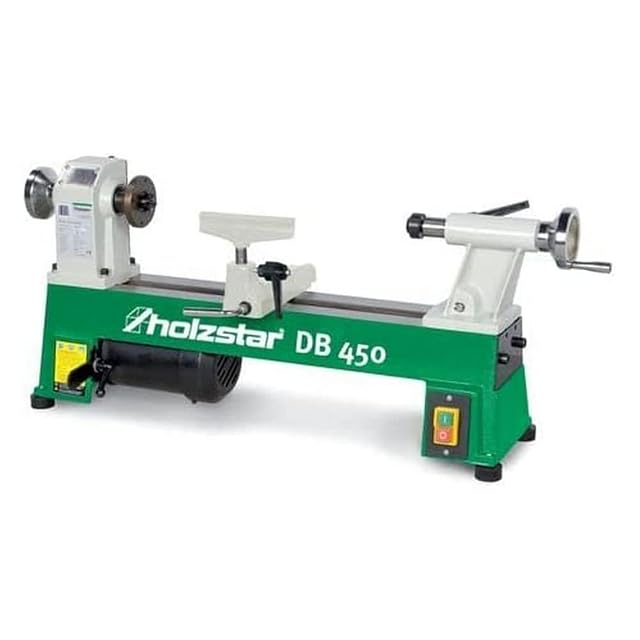
  1. Holzstar DB 450

    230 V · Ø 254 mm (10 in) swing · 5 speeds

    A properly built small lathe with five speeds and a stated swing — the first machine here that publishes what it can turn.

    Best for: Bowls up to 254 mm (10 in) and spindle work, in a workshop that wants a machine rather than a starter kit
    7.8/10

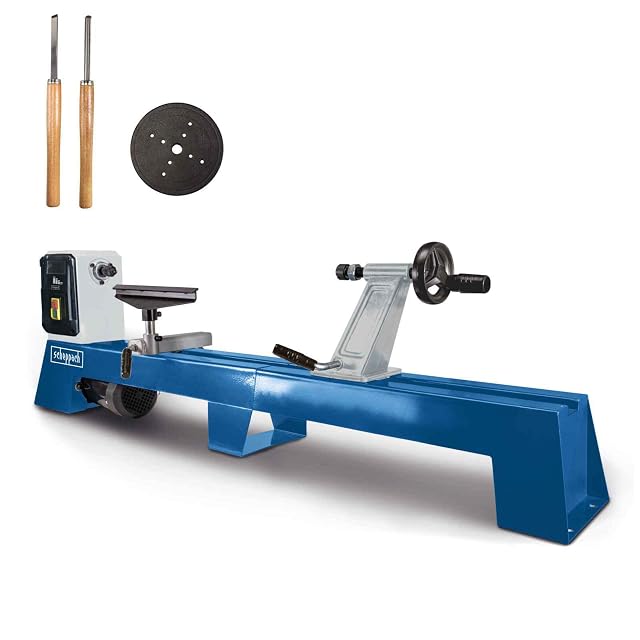
  2. Scheppach DM1100T

    400 W · Ø 350 mm (13.8 in) · 1,000 mm (39.4 in) between centers

    The most capacity per euro of the European lathes on this page — and a listing whose title and part number name two different machines.

    Best for: Long spindle work — stair balusters, table legs — if you can confirm which machine you are buying

    7.8/10

    ≈ $480

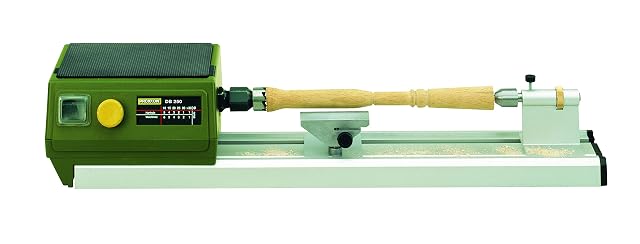
  3. Proxxon DB 250

    Micro lathe · electronic speed control

    A micro lathe for model work, with proper electronic speed control and a faceplate — and no pretensions to being a furniture machine.

    Best for: Pens, small boxes, model parts — precise work at small scale

    7.2/10

    ≈ $295

What comes up most often

What size lathe do I need?

Swing over bed sets the largest diameter; distance between centers sets the longest spindle. A 254 mm (10 in) swing covers most domestic bowls; a meter between centers covers table legs and balusters.

What else do I need to buy?

A grinder and a sharpening jig, without exception. Turning tools dull within minutes, and a dull gouge scrapes, tears and catches rather than cutting.

What size lathe should I start with?

A midi lathe covers most beginner work: enough swing for small bowls, enough length for spindles, and it can often be extended.

Why does low speed matter so much?

An unbalanced blank must start slowly. A lathe whose minimum speed is high shakes badly and can throw the work.

Do I need a chuck straight away?

Not for spindles between centers. For bowls you will want one, which is why a common spindle thread matters at purchase.

Why do my cuts tear the wood?

Nearly always a blunt tool or the wrong presentation angle. Sharpening equipment is part of the cost of turning, not an extra.

How close should the tool rest be?

As close as it can be without touching, and moved in repeatedly as the work reduces. A large gap is how tools get snatched.

Is turning green wood different?

It cuts more easily and it moves as it dries, which is why green-turned bowls are usually roughed, dried and finished later.

Each saw, and the cut it was bought for

Holzstar DB 450

For cutting: Bowls up to 254 mm (10 in) and spindle work, in a workshop that wants a machine rather than a starter kit

Where it shines: States its swing, which two of the four European lathes here do not

Where it disappoints: No stated distance between centers

Read the full review →

Scheppach DM1100T · $480

For cutting: Long spindle work — stair balusters, table legs — if you can confirm which machine you are buying

Where it shines: Ø 350 mm (13.8 in) swing and 1,000 mm (39.4 in) between centers, both stated

Where it disappoints: The listing contradicts itself: the title says DM1100T, the part number says SC-DM500T

Read the full review →

Proxxon DB 250 · $295

For cutting: Pens, small boxes, model parts — precise work at small scale

Where it shines: Electronic speed control at this size, which most micro lathes lack

Where it disappoints: Model-making capacity only — pens, small boxes, chess pieces

Read the full review →

What each band of spend cuts

What else the cut needs

Blades, inserts and spares from the same aisle, at the price we recorded. Check they fit the saw you pick before ordering: it depends on the bore and the part number, which the listing states.

The quick cut

How this selection was built

The saws above are drawn from the catalog of this site. Specifications are the published ones, from the maker and from the Amazon product page; prices are the Keepa figure for the date below, and both shift. Ranking uses declared specifications, the balance of stated strengths and stated limits, and price. No machine here has cut wood for us, and the page claims nothing else.

Last checked on

Prices quoted in these summaries are dated readings. The live price is shown next to each product.

The tool we use ourselves

Chosen your machine? Now buy it at the right price.

Table saws and planers swing by a hundred dollars or more across the year, and the biggest "discounts" often land at prices the same model sold for six weeks earlier. UniverTrack tracks the real price history across retailers, spots fake reductions, and alerts you when it is genuinely the moment to buy.

Real price historyBuy-now alertsAI buying assistant
Try free for 14 days →
No commitment · Cancel in one click · 5 languages