Every figure below names its source. Each one is a manufacturer
specification read off the listing itself. The judgments are ours.
Four thousand two hundred and twenty, at the bottom
Every turning operation begins by making something round, and that is done
slowly.
An unbalanced blank at 4,220 rpm is not roughed. It is thrown, or it shakes the
machine off the bench.
So what this lathe turns is stock that arrives round and balanced: dowel, pen
blanks, bought beads. Anything else has to be rounded somewhere else first.
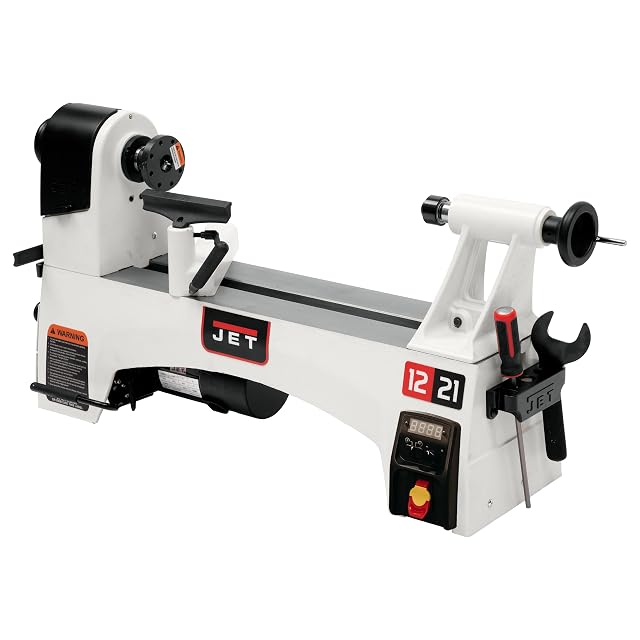
Every other lathe on either half of this shelf starts at 150 or below. The JET
starts at sixty.
Four thousand two hundred and twenty is higher than the top speed of three of
them.
Seven speeds, published one by one
Four thousand two hundred and twenty. Five thousand three hundred. Five
thousand six hundred and fifty. Six thousand three hundred and fifty. Six
thousand six hundred and sixty. Seven thousand and fifty. Eight thousand four
hundred and fifty.
That is more candour about the speeds than any other listing on this shelf, and
it is what makes the problem above visible. A listing that said “150 to 8,500”
would have hidden it.
And then eight thousand five hundred
A bullet says the motor delivers a maximum of 8,500 rpm. The title’s seventh
step is 8,450.
Fifty rpm apart, at a speed where fifty is less than one per cent. It changes
nothing in use.
It says something about how the page was assembled, and both figures are above.
Seventy by a hundred and sixty millimeters
A pen, a bead, a small finial, a drawer knob, a chess pawn.
Two and three-quarter inches of swing is the diameter of a mug. Six and a third
inches between centers is a pen blank once the drive and the center have taken
their share.
The published Proxxon DB 250 on this shelf is the European machine of this class,
and its page is blunt: excellent within its scale and useless outside it.
That frame fits here, with one addition — the Proxxon has electronic speed
control at the low end, and this has 4,220 rpm.
The thread nobody publishes
A lathe is chosen on two dimensions and one commitment.
The dimensions are the swing over the bed and the distance between centers. The
commitment is the spindle thread, because every chuck, faceplate and screw center
bought afterwards has to match it — and the common threads are 1 in by 8 TPI,
M33 by 3.5 and 3/4 in by 16, which are not interchangeable in any direction.
Across all five American listings on this shelf, not one publishes it. The
published Einhell page here carries the same absence in its cons, and the
shelf’s own intro names it as the reason to care.
Availability
Read on the day this page was built: $50 at the American Amazon shop.
Read from Keepa on the day this page was last revised; stock and price both move without notice.
Prices quoted in this text were read on 2026-10-07. The live price is at the top of the page.