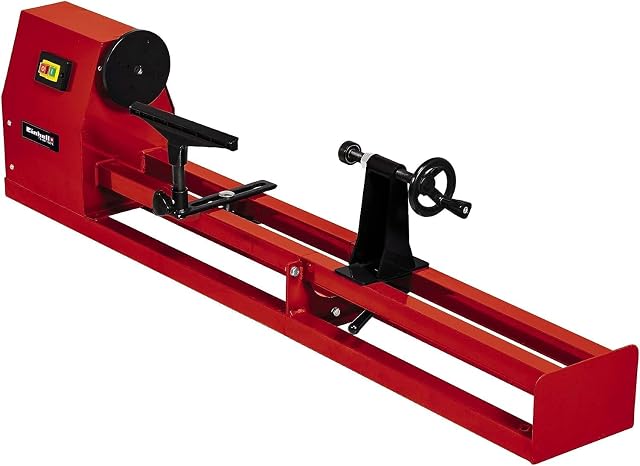
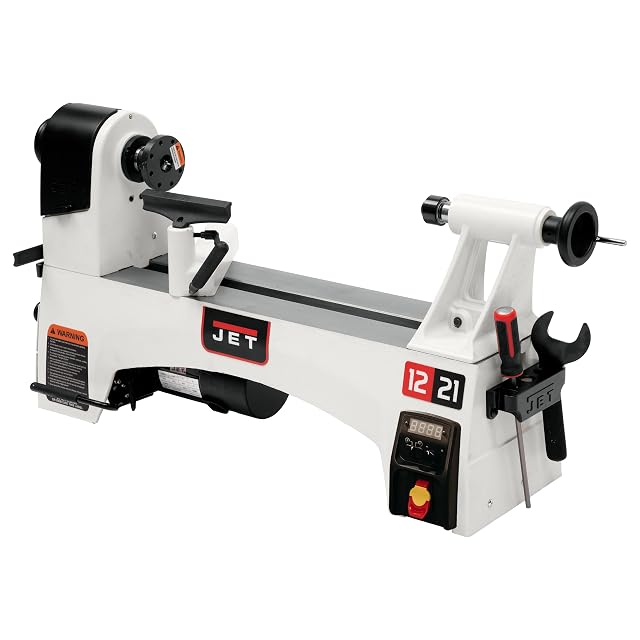
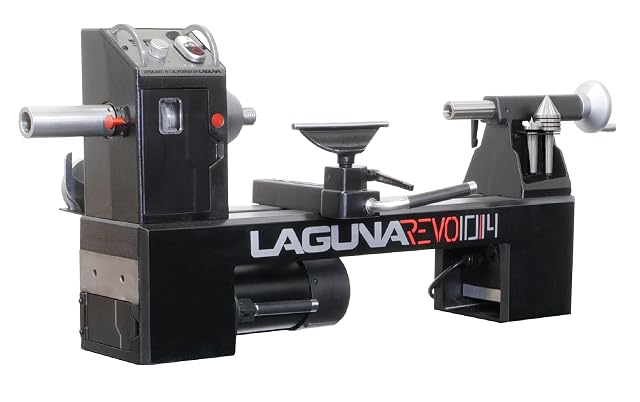
The end of it The one we would buy on this page. It publishes its capacity, it has sensible speeds, and it is built by a machine maker.
Every figure is a manufacturer specification, read off the
listing itself, and the judgments are ours — drawn from how the
specification behaves in this class of machine and from what long-term
owners consistently report. Where a figure is missing, we say so rather
than fill it in.
What the specification says
254 mm (10 in) maximum turning diameter, five speed steps, 230 V, part number 5920450.
Holzstar does not publish the distance between centers on this listing.
Mass is the specification nobody advertises
A lathe spins an unbalanced lump of wet timber at several hundred
revolutions a minute. Everything you feel through the tool — chatter, a
surface that will not come clean, the machine creeping across the floor —
comes back to whether there is enough mass to absorb that.
A light lathe is not unusable; it is a lathe that has to be bolted down
and its stand loaded with ballast. Sand bags in the base of a stand are
the cheapest upgrade in turning, and almost every owner of a light
machine ends up making it.
The speed steps are the argument
Turning speed has to fall as diameter rises — the rim of a 250 mm (9.84 in) blank at
1,000 rpm is moving four times faster than a 60 mm (2.36 in) spindle at the same rpm, and
an out-of-balance blank at too high a speed is the classic way to get hurt on a
lathe.
Five steps means you can actually pick a sensible one for each job. Two-speed
machines force a compromise on one end or the other.
Check the spindle thread before buying anything else
Every chuck, faceplate and screw center you will ever own has to match
the lathe’s spindle thread, and several standards are in common use.
An adaptor exists for most combinations and it moves the work further
from the bearings, which is exactly where you do not want it.
Read the thread off the machine — not off a forum post about the same
model — before spending anything on chucks.
Availability
No such listing: the American Amazon shop answers the reference with a search box rather than a page.
Read from Keepa on the day this page was last revised; stock and price both move without notice.
The good side, and the catch
Strengths
States its swing, which two of the four European lathes here do not
Five speed steps, so large and small work each get a sensible speed
Holzstar is a workshop-machine brand rather than a general tool label
Compromises
No stated distance between centers
Not sold on amazon.com
Specifications
Maximum turning diameter
254 mm (10 in)
Speeds
5
Supply
230 V
Part number
5920450
Amazon reference
B002K8X8Y0 (identical on 5 markets)
EAN
4036351016328
What comes up most often
Why do five speeds matter more than variable speed marketing?
Because on a belt-change lathe the steps are what you actually get, and five well-spaced ones cover bowl roughing to spindle finishing. Electronic variable speed is more convenient and, on cheap machines, loses torque at the bottom of its range — where a big blank needs it most.
Is 254 mm (10 in) enough for bowls?
It is a 10-inch swing, which covers most domestic bowls and all boxes and platters up to that size. What it will not take is a large salad bowl or a platter over 254 mm (10 in), and swing cannot be increased later.
Where this model is listed
A listing is not an offer: the reference exists on these stores, availability changes daily.
France
Germany
Italy
Spain
United Kingdom
Our score
7.8/ 10
The one we would buy on this page. It publishes its capacity, it has sensible speeds, and it is built by a machine maker.
Who buys this one, among woodworking machines
Bowls up to 254 mm (10 in) and spindle work, in a workshop that wants a machine rather than a starter kit
Specifications: the manufacturer sheet for woodworking machines and the matching Amazon product page. Prices and availability: Keepa. Every figure on this page names its source.