Every figure below names its source. Each one is a manufacturer
specification read off the listing itself. The judgments are ours.
Sixty revolutions a minute
The lowest speed on either half of this shelf, and the reason to buy this
machine.
A bowl blank starts out of balance: a square or bark-edged lump on a faceplate is
heavier on one side. At 500 rpm that shakes the lathe across the bench. At 60 it
turns over while the corners come off.
Every other lathe here starts at 150 or above. The VEVOR mini starts at 4,220.
Sixty is not a convenience. It is the difference between roughing a blank and
throwing it.
Three ranges, published as pairs
Sixty to 900. A hundred and ten to 1,800. Two hundred and twenty to 3,600.
Three belt positions, each with its own electronic range, so the useful band is
wide at both ends rather than stretched thin across one.
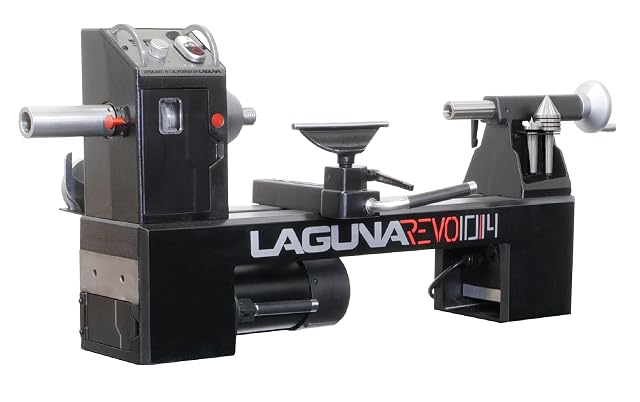
The Laguna on this shelf publishes the same architecture at 250 to 3,200. The
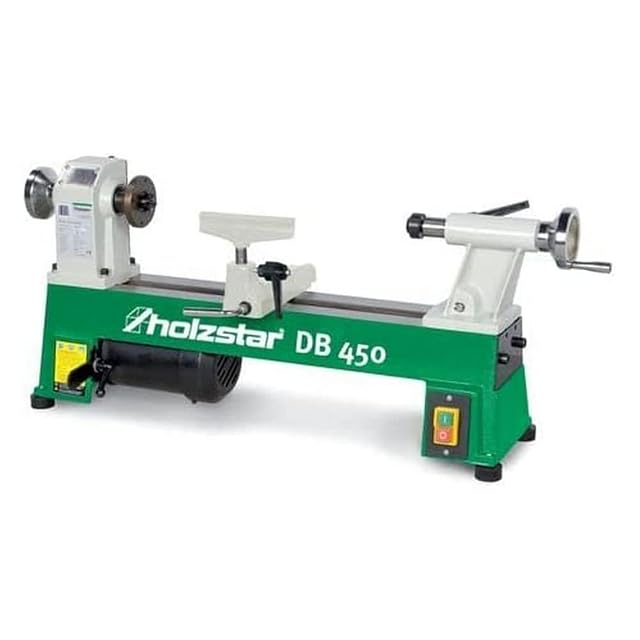
published Holzstar here publishes five fixed steps, and its page is praised for
exactly that.
Reverse, and an Acme thread
Reverse is for sanding: turning tears the grain on one side of a profile, and
sanding the way the tool cut lays the fibers over the tear instead of cutting
them. Running backwards presents the other side of every fiber.
What reverse needs is a chuck that cannot unscrew, which means a set screw or a
locking collar — and this page does not publish the spindle thread at all.
The Acme tailstock thread is the other unusual figure: a coarse square-ish form
that keeps turning when it is full of shavings, where a fine V-thread jams.
The thread nobody publishes
A lathe is chosen on two dimensions and one commitment.
The dimensions are the swing over the bed and the distance between centers. The
commitment is the spindle thread, because every chuck, faceplate and screw center
bought afterwards has to match it — and the common threads are 1 in by 8 TPI,
M33 by 3.5 and 3/4 in by 16, which are not interchangeable in any direction.
Across all five American listings on this shelf, not one publishes it. The
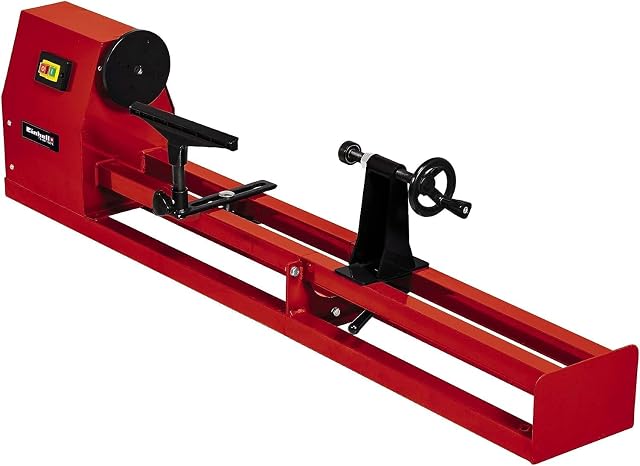
published Einhell page here carries the same absence in its cons, and the
shelf’s own intro names it as the reason to care.
Availability
Read on the day this page was built: $990 at the American Amazon shop.
Read from Keepa on the day this page was last revised; stock and price both move without notice.
Prices quoted in this text were read on 2026-10-07. The live price is at the top of the page.