Skip to content

Laguna Revo 10|14, 10 × 14 in review

Ninety-five pounds and a published footprint, with a bearing-spacing claim no other lathe here makes.

The end of it The best-documented lathe here — weight, footprint, bearings, tool rest — and the bottom speed is 250.

Every figure below names its source. Each one is a manufacturer specification read off the listing itself. The judgments are ours.

Ninety-five pounds, and a footprint

Forty-three kilograms, and 899 by 264 by 427 millimeters.

No other lathe on either half of this shelf publishes either figure, and on a lathe they are most of the specification: mass is what absorbs an out-of-balance blank, and a benchtop machine has to fit a bench.

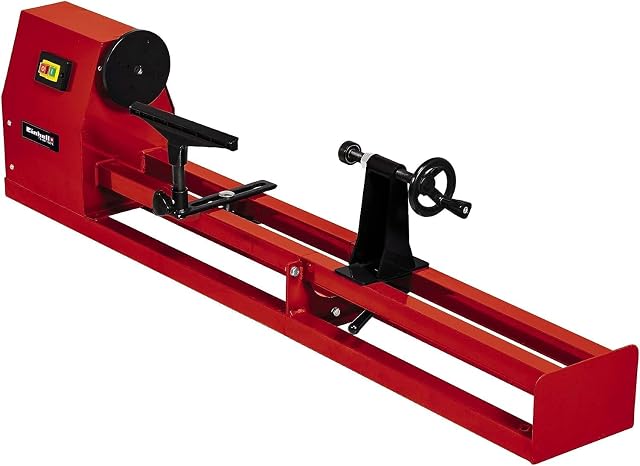
The published Einhell page on this shelf has the opposite problem in its cons — light, so it will need ballast and bolting down.

Six millimeters of hardened steel

On the leading edge of the tool rest, which is the part that wears fastest and shows it worst.

A gouge pivots on the rest and is dragged along it. A soft rest picks up nicks, and every nick is a stutter in the cut because the tool catches instead of sliding. Filing them out lowers the rest a little each time.

This is the only listing on either half of this shelf to publish a hardened edge. The rest publish that a tool rest exists.

A projected bearing cone

A headstock casting that moves the two spindle bearings further apart.

Spindle deflection under side load falls sharply as the bearings separate, so wider spacing means less flex when a gouge is pushed into a bowl rim a hundred millimeters out from the headstock.

It is a real design claim and it is unmeasured: no spacing figure, no runout figure. Across fourteen lathe and grinder listings on this shelf, this is the only page that mentions bearings.

Two hundred and fifty at the bottom

Which is the one place this machine gives ground to the JET beside it.

Two fifty is slow enough for spindle work and for a balanced bowl blank. It is not slow enough for a square lump on a faceplate, and sixty is.

The thread nobody publishes

A lathe is chosen on two dimensions and one commitment.

The dimensions are the swing over the bed and the distance between centers. The commitment is the spindle thread, because every chuck, faceplate and screw center bought afterwards has to match it — and the common threads are 1 in by 8 TPI, M33 by 3.5 and 3/4 in by 16, which are not interchangeable in any direction.

Across all five American listings on this shelf, not one publishes it. The published Einhell page here carries the same absence in its cons, and the shelf’s own intro names it as the reason to care.

Availability

Read on the day this page was built: $565 at the American Amazon shop.

Read from Keepa on the day this page was last revised; stock and price both move without notice.

Prices quoted in this text were read on 2026-10-07. The live price is at the top of the page.
The good side, and the catch

Strengths

  • Publishes weight and footprint, which no other lathe on this shelf does
  • A hardened 6 mm (0.24 in) leading edge on the tool rest, which is where a rest wears
  • TEFC, so sawdust does not pass through the windings
  • Four turning accessories in the box, each named

Compromises

  • No spindle thread, so no chuck can be ordered with it
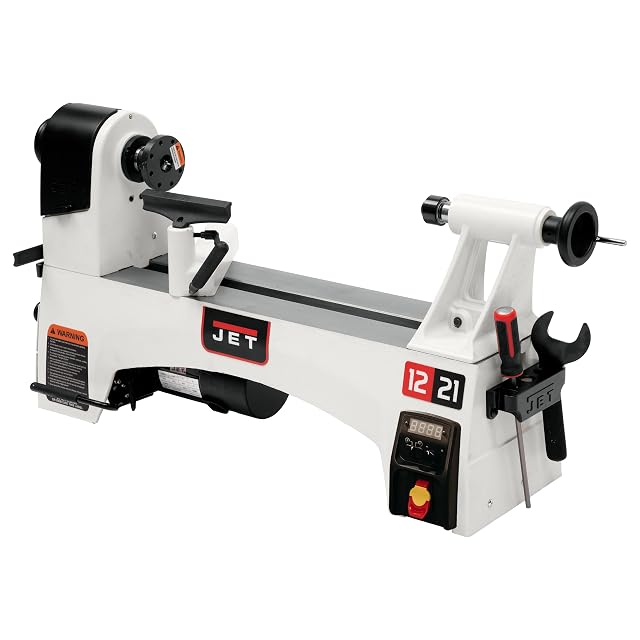
  • Two hundred and fifty rpm at the bottom, against sixty on the JET here
  • Ten inches of swing is the smallest of the full-size lathes here
  • The stand, the bed extension, the casters and the light are all extra

Specifications

Swing over bed10 in — 254 mm
Between centers14 in — 356 mm
Motor1 HP TEFC — totally enclosed fan cooled, 110–120 V · The only enclosed motor on this shelf
Speed range250 to 3,200 rpm, electronic control over a 3-step pulley giving three ranges, with a digital rpm display
Spindle threadNot published by the maker.
Spindle bearingsA projected bearing cone, stated to increase bearing spacing for spindle stability — the only bearing claim on this shelf
Indexing24 positions, with a push-button spindle lock
TailstockA self-ejecting quill
ConstructionCast iron headstock and tailstock
SuppliedA 3 in faceplate, a spur drive, a live center, and a 1 in tool rest post with a 6 mm (0.24 in) hardened steel leading edge
Overall size35.4 × 10.4 × 16.8 in, published — 899 × 264 × 427 mm (35.4 × 10.4 × 16.8 in)
Weight95 lb, published — 43 kg (94.8 lb)
Auxiliary outletA 120 V outlet for a work light — the only auxiliary outlet on this shelf
Part numberMLAREVO10A
Amazon referenceB0G4NMBL2Q
EAN0195444297106

What comes up most often

Why does a hardened tool rest edge matter?

Because the rest is the part that wears fastest and shows it worst. A gouge is pivoted on the rest and dragged along it, and a soft rest develops nicks; every nick becomes a stutter in the cut, because the tool catches on it instead of sliding. Filing them out lowers the rest a little each time. Six millimeters of hardened steel along the leading edge is the fix, and this is the only listing on either half of this shelf to publish one — the rest of this shelf publishes that a tool rest exists.

What is a projected bearing cone?

A headstock casting that moves the two spindle bearings further apart. Spindle deflection under a side load goes down sharply as the bearings separate, so a wider spacing means less flex when a gouge is pushed into a bowl rim 100 mm (3.94 in) from the headstock. It is a real design claim and it is unmeasured — no spacing figure and no runout figure is published. Across both halves of this shelf this is the only listing that mentions the bearings at all.

What does the auxiliary outlet add?

One fewer extension lead. A work light on a lathe has to move with the work, so it is clamped to the bed or the headstock and trails a cable — and a trailing cable near a spinning spindle is the thing that catches. A 120 V outlet on the machine keeps that cable short and switched with the lathe. It is the only one on this shelf, and it is the sort of detail that only appears on a listing written by somebody who turns.

Who buys this one, among woodworking machines

A bench that can take 43 kg (94.8 lb), and spindle work where the tool rest edge matters

Sources

Specifications: the manufacturer sheet for woodworking machines and the matching Amazon product page. Prices and availability: Keepa. Every figure on this page names its source.

How we assess these woodworking machines