Non-woven pads · 4 grades
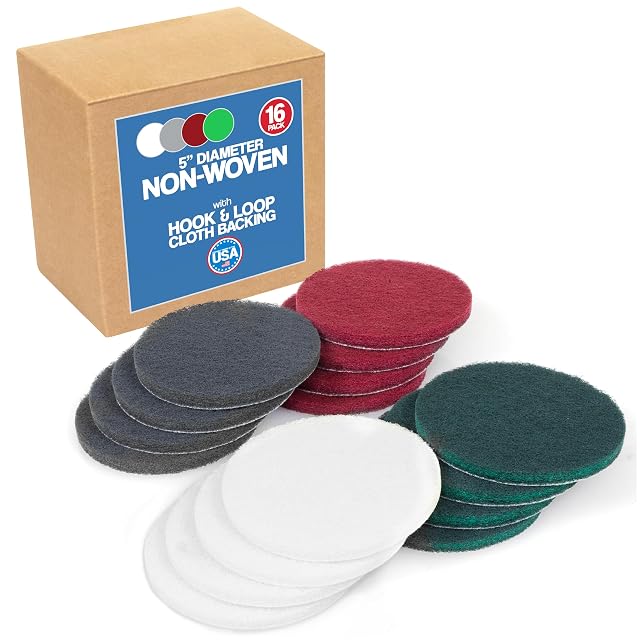
Peachtree Woodworking Supply 21904 non-woven pads, 5 in, 16 pack
Four grades told apart by color rather than by a printed number — and one of the four is non-abrasive by the listing's own account.
Specifications
- Diameter
- 5 in
- Quantity
- 16 pads · The split between the four grades is not published
- Grades
- Four, by color: green stated like 240 grit, maroon stated 320, grey stated 800 very fine, and white stated non-abrasive — the only color-coded grading on this shelf
- Backing
- Hook and loop, for a 5 in random orbital sander or polisher
- Construction
- Non-woven
- Named uses
- Paint removal, scuff sanding between coats, smoothing before a final finish, buffing, applying oils and waxes · Also rust removal, deburring, metal cleaning and auto paint prep
- Water
- The white pad is stated to stand up to water, cleaners and wood finishes
- Part number
- 21904
- Amazon reference
- B0FB46JFX6
- EAN
- 0817918025045
Every figure below names its source. Each one is a manufacturer
specification read off the listing itself. The judgments are ours.
Four grades, told apart by color
Green is stated like 240 grit. Maroon is 320. Grey is 800, stated very fine.
White is stated non-abrasive.
That last one is the honest part: a quarter of this pack removes nothing. It
applies oil and wax and buffs the result, and the listing says so rather than
calling it a polishing grade.
Color is the right system for a pad, and for a reason that only shows after
use: a non-woven pad carries no printing that survives being used. The published
wet-and-dry sheets on this shelf are praised here for the mirror image — the
grit is marked on the back of every sheet — and that marking is on paper, which
keeps it.
On a pad, the color is the number.
Sixteen pads, and no split
Four grades. Sixteen pads. Nothing that says how many of each.
Four of each would be an even progression. Six green and two grey would not, and
a buyer cannot tell from the page which they are getting.
The published sanding-sleeve set on this shelf publishes its split outright —
three of each diameter — and its page says why that matters: three means a worn
one does not stop the job.
Here it cannot be said either way.
Three hundred and twenty to eight hundred
A long step, on the part of the progression where steps show.
Between coats of lacquer, 320 cuts the nibs back and 800 polishes what is left;
there is no 400 or 600 in this pack to bridge them. The published belt set on
this shelf has the same shape of gap and its page names it: jumps 120 to 240,
which skips a step.
On a clear finish the jump is visible as a change of sheen rather than as
scratches. It is still a jump.
What a pad does that a disc cannot
Follow a shape.
A paper disc is flat and takes the high spots off something flat. A non-woven
pad is a web of fibers with grit through it, so on a molding or a turned leg it
goes into the hollows instead of bridging them.
The price is that it cuts slowly and holds no flat at all — on a panel it will
round the edges before it levels the middle.
Availability
Read on the day this page was built: $27 at the American Amazon shop.
Read from Keepa on the day this page was last revised; stock and price both move without notice.
Prices quoted in this text were read on 2026-10-07. The live price is at the top of the page.
What comes up most often
What is a non-woven pad for, against a disc?
Shape. A paper disc is flat and takes the high spots off a flat surface; a non-woven pad is a web of fibers with grit through it, so it conforms. On a molding, a turned leg or a raised panel, a disc bridges the hollows and a pad follows them. The trade is that a pad cuts more slowly and cannot hold a flat — used on a flat panel it will round the edges. The published wet-and-dry sheets on this shelf are the hand-and-block answer to the same problem, and the published mesh disc is the flat-surface one.
Why does color-coding matter?
Because a used pad has no number on it. The published wet-and-dry set on this shelf is praised on this page for exactly the same reason in reverse — the grit is marked on the back of every sheet, which sounds trivial until there is a bench full of them. Non-woven pads carry no printing that survives use, so color is the only grading that lasts: green is 240, maroon 320, grey 800, white nothing. It is the one system on this shelf that still works after the pad has been used.
How many of each grade are in the pack?
Not published. Sixteen pads, four grades, and the listing never says the split — which on a four-grade assortment is the figure that decides whether it is usable. Four of each would be an even progression; six green and two grey would not. The published sanding-sleeve set on this shelf publishes its split outright, three of each diameter, and its page makes the point that three means a worn one does not stop the job. Here that cannot be said either way.