Skip to content

The best band saw for resawing

Most saws sold as band saws under €300 cannot resaw anything worth resawing. That is not a fault; it is a different machine. This guide separates the two.

The line between the two kinds

A saw with 80 mm (3.15 in) of height and 350 W is a curve saw. It will follow a shape better than any jigsaw, and it will not split a board. Machines at 900 W with a frame to match are where resawing starts.

What to confirm before ordering

Resaw height is rarely published, and when it is, the figure assumes a properly tensioned wide blade. Ask for it. The difference between 160 mm (6.30 in) and 200 mm (7.87 in) is the difference between splitting a board and nearly splitting it.

The blade decides the rest

Width sets the minimum radius you can follow: roughly 6 mm (0.24 in) for a 20 mm (0.79 in) radius, 13 mm (0.51 in) for 60 mm (2.36 in). Pitch decides whether the gullets clear — three teeth in the cut, always.

Which saw fits your shop?

You want to slice boards from thicker stock
Resaw height under the guides is the specification that decides everything.
You mostly cut curves
A smaller machine with a narrow blade suits better and costs far less.
You resaw wide boards regularly
You need blade tension and wheel size, and that means a heavier machine.
You have limited height in the shop
Measure before buying: resaw capacity comes from a tall machine.

Picking by the cut you need

Resawing

Slicing a thick board into thinner ones. It is the use that justifies a large band saw and it demands tension and a wide blade.

Cutting veneers

The extreme of resawing: thin slices where blade drift and wander show immediately.

Curves and shapes

A narrow blade on a smaller machine. Wide-blade resaw machines cut curves badly.

Breaking down green or awkward stock

Where a band saw is safer than any other saw, because the cutting force pushes the work down onto the table.

What matters once the blade is turning

Resaw height under the guides
The number that decides what you can slice. Everything else on a resaw machine is in service of this figure.
Blade tension capability
A wide blade needs real tension to cut straight. A frame that flexes cannot hold it, and the cut wanders however good the fence is.
Guides and their adjustment
Guides that are hard to set are guides that stay wrong. They are what keep a wide blade from twisting under load.
Table size and fence
A resaw fence needs to be tall and square. A short fence cannot support a board on edge, which is the whole operation.
Dust extraction at the lower wheel
Band saws pack dust into the lower housing where it packs onto the tire and throws the blade off. It is a mechanical issue as much as a health one.

Which figure for which cut

What you cutWhat it needsWhat suffers
Thin veneersTension and a wide bladeCurve cutting
CurvesA narrow bladeResaw capacity
Wide boardsHeight under the guidesShop headroom
Green timberAggressive tooth pitchFinish quality

Where it goes wrong in the shop

Blaming drift on the machine
Most drift comes from a dull or badly tensioned blade, or guides not set. A band saw that wanders is usually telling you about its blade.
Leaving a blade tensioned
Tension left on flattens the tires and stresses the bearings over long idle periods. Releasing it takes seconds.
Using too wide a blade for the curve
Blade width sets the tightest radius possible. Forcing a wide blade round a tight curve twists it and breaks it.
Setting the upper guide high
The guide should sit just above the work. High, it leaves blade exposed and allows the blade to twist.

By the woodworker you are

The resaw user
Height, tension and a tall fence. A heavier machine, and the space for it.
The curve cutter
A modest machine with a narrow blade does this well and takes far less room.
The general workshop
A mid-size machine compromises: enough height for occasional resawing, enough finesse for curves with a blade change.

Blades, alignment and working life

A band saw is a machine of adjustments rather than parts. Blade tension, tracking, guides and clean tires between them decide whether it cuts straight, and all four drift with use.

  • Release blade tension when the saw will be idle for a long period.
  • Keep the tires clean of packed dust and pitch, which throws the tracking off.
  • Set the guides close to the blade and just above the work every time.
  • Change blades when they wander despite correct setup; blades are consumables.

Safety

A continuous blade under tension, with the cutting force pushing the work down.

  • Set the upper guide just above the workpiece before every cut.
  • Never reach around the blade to retrieve an offcut while it runs.
  • Use a push stick for narrow rips and keep fingers out of the blade line.
  • Stand aside when tensioning and when first starting after a blade change.

Our picks, and the case for each

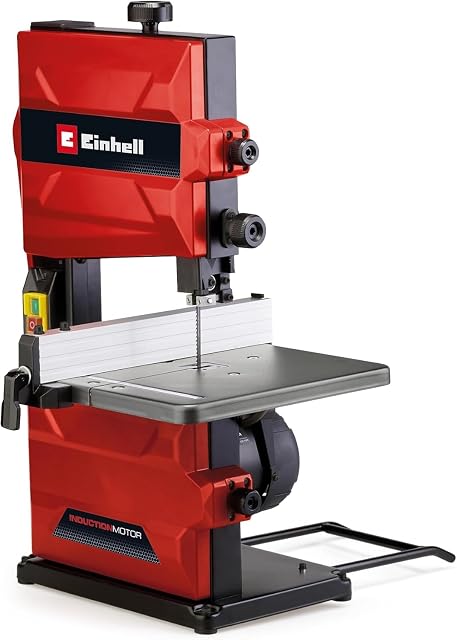
  1. Einhell TC-SB 200/1

    Tool-free blade change · ball-bearing guides

    The most consistently priced saw on this page — around €160 to €175 everywhere in Europe — with ball-bearing guides at that money.

    Best for: A first band saw, where the ability to change blades quickly matters more than capacity

    7.5/10

What comes up most often

What is resawing?

Splitting a board through its thickness — turning one 50 mm (1.97 in) plank into two 22 mm (0.87 in) ones. It needs height under the guides, a frame stiff enough to tension a wide blade, and power to keep it moving.

Why is my band saw not cutting straight?

Usually the blade, then the tension, then the guides. Keep at least three teeth in the cut, tension properly, and set the bearings close. Drift is also normal: every band saw needs its fence angled to match.

What is resaw capacity?

The height under the upper guides, which is the thickest board you can stand on edge and slice. It is the defining specification of a resaw machine.

Why does my cut drift?

Usually a dull blade, insufficient tension, or guides not set. Drift is far more often the blade than the machine.

How wide a blade should I use?

As wide as the machine will tension for resawing; narrow enough for the tightest radius when cutting curves. The two uses want different blades.

Should I release the tension?

For long idle periods, yes: it spares the tires and bearings. For a lunch break it makes no difference.

Is a band saw safer than a table saw?

The cutting force pushes the work down rather than back, so there is no kickback in the same sense. It is still a moving blade and needs the same discipline.

Why does the blade come off the wheels?

Most often dust packed on the tires, or tracking not set after a blade change. Clean tires and set tracking before blaming the blade.

Each saw, and the cut it was bought for

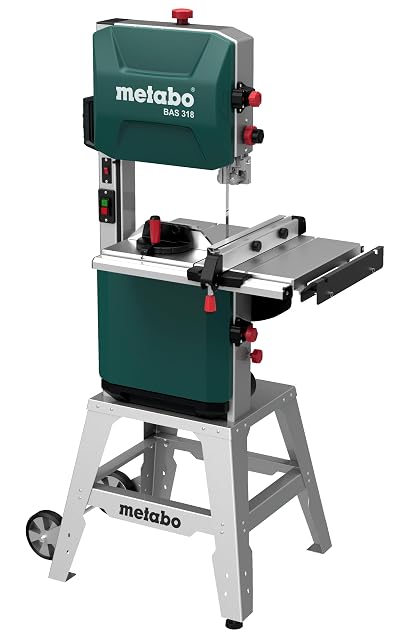
Metabo BAS 318 Precision WNB

For cutting: A workshop that wants to resaw its own stock rather than buy it thicknessed
Where it shines: 900 W — nearly three times the motor of the entry saws here

Where it disappoints: The listing publishes the motor rating and little else

Read the full review →

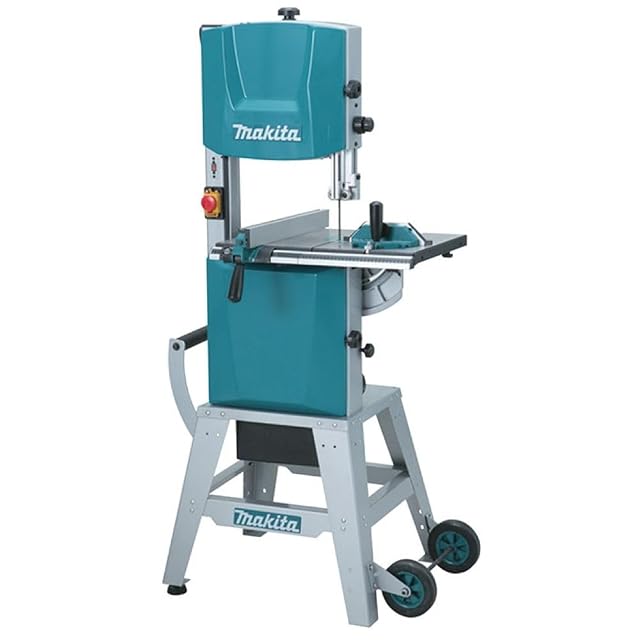
Makita LB1200F

For cutting: A workshop buying its last band saw rather than its first

Where it shines: 900 W and a full-size frame

Where it disappoints: Two different Amazon references across Europe, on the same EAN

Read the full review →

Einhell TC-SB 200/1

For cutting: A first band saw, where the ability to change blades quickly matters more than capacity

Where it shines: Ball-bearing blade guides rather than friction blocks

Where it disappoints: Einhell publishes no cut height or throat depth on this listing

Read the full review →

What else the cut needs

Blades, inserts and spares from the same aisle, at the price we recorded. Check they fit the saw you pick before ordering: it depends on the bore and the part number, which the listing states.

The quick cut

How this selection was built

The saws above are drawn from the catalog of this site. Specifications are the published ones, from the maker and from the Amazon product page; prices are the Keepa figure for the date below, and both shift. Ranking uses declared specifications, the balance of stated strengths and stated limits, and price. No machine here has cut wood for us, and the page claims nothing else.

Last checked on

Prices quoted in these summaries are dated readings. The live price is shown next to each product.

The tool we use ourselves

Chosen your machine? Now buy it at the right price.

Table saws and planers swing by a hundred dollars or more across the year, and the biggest "discounts" often land at prices the same model sold for six weeks earlier. UniverTrack tracks the real price history across retailers, spots fake reductions, and alerts you when it is genuinely the moment to buy.

Real price historyBuy-now alertsAI buying assistant
Try free for 14 days →
No commitment · Cancel in one click · 5 languages