Spring calipers · transfer
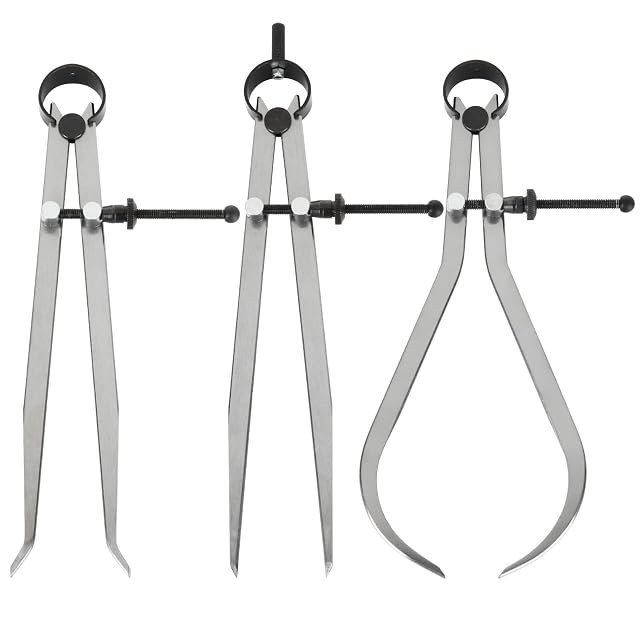
Acrux7 3-piece spring caliper set, 8 in
Three instruments that read no number at all — they carry a distance from the work to the rule.
Specifications
- Contents
- Three at 8 in — an outside caliper, an inside caliper and a divider
- Material
- Carbon steel, chrome plated, stated for corrosion resistance
- Legs
- Forged steel with hardened points, stated for precise marking
- Adjustment
- A solid nut for fine adjustment, stated
- Outside caliper
- Stated for round or oddly shaped stock, transferring the measurement to a rule
- Inside caliper
- Stated for the inner diameter of an opening, transferred the same way
- Divider
- Stated for tracing contours and scribing circles
- Part number
- Not published by the maker.
- Amazon reference
- B09KV7GJK9
- EAN
- 0735626269448
Every figure below names its source. Each one is a manufacturer
specification read off the listing itself. The judgments are ours.
No numbers at all
Three instruments on this page, and not one of them reads a measurement.
An outside caliper is set on the work, lifted off with the spring holding it, and
read against a rule afterwards. An inside caliper does the same in reverse. A
divider carries a spacing from one place to another.
They exist because on round or awkward work there is nowhere to put a rule. A
bowl wall, the inside of a box, a spindle between its beads — a digital caliper
either will not reach or will not sit square.
Or used the other way round
Set from a rule, a spring caliper becomes a go/no-go gauge.
Which is how a bowl is turned to a wall thickness: set the caliper once, then cut
and check until it closes over the rim.
Nothing with a display does that, because a display has to be read and the lathe
is still turning.
Set to a spacing, it walks round a circle and divides it into equal parts — six
flutes on a column, eight facets on a lid, a hexagon on a turned disc.
Set to a radius, it scribes the circle.
The published Laguna lathe in this catalog does the first job mechanically,
with a 24-position indexing head. A divider does it on anything, including a part
already taken off the lathe.
Eight inches of leg
Which reaches round stock of roughly 150 millimeters, and into an opening of
about the same.
That covers a bowl, a box, a spindle and most turning. It will not reach across a
300 mm (11.8 in) platter, and for a hollow form the legs are the wrong shape entirely.
It is the only figure on the page, and it is the right one to publish.
Availability
Read on the day this page was built: $20 at the American Amazon shop.
Read from Keepa on the day this page was last revised; stock and price both move without notice.
Prices quoted in this text were read on 2026-10-07. The live price is at the top of the page.
What comes up most often
Why use a caliper with no numbers on it?
Because on round or awkward work there is nowhere to put a rule. A bowl wall, the inside of a box, the diameter of a spindle between its beads — a digital caliper either will not reach or will not sit square. A spring caliper is set on the work, lifted off with the spring holding it, and read against a rule afterwards. It can also be set from a rule and used as a go/no-go gauge, which is how a bowl is turned to a wall thickness: set it once, check until it closes.
What is the divider for?
Stepping and scribing. Set to a spacing, it walks round a circle dividing it into equal parts — which is how a hexagon is laid out on a turned disc, or six flutes spaced round a column. Set to a radius, it scribes the circle itself. The published Laguna lathe in this catalog has a 24-position indexing head that does the same job mechanically; a divider does it on anything, including a part already off the lathe. It is the oldest instrument in any workshop and it is on this shelf for the same reason it has always been there.
Eight inches — what does that reach?
An outside caliper of eight-inch legs will go round stock of roughly 150 mm (5.91 in), and an inside one into an opening of about the same. That covers a bowl, a box, a spindle and most turning. It will not reach across a 300 mm (11.8 in) platter, and for a hollow form the legs are the wrong shape entirely — those need a dedicated depth gauge. The eight-inch size is stated in the title three times and is the one specification on the page, which is the right one to publish.