Skip to content

The best table saw for a home workshop

A table saw is judged on whether its fence stays parallel to the blade along its whole length. Everything else — wattage, blade diameter, table material — is downstream of that. These three are ordered on it.

The one specification that matters

A fence that clamps only at the operator’s end pivots a fraction of a degree at the far end. That is invisible to the eye, and it is enough to burn the cut, pinch the offcut against the blade and push the workpiece off the line. A fence that clamps at both ends of the rail does not.

Only one saw on this site has that as standard, and it leads this guide.

If the budget is under €250

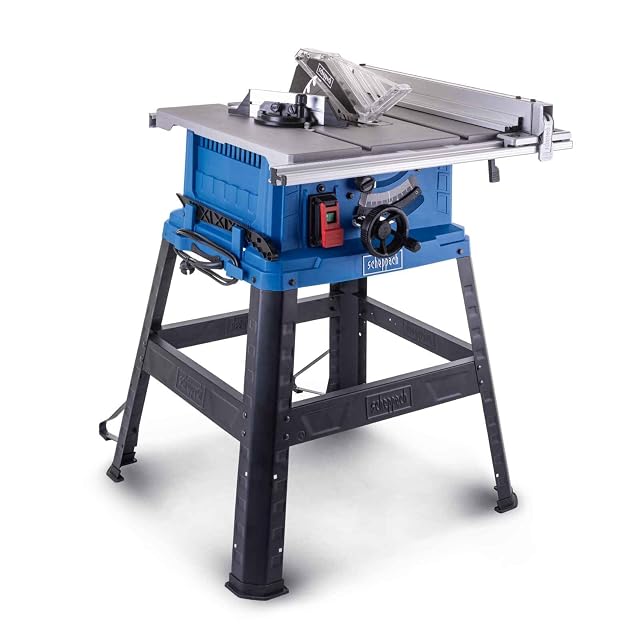
The Scheppach HS105 gives you a 255 mm (10 in) blade, 75 mm (2.95 in) of cut height, a table that reaches 640 × 920 mm (25.2 × 36.2 in) with the extension out, and its own stand — for less than the compact site saws cost without one. It stays where you put it, which for a garage is not a limitation.

If the saw has to travel

None of the three above. A site saw is a different machine, and the compact Bosch reviewed on this site is the one to look at.

Which saw fits your shop?

You mostly break down sheet goods
A track saw handles that more safely in a small shop, and the table saw becomes the second purchase.
You rip solid stock regularly
This is the machine for it, and fence quality is what decides the result.
The saw has to be moved and stored
A jobsite saw on a folding stand, accepting a smaller table and less mass.
You have a dedicated space and a supply
A contractor or cabinet saw brings mass, and mass is what makes a cut clean and quiet.

Picking by the cut you need

Ripping solid timber

The core job. A fence that locks parallel and stays there decides everything else.

Sheet goods

Possible, and awkward alone. Outfeed support matters more than the saw, and a track saw is often the better answer.

Joinery cuts

Grooves, rebates and tenons with jigs. Here the mitre slots and their accuracy become the interesting specification.

Repeat cuts

Where a table saw is unbeatable: set the fence once and every piece matches.

What matters once the blade is turning

The fence, before anything else
A fence that flexes or shifts out of parallel makes accuracy impossible and burns the cut. It is the single most important part of the machine.
Mass and vibration
A heavy saw cuts more cleanly and quietly at the same power. It also cannot be lifted onto a shelf, which is the trade.
The riving knife and guard
A riving knife that follows the blade height is what prevents the offcut closing on the blade. This is a safety component, not an accessory.
Table flatness and mitre slots
A twisted table or slots not parallel to the blade defeats every jig you will ever build for it.
Dust extraction
A table saw produces a great deal of fine dust below the table. A cabinet with a proper port changes the air in a small workshop.

Which figure for which cut

Your workThe right sawWhat it costs
Ripping timberContractor or cabinet sawSpace and weight
Sheet goods aloneA track saw firstSlower repeat cuts
Site workJobsite saw and standLess mass, smaller table
Joinery with jigsAccurate mitre slotsSetup time

Where it goes wrong in the shop

Removing the riving knife and leaving it off
It is the part that prevents the workpiece pinching the blade and being thrown back. Removing it for one cut and forgetting is how the accident happens.
Cutting freehand
Every cut is guided by the fence or the mitre gauge, never by both at once and never by hand alone. This is not a stylistic preference.
Using the fence as a stop for crosscuts
The offcut becomes trapped between blade and fence and is thrown. A stop block clamped ahead of the blade is the correct method.
Reaching over the blade
Push sticks and push blocks exist so that hands never travel across the blade path, including to clear an offcut.

By the woodworker you are

The small home shop
A compact saw with a genuinely good fence, plus outfeed support. The fence matters more than the badge.
The sheet goods worker
A track saw first, then a table saw for ripping and repeat work. That order suits most small shops.
The furniture maker
Mass, a locking fence and accurate slots. Everything you build afterwards depends on those three.

Blades, alignment and working life

A table saw stays accurate through alignment and cleanliness. Pitch builds on the blade and makes it cut hot and burn, and dust under the table binds the trunnions so height and tilt no longer move freely.

  • Clean pitch off the blade rather than assuming it is blunt.
  • Vacuum under the table so height and bevel mechanisms stay free.
  • Check blade-to-slot parallelism periodically, and after any knock.
  • Wax the cast table to reduce friction and keep rust off; never oil it.

Safety

The table saw causes more serious workshop injuries than any other machine, and the causes are well known.

  • Always use the riving knife, and the guard whenever the cut allows it.
  • Never use the rip fence as a length stop for crosscuts.
  • Stand out of the line of the blade: kickback travels straight back.
  • Use push sticks near the blade, and never reach over a spinning blade to clear an offcut.

Prices quoted in this text were read on 2026-08-12. The live price is at the top of the page.

Our picks, and the case for each

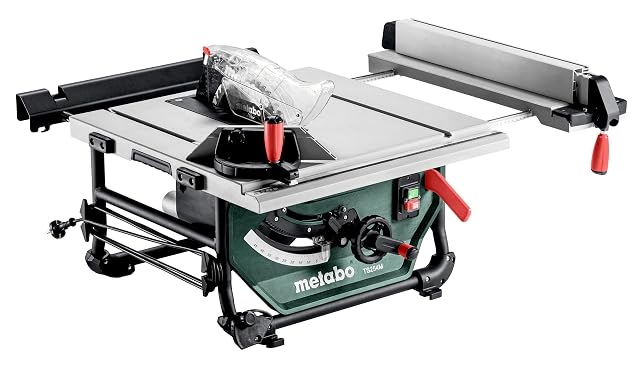
  1. Metabo TS 254 M

    254 mm (10 in) · double-clamped fence · 3 s brake

    The saw on this page whose fence clamps at both ends — the single detail that separates a machine you can trust from one you fight.

    Best for: Anyone who wants accuracy out of the box rather than after a weekend of tuning
    7.6/10

  2. Scheppach HS105

    255 mm (10 in) · 2,000 W · with stand

    A full-size blade, a stand and a 640 × 920 mm (25.2 × 36.2 in) table for the price of a compact site saw — the most machine per euro on this page, with the compromises that implies.

    Best for: A garage or a shed where the saw stays put and space, not portability, is the constraint

    7.4/10

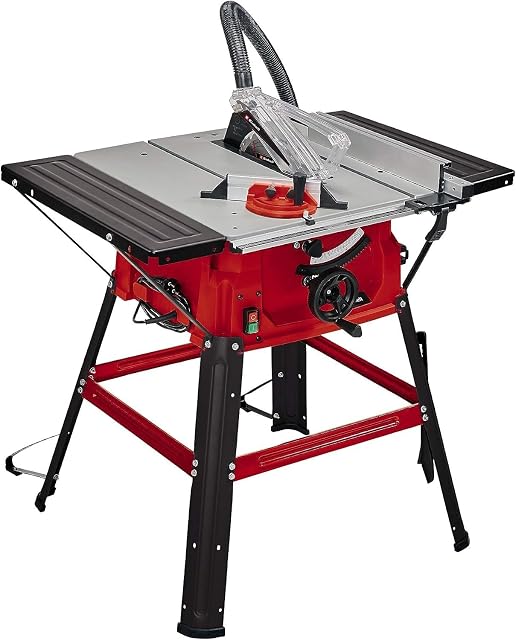
  3. Einhell TC-TS 2025/2 U

    250 mm (9.84 in) · 2,000 W · 85 mm (3.35 in) cut

    The cheapest way into a real table saw, and honest about what that buys — a big blade, a big cut, and a fence you will end up improving.

    Best for: A first table saw for occasional sheet and softwood work, where the alternative is no table saw at all

    6.8/10

What comes up most often

How much should a first table saw cost?

Between €150 and €350 buys a machine that will do real work. Below that the fence and the table are compromised to the point where you fight the saw; above it you are buying capacity and refinement rather than basic accuracy.

What should I upgrade first?

The blade, then the fence. A 24-tooth rip blade and a 60-tooth crosscut blade transform any saw for under €80 — far more than the next €200 of machine would.

Do I need a table saw if I have a track saw?

For breaking down sheets, a track saw is often better and safer. For repeat ripping of solid timber and jig-based joinery, the table saw is hard to replace.

What matters most on a table saw?

The fence. A fence that does not lock parallel and stay there makes accuracy impossible, regardless of the motor.

What is a riving knife for?

It keeps the kerf open behind the blade so the workpiece cannot pinch and be thrown back. It is a safety part and it belongs on the saw.

Why does my cut burn?

Usually a fence out of parallel, a blade with pitch build-up, or feeding too slowly. All three are correctable before buying anything.

How much power do I need?

Enough for the thickness you rip most; beyond that, mass and fence quality change the result more than motor size.

Is dust extraction really necessary?

Wood dust is a health matter, and a table saw makes a lot of the fine kind. Extraction is part of the machine, not an optional accessory.

Each saw, and the cut it was bought for

Metabo TS 254 M

For cutting: Anyone who wants accuracy out of the box rather than after a weekend of tuning
Where it shines: Fence clamps at both ends — the specification this whole category should be judged on

Where it disappoints: A tubular frame is rigid but never as dead as cast iron under vibration

Read the full review →

Scheppach HS105

For cutting: A garage or a shed where the saw stays put and space, not portability, is the constraint

Where it shines: Comes with its own stand, which is otherwise a separate purchase and an awkward one

Where it disappoints: Not sold on amazon.com — a European machine

Read the full review →

Einhell TC-TS 2025/2 U

For cutting: A first table saw for occasional sheet and softwood work, where the alternative is no table saw at all

Where it shines: 85 mm (3.35 in) of cut height, which is more than saws costing three times as much

Where it disappoints: The fence is the weak point at this price and is the first thing to outgrow

Read the full review →

What else the cut needs

Blades, inserts and spares from the same aisle, at the price we recorded. Check they fit the saw you pick before ordering: it depends on the bore and the part number, which the listing states.

The quick cut

Pairings that settle the choice

Saw against saw, where the comparison already exists in this guide or this aisle.

How this selection was built

The saws above are drawn from the catalog of this site. Specifications are the published ones, from the maker and from the Amazon product page; prices are the Keepa figure for the date below, and both shift. Ranking uses declared specifications, the balance of stated strengths and stated limits, and price. No machine here has cut wood for us, and the page claims nothing else.

Last checked on

The tool we use ourselves

Chosen your machine? Now buy it at the right price.

Table saws and planers swing by a hundred dollars or more across the year, and the biggest "discounts" often land at prices the same model sold for six weeks earlier. UniverTrack tracks the real price history across retailers, spots fake reductions, and alerts you when it is genuinely the moment to buy.

Real price historyBuy-now alertsAI buying assistant
Try free for 14 days →
No commitment · Cancel in one click · 5 languages