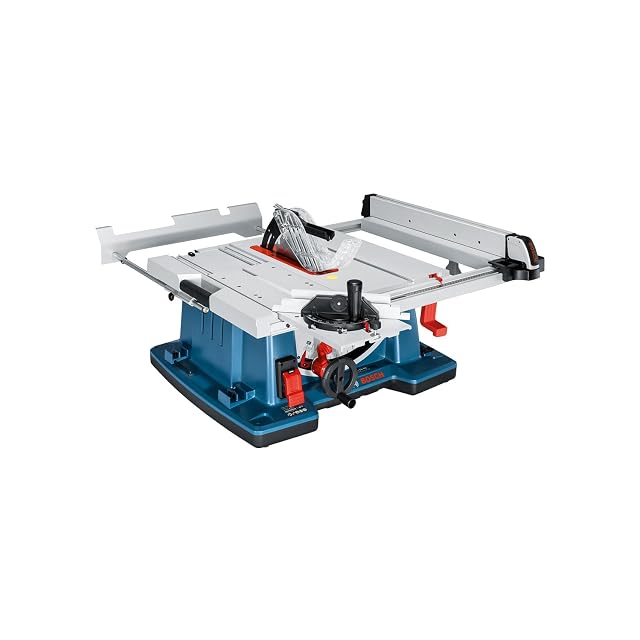
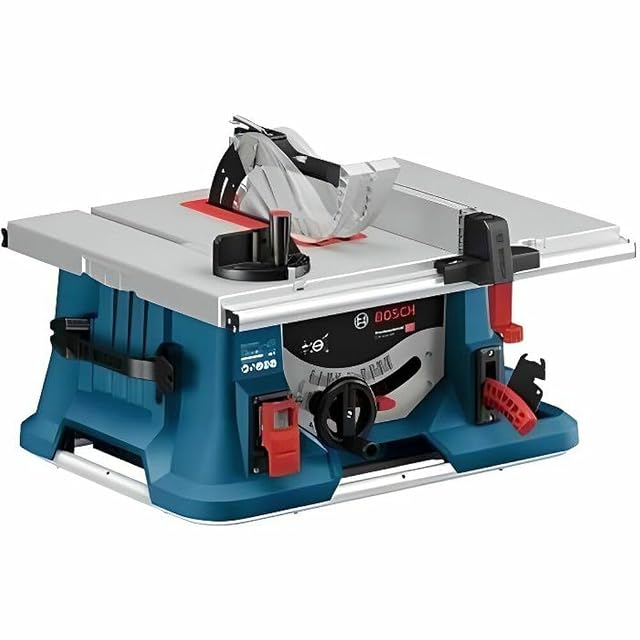
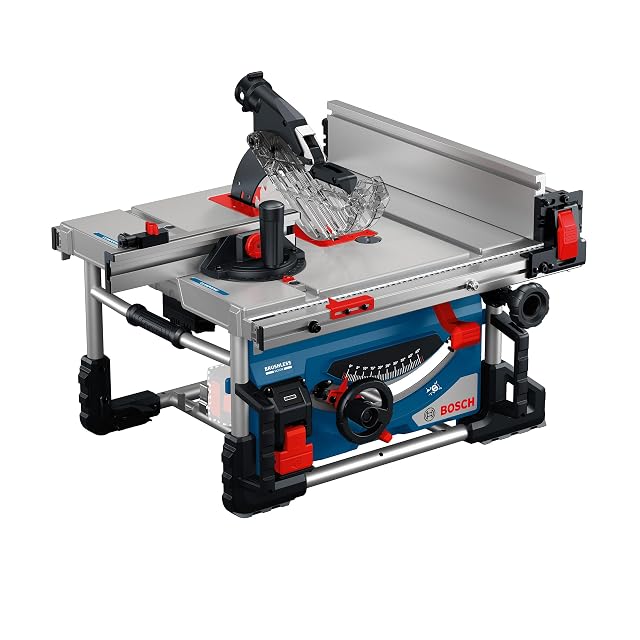
The end of it The entry point, and a defensible one — provided you treat the fence as a starting position rather than a finished component.
Every figure is a manufacturer specification, read off the
listing itself, and the judgments are ours — drawn from how the
specification behaves in this class of machine and from what long-term
owners consistently report. Where a figure is missing, we say so rather
than fill it in.
What the specification says
A 250 mm (9.84 in) blade, 2,000 W, and 85 mm (3.35 in) of cut height at 90°. That last number is
the interesting one: it is more than the compact site saws in the middle of this
page manage, because they run smaller blades. A full-size blade in a cheap saw
still cuts as deep as a full-size blade in an expensive one.
The listing includes a rip fence, a mitre gauge, a table extension and blade
tilt. Nothing is missing from the inventory.
Where the money went, and where it did not
It went into the motor and the blade diameter. It did not go into the fence, and
that is the whole story of this saw.
A rip fence has one job: to stay exactly parallel to the blade along its full
length, under hand pressure, every time it is locked. A fence that clamps only
at the operator’s end pivots a fraction of a degree at the far end — invisible
to the eye, and enough to burn the cut, pinch the offcut and push the workpiece
away from the line. On this saw, that is what you are working with, and it is
the reason to keep a straight batten and two clamps within reach.
The table is pressed steel rather than cast iron. Cast iron is flatter and it
damps vibration; pressed steel does neither as well, and it is why a cheap saw
sounds busier than an expensive one doing identical work.
What it is genuinely good at
Breaking down softwood and sheet material where the finished edge will be
planed, jointed or hidden. In that role, 85 mm (3.35 in) of capacity and a full-size blade
are worth considerably more than a better fence would be.
What we could not check
Table flatness and blade-to-slot parallelism are the two numbers that decide
this class of saw, and neither is published by anyone. They also vary between
individual machines more than between models — which is a reason to check yours
on arrival rather than to trust any review, including this one.
The good side, and the catch
Strengths
85 mm (3.35 in) of cut height, which is more than saws costing three times as much
Bevel, table extension, rip fence and mitre gauge all included
Sold under one reference across every European market we checked
Compromises
The fence is the weak point at this price and is the first thing to outgrow
A stamped-steel table is never as flat as a cast one
Dust extraction on saws in this class is nominal at best
Specifications
Blade diameter
250 mm (9.84 in)
Maximum cut height
85 mm (3.35 in)
Motor
2,000 W
Supplied with
Rip fence, mitre gauge, table extension
Amazon reference
B0816XHC1G (identical on 6 markets)
EAN
4006825646474
What comes up most often
Is a saw at this price worth buying at all?
For occasional work, yes — with one condition. Everything mechanical on it is adequate; the fence is what limits accuracy, and a fence can be improved with a straight length of hardwood and two clamps. What cannot be improved is a blade that will not stay perpendicular, and on this class of saw that is a matter of setup rather than of price.
Why is 85 mm (3.35 in) of cut height unusual here?
Because cut height follows blade diameter, and 250 mm (9.84 in) is a full-size blade. Compact site saws use 210 or 216 mm (8.50 in) blades and stop around 65 to 70 mm (2.56 to 2.76 in). If you need to rip 80 mm (3.15 in) stock in one pass, the cheap big-blade saw does it and the expensive compact one does not.
Where this model is listed
A listing is not an offer: the reference exists on these stores, availability changes daily.
France
Germany
Italy
Spain
United Kingdom
United States
Our score
6.8/ 10
The entry point, and a defensible one — provided you treat the fence as a starting position rather than a finished component.
Who buys this one, among woodworking machines
A first table saw for occasional sheet and softwood work, where the alternative is no table saw at all
Specifications: the manufacturer sheet for woodworking machines and the matching Amazon product page. Prices and availability: Keepa. Every figure on this page names its source.