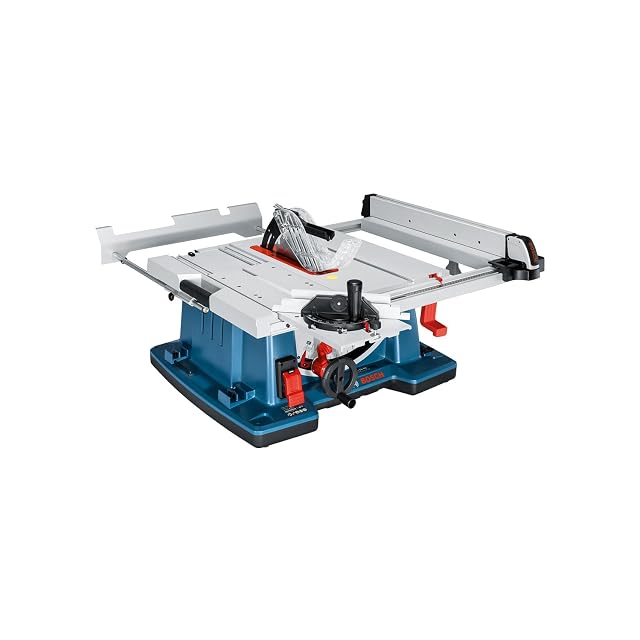
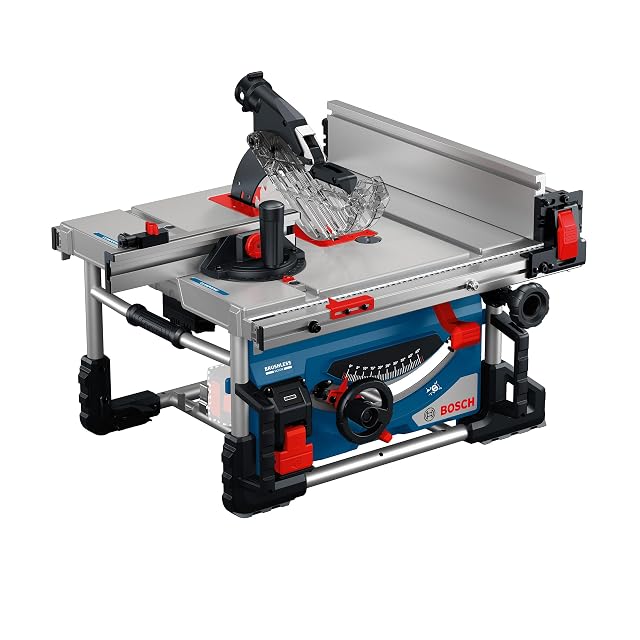
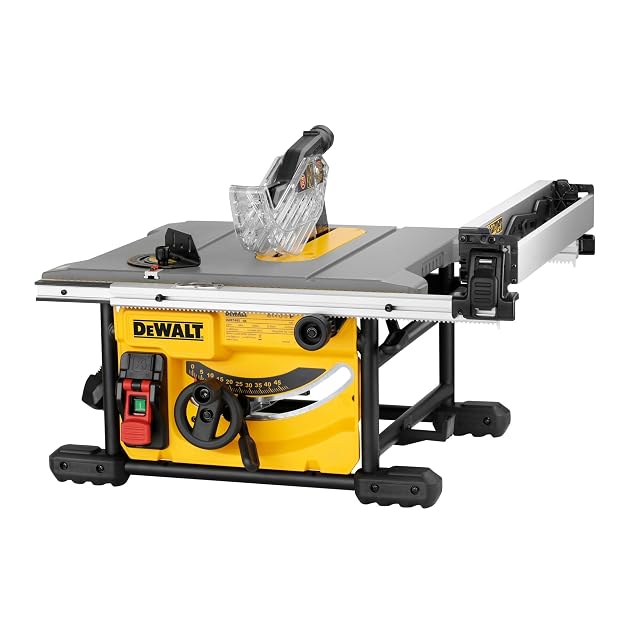
The end of it The one to buy if the saw has to be carried. The one to skip if it lives in one place, where the same money buys more blade.
Every figure is a manufacturer specification, read off the
listing itself, and the judgments are ours — drawn from how the
specification behaves in this class of machine and from what long-term
owners consistently report. Where a figure is missing, we say so rather
than fill it in.
What the specification says
216 mm (8.50 in) blade on a 30 mm (1.18 in) arbor, 1,600 W, and a self-closing blade guard described
by Bosch as part of the safety package alongside the safety switch and the
lightweight construction.
The trade this saw makes
Every compact site saw trades cut height and table area for the ability to be
picked up. The GTS 635-216 makes that trade explicitly: a 216 mm (8.50 in) blade instead
of a 250 or 254, and a smaller table than the stationary machines further down
this page.
Whether that is the right trade depends on one question you can answer in a
second — does the saw move? If it lives in a garage and never leaves, you are
paying for portability you will never use and giving up capacity you will. If it
goes into a van, none of the stationary saws here are in the running.
The guard is the underrated part
A self-closing guard matters more than it sounds. Guards get removed because
they are in the way of a specific cut, and the ones that are awkward to refit
stay off. A guard that drops back into place on its own survives the second
week, and a saw that still has its guard in year three is a meaningfully safer
machine than one with better paper specifications and a guard in a drawer.
Availability
Catalogued and unsold: the American Amazon shop lists the reference with nobody behind it.
Read from Keepa on the day this page was last revised; stock and price both move without notice.
What we could not check
Fence parallelism under load, and the actual proportion of dust captured. Bosch
publishes an extraction port but not a capture figure, and no manufacturer in
this category does.
The good side, and the catch
Strengths
Light enough to be carried by one person, which decides whether a site saw gets used
Self-closing guard — the guard that is still fitted a year later is the one that does not need removing
30 mm (1.18 in) bore, so European blades fit without a reducer
Compromises
216 mm (8.50 in) blade caps cut height well below a 250 mm (9.84 in) machine
Compact saws trade table area for portability, and large panels need outfeed support
The US listing is an import rather than local distribution — the price shows it
For everything up to about 65–70 mm (2.56 to 2.76 in) in one pass, yes — which covers sheet goods, trim, and most softwood framing on edge. It is not enough to rip a 100 mm (3.94 in) oak blank, and no accessory changes that. Blade diameter is the one specification on a table saw you cannot upgrade.
Why does the blade bore matter?
Because European blades are made with a 30 mm (1.18 in) center hole and much of the rest of the world is not. A saw with a 30 mm (1.18 in) arbor takes them directly; anything else needs a reducer ring, which is one more part to lose and one more source of runout.
Where this model is listed
A listing is not an offer: the reference exists on these stores, availability changes daily.
France
Germany
Italy
Spain
United Kingdom
United States
Our score
7.4/ 10
The one to buy if the saw has to be carried. The one to skip if it lives in one place, where the same money buys more blade.
Who buys this one, among woodworking machines
Trim, second-fix and repeated small rips, where the saw has to move between rooms or sites
Specifications: the manufacturer sheet for woodworking machines and the matching Amazon product page. Prices and availability: Keepa. Every figure on this page names its source.