Skip to content

Fyeme Roller featherboard for 30 and 45 mm T-track

Rollers instead of plastic fingers: the same pressure against the fence with far less drag on the feed.

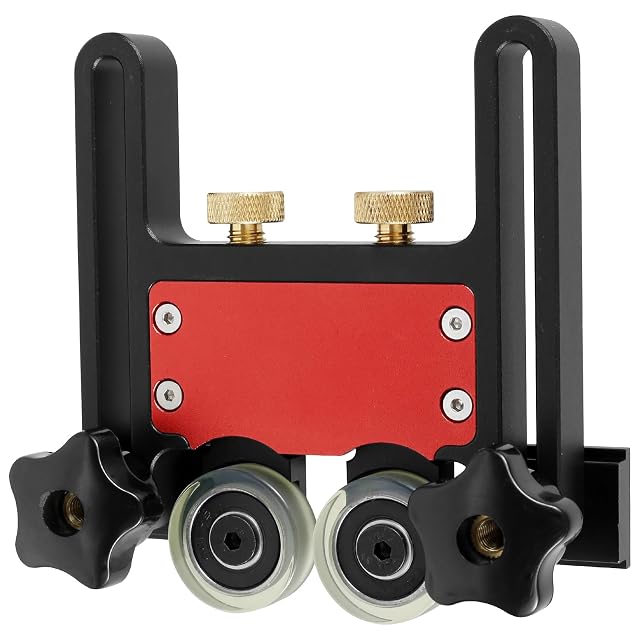
Aluminum roller featherboard with polyurethane wheels, product photograph

Fyeme Roller featherboard for 30 and 45 mm T-track

Rollers instead of plastic fingers: the same pressure against the fence with far less drag on the feed.

Body
Anodized aluminum alloy
Rollers
Polyurethane, bearing mounted
Pressure
Adjustable by a brass knob
Fits
3/4 × 3/8 inch mitre slots, and 30 mm (1.18 in) and 45 mm (1.77 in) T-track
Mounting
Horizontal or vertical
Part number
200039876-17
Availability
No EAN published — other markets could not be verified
Amazon reference
B0CSKFRZFC
  • Bearing rollers cut the friction that makes a plastic featherboard hard to feed against
  • Adjustable pressure, so the same board suits thin stock and thick
  • The slot dimensions quoted are the imperial 3/4 × 3/8 inch standard — measure your own slot

Best for: Narrow rips on a table saw and repeated passes on a router table
Search Amazon for this model

Specifications

Body
Anodized aluminum alloy
Rollers
Polyurethane, bearing mounted
Pressure
Adjustable by a brass knob
Fits
3/4 × 3/8 inch mitre slots, and 30 mm (1.18 in) and 45 mm (1.77 in) T-track
Mounting
Horizontal or vertical
Part number
200039876-17
Availability
No EAN published — other markets could not be verified
Amazon reference
B0CSKFRZFC

Every figure below is a manufacturer specification read off the listing itself. The judgments are ours.

What the specification says

An anodized aluminum body with bearing-mounted polyurethane rollers, pressure adjusted by a brass knob, mounting horizontally or vertically, supplied with a slider and T-bolt for 3/4 × 3/8 inch mitre slots and 30 mm (1.18 in) and 45 mm (1.77 in) T-track. Part number 200039876-17. No EAN on the listing.

Rollers against fingers

A conventional featherboard uses angled plastic fingers that flex: they hold the work and they resist it moving in either direction, which means you push against them for the whole cut. Rollers hold with the same force and turn as the board passes, so the drag disappears and the feed rate is yours to choose. On a long rip that changes how controlled the cut feels.

Set the pressure, not the position

The brass knob is the adjustment that matters. Enough pressure to hold the work against the fence, not so much that the board bows between the featherboard and the blade — which is the fault that produces a rip narrower in the middle than at the ends.

Availability

No such listing: the American Amazon shop answers the reference with a search box rather than a page.

Read from Keepa on the day this page was last revised; stock and price both move without notice.

Saws this fits

What comes up most often

What does a featherboard do beyond keeping fingers away?

It presses the workpiece against the fence for the whole length of the cut, which is what makes a rip a consistent width rather than a tapered one. It also resists the board traveling backwards, which is the direction kickback throws it. The safety benefit and the quality benefit come from the same mechanism.

Will it fit my mitre slot?

Measure before ordering. The listing quotes the 3/4 × 3/8 inch slot, which is the standard on American-pattern saws and on many imported machines, but European table saws are not consistent about it. The 30 mm (1.18 in) and 45 mm (1.77 in) T-track options cover most aftermarket track, and between the three most tables are catered for.

All jigs & guides

Prices quoted in these summaries are dated readings. The live price is shown next to each product.