Caliper · non-marring
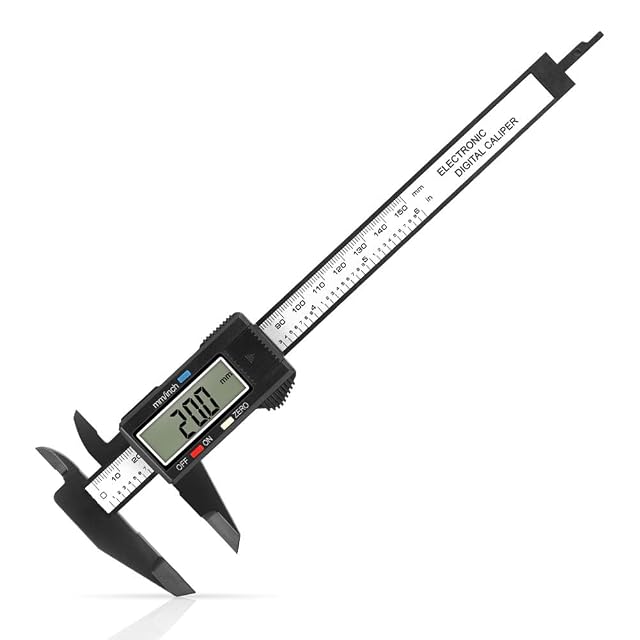
Sangabery S-0916 digital caliper, 0–6 in
A caliper that will not scratch a finished surface — and whose resolution is twice as fine as its accuracy.
Specifications
- Range
- 0 to 6 in / 0 to 150 mm (0 to 5.91 in)
- Resolution
- 0.01 in / 0.1 mm
- Accuracy
- ±0.2 mm (0.01 in) / ±0.01 in, published — twice as coarse as the resolution, and ten times coarser than the published Hardell caliper on this shelf
- Body
- Plastic carbon fiber composite, stated tough yet low hardness so it does not scratch finished surfaces
- Modes
- Four: outside, inside, depth and step, with two sets of jaws and a probe
- Units
- Inch and millimeter, switched by one button · Zero can be set anywhere along the range
- Display
- A large LCD, auto on when the rail is slid, auto off after 5 minutes
- Stated limit
- The maker states plainly that it is not for technical measurement
- Part number
- S-0916
- Amazon reference
- B07VSVMWTJ
- EAN
- 0699747227513
Every figure below names its source. Each one is a manufacturer
specification read off the listing itself. The judgments are ours.
Resolution is not accuracy
A digital instrument has two numbers and they are not the same.
Resolution is the smallest change the display can show. Accuracy is how far the
reading may be from the truth. A caliper that displays hundredths and is accurate
to two tenths is showing twenty times more precision than it possesses.
The published digital angle gauge on this shelf carries the same gap in its cons
— a display reading to 0.05 degrees on an instrument accurate to ±0.2. Reading
the second figure is the whole skill, and only the listings that publish both
allow it.
Here it is a tenth against two tenths
The display shows 0.1 mm (0.004 in). The accuracy is ±0.2 mm (0.01 in).
So the last digit is decoration, and the instrument is honest enough to publish
both figures so that can be seen.
The published Hardell caliper on this shelf is ±0.02 mm (0.001 in) — ten times finer — and
its page argues the opposite case: finer than wood moves with the weather.
Both are true. They are different jobs.
Two tenths is enough for timber
Wood moves several tenths across its width with the seasons, so measuring a
board to hundredths is measuring the humidity.
What two tenths will not do is set a machine. A router bit diameter, a tenon
against its mortice, a bearing fit — those want the finer instrument.
And it will not scratch the work
A low-hardness composite body, stated.
Steel jaws dragged across lacquer or wax leave a mark, and the place a caliper is
most used in a workshop is on a part that is nearly finished.
What it costs is stiffness: a plastic jaw flexes under thumb pressure, so a hard
squeeze reads small. That flex is part of why the accuracy is two tenths.
Not for technical measurement
The listing says so, in its own fourth feature.
Across both halves of this shelf two listings name their own boundary — this one,
and the published Hardell, which says splash resistant is not waterproof.
Naming the limit is what lets a reader buy the right instrument. The rest of
this shelf leaves it to be found out.
Availability
Read on the day this page was built: $9 at the American Amazon shop.
Read from Keepa on the day this page was last revised; stock and price both move without notice.
Prices quoted in this text were read on 2026-10-07. The live price is at the top of the page.