Skip to content

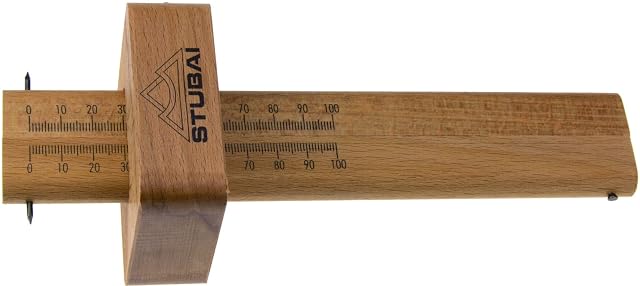
STUBAI 345501 double marking gauge, 150 and 220 mm

Two beams means two settings held at once — a mortice and its tenon, marked without touching the adjustment.

Stubai beech double marking gauge, product photograph

STUBAI 345501 double marking gauge, 150 and 220 mm

Two beams means two settings held at once — a mortice and its tenon, marked without touching the adjustment.

Beam lengths
150 mm (5.91 in) and 220 mm (8.66 in)
Scale
Millimeter, on the beam
Body
Beech
Pins
Hardened
Origin
Made in Austria
Part number
345501
Amazon reference
B00BRTS4WY (identical on 6 markets)
EAN
9002793307572
  • Two beams, so two dimensions stay set through a whole batch of joints
  • A millimeter scale on the beam, which most traditional gauges omit
  • A pin tears across the grain where a knife or a wheel would sever cleanly

Best for: Marking mortices and tenons, and any joint where the same two dimensions repeat

≈ $46
Check price on Amazon
Specifications

Beam lengths
150 mm (5.91 in) and 220 mm (8.66 in)
Scale
Millimeter, on the beam
Body
Beech
Pins
Hardened
Origin
Made in Austria
Part number
345501
Amazon reference
B00BRTS4WY (identical on 6 markets)
EAN
9002793307572

Every figure below is a manufacturer specification read off the listing itself. The judgments are ours.

What the specification says

A double marking gauge in beech with hardened pins, beams of 150 mm (5.91 in) and 220 mm (8.66 in), and a millimeter scale on the beam. Made in Austria. Part number 345501.

What the scale changes

Traditional gauges are set against the work, not against a number: you slide the stock until the pin sits on a line and lock it. A printed scale adds the ability to set a dimension you know in advance, and — more usefully — to return to it after the gauge has been moved. It does not replace setting against the work; it makes the setting recoverable.

Look after the fence

The stock is the face that registers against the timber, and it is beech. A dent in it, from being dropped or from being clamped, tilts every line the gauge draws afterwards. Keep it off the concrete and keep it out of the vice.

What comes up most often

Why two beams?

Because a mortice and tenon needs two parallel lines at fixed distances from the same face, and a single gauge has to be reset between them. A double gauge holds both settings at once: mark all the mortices with one beam, all the tenons with the other, and neither dimension is ever re-measured. On a batch of frames that removes the commonest source of error.

Pin, knife or wheel?

A pin drags and tends to follow the grain, particularly along a soft earlywood line, and it tears rather than cuts when marking across the fibers. A knife or a cutting wheel severs. The pin gauge remains standard for marking with the grain, where the fault does not arise, and that is most of what a mortice gauge does.

All measuring & marking

Prices quoted in these summaries are dated readings. The live price is shown next to each product.