M42 bi-metal · sawmill
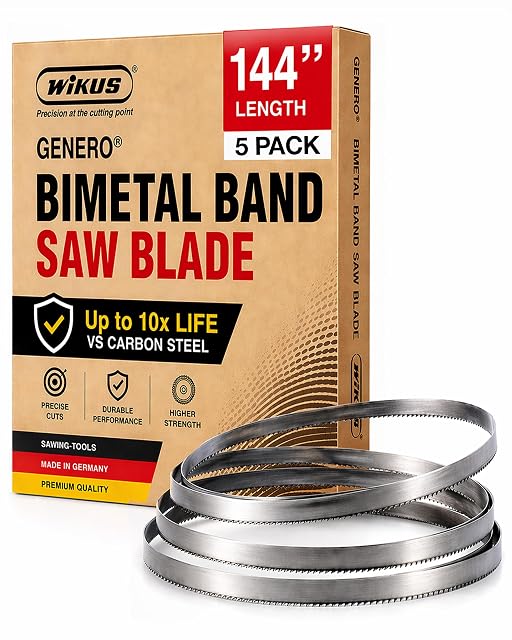
WIKUS 34281-0024, 144 in × 1-1/4 in, M42, 5 pack
The only band here that publishes a hook angle, and the only one meant to be resharpened rather than replaced.
Specifications
- Length
- 144 in, published — 3,658 mm (144 in)
- Width
- 1-1/4 in, published — 31.75 mm (1.25 in), the widest band on this shelf
- Thickness
- Not published by the maker.
- Pitch
- 1.15 TPI, published — the coarsest pitch on this shelf by a factor of three
- Tooth form
- A 10 degree hook angle, published — the only hook angle on this shelf · No set is named
- Steel
- M42 bi-metal, stated made in Germany, stated to last ten times longer than carbon steel
- Resharpening
- Stated resharpenable multiple times with a CBN grinding wheel — the only resharpenable band on this shelf
- Quantity
- 5 blades
- Intended machine
- Stationary and portable sawmills, stated · No mill model is named
- Part number
- 34281-0024
- Amazon reference
- B0DTQ7VCYC
- EAN
- 0990312391814
Every figure below names its source. Each one is a manufacturer
specification read off the listing itself. The judgments are ours.
Ten degrees of hook
The only hook angle published on either half of this shelf.
Hook angle is the lean of the tooth face: zero scrapes, ten degrees pulls the
tooth into the wood and takes a bigger bite per pass.
On a mill cutting green softwood that is what keeps the feed rate up. On hard
dry timber too much hook grabs, and the band dives out of the cut.
Ten is the usual general-purpose mill figure. The published carbide mill band on
this shelf has its absence recorded as a fault: no thickness and no tooth pitch
published.
One point one five teeth to the inch
A tooth every 22 millimeters, written upside down for the job.
A mill cut is a meter of travel through 300 mm (11.8 in) of log, and the gullet has to
carry all of that sawdust out of it. A fine pitch packs in the first few inches,
heats the band, and burns the cut.
So mill bands go to one tooth an inch or less. The figure only looks strange
because the unit does.
M42, and sharpened rather than replaced
A hardened tooth tip welded to a flexible back, which is what survives the nail
that ends a carbon band.
And the tip is deep enough to grind several times — the maker names a CBN wheel
for it. Five bands sharpened five times each is a different purchase from five
bands.
What the listing does not mention is the second tool. Grinding a band also
removes the tooth set, so a setter has to come with the grinder.
And no thickness
On a band of three and a half meters.
Thickness is what decides whether a mill can tension it at all, and whether the
weld survives the number of revolutions a long band makes.
Every argument on this page is about the tooth — the angle, the pitch, the
metal, the grinding. The band behind the tooth is unspecified.
Length first, everything else second
A band saw blade is a closed loop, and the loop has one length.
Too short and it will not reach round both wheels. Too long and the tension
spring runs out of travel before the band is tight. There is no adjustment and
no adapter: the number stamped on the saw is the number to buy.
Every listing on this shelf says so in its own words, and three of them say it
twice. It is the only compatibility question that cannot be worked around.
Availability
Read on the day this page was built: $222 at the American Amazon shop.
Read from Keepa on the day this page was last revised; stock and price both move without notice.
Prices quoted in this text were read on 2026-10-07. The live price is at the top of the page.