Skip to content

The best track saw for breaking down sheet goods

A track saw is how you break down a full sheet alone, without a panel saw. The saw is a ten-year decision only in the sense that the rail system is.

Compare systems, not saws

Over ten years you will buy rails, connectors, clamps and guides, and their cost dwarfs the difference between two machines. Makita’s rail is shared across a wide range of its other tools; Festool’s accessory range is the deepest; Triton’s is the smallest and the cheapest to enter.

The splinter strip

The rubber edge on the rail supports the fibers right at the cut line. It is a consumable, and it must be trimmed by the saw that will use it before the first real cut. A strip cut by another saw sits in the wrong place.

Which saw fits your shop?

You work alone with full sheets
This is the format designed for it: the saw goes to the sheet rather than the sheet to the saw.
You need repeatable narrow rips
A table saw does that faster, and the track saw becomes the tool for the first cuts.
You have no space for a table saw
A track saw and a sheet of insulation on the floor covers a surprising amount of work.
You want a splinter-free finish
The splinter guard on the track is what gives it, and it only works while the track edge is still true.

Picking by the cut you need

Breaking down sheets

The main use, and the one where a track saw genuinely changes what is possible alone in a small space.

Straightening rough edges

A track laid on a wavy board gives a true edge without a jointer. That is a real capability, not a workaround.

Long rips in solid timber

Slower than a table saw and perfectly accurate. The dust extraction is also better than on most site saws.

Plunge cuts

Cutting into a fitted worktop or a floor. It is what the plunge mechanism exists for and no other saw does it as cleanly.

What matters once the blade is turning

Track length and joining
A track that does not reach the length of a sheet forces a joint, and a badly joined track leaves a step in the cut. Whether the joiners hold matters.
The splinter guard
It is trimmed by the blade on first use and then defines the cut line exactly. Once worn or cut on a bevel, it no longer tells the truth.
Riving knife and plunge lock
The safety features specific to the format. A saw that can plunge unexpectedly is a saw that will.
Dust extraction quality
Track saws capture dust better than most saws because the blade is enclosed. That is a genuine reason to use one indoors.
Bevel capability
Bevelling moves the cut line away from the splinter guard edge. How the saw handles that determines whether bevels are usable or guesswork.

Which figure for which cut

The jobTrack sawThe alternative
Full sheets aloneIdealTwo people and a table saw
Repeat narrow ripsSlowTable saw
Straightening an edgeVery goodA jointer
Plunge into a fitted topThe only clean wayNone

Where it goes wrong in the shop

Not supporting the offcut
A sheet cut on two trestles closes on the blade as it separates. Full support underneath, on foam or a sacrificial sheet, is the method.
Bevelling and expecting the guard to be right
The splinter guard is trimmed at ninety degrees. On a bevel the cut line moves, and reading the guard edge gives the wrong position.
Letting the track slip
Grip strips wear and dust makes them slide. Clamping the track is quick and it prevents the cut wandering.
Using a blade meant for solid timber on laminate
Tooth count and grind decide chipping on faced boards far more than the saw does.

By the woodworker you are

The one-person workshop
A track saw and floor support: full sheets become manageable without a second pair of hands.
The fitter
Plunge cuts and clean edges on site, with dust captured. This is the format's home ground.
The furniture maker
Track saw for breakdown, table saw for dimensioning. The two complement rather than compete.

Blades, alignment and working life

A track saw depends on the track being straight and the splinter guard true. Both are consumable in effect: a dropped track and a chewed guard both put the cut line where you are not expecting it.

  • Store the track flat and unbent; a dropped track is no longer a straight edge.
  • Replace the splinter guard when it is torn or has been cut on a bevel.
  • Clean the grip strips so the track does not slide.
  • Keep the blade clean of pitch: a track saw burns easily in hardwood.

Safety

A plunging blade under a hood, used on unsupported material.

  • Support the workpiece fully underneath so the kerf cannot close.
  • Check the plunge lock engages before setting the saw down.
  • Never start a plunge with the saw not flat on the track.
  • Let the blade stop before lifting the saw off the cut.

Our picks, and the case for each

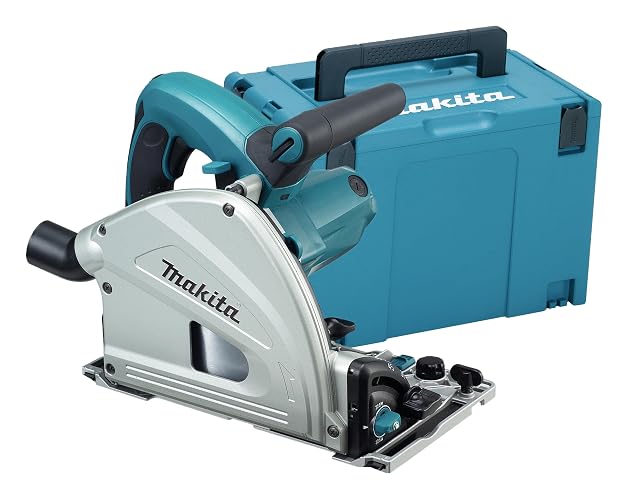
  1. Makita SP6000J

    165 mm (6.50 in) · Makpac case · six markets

    The professional plunge saw that is cheaper in France than in Germany, and the one whose rails are shared with the widest range of machines.

    Best for: Someone buying into a system rather than buying one saw

    7.7/10

    ≈ $570

  2. Triton TTS1400

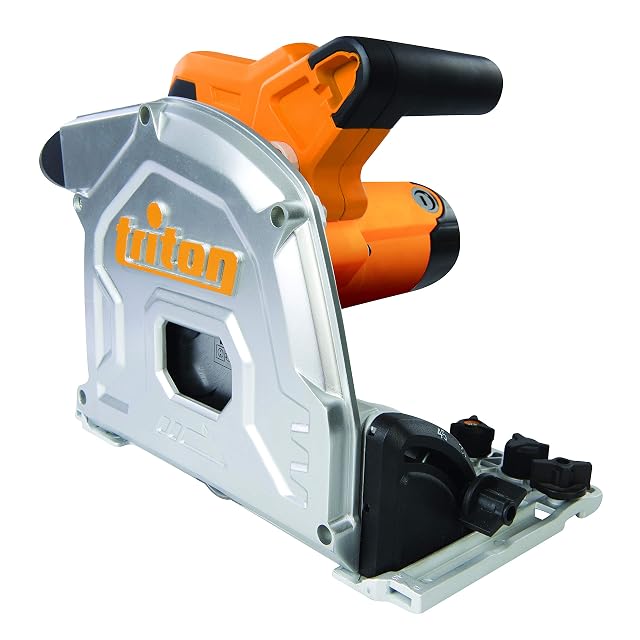
    1,400 W · plunge · six markets

    A 1,400 W plunge saw at €260 in Germany that resolves on all six Amazon stores — the cheapest system here you can buy anywhere.

    Best for: A first track saw where the rail ecosystem matters less than the price

    7.5/10

What comes up most often

Do I need a track saw if I have a table saw?

For full sheets, yes. Manhandling 2,440 × 1,220 mm (96.1 × 48 in) of MDF across a table saw alone is awkward and unsafe; a track saw brings the machine to the sheet instead.

Are rails interchangeable?

Not reliably. The rib profile differs by brand, and a saw on a rail it was not cut for chips the good face.

Can a track saw replace a table saw?

For breaking down sheets and straightening edges, largely. For repeated narrow rips and jig-based joinery, no: the table saw is faster and more repeatable.

How long a track do I need?

Enough to cross the longest sheet you cut, ideally without joining. Joined tracks work, but only if the joiners are set carefully.

Why is my cut chipping?

Usually the wrong blade for the material, or a splinter guard that is torn or was trimmed at a different angle. Both are cheap to fix.

Do I need to clamp the track?

Not always, but it is quick and it removes the risk of the track sliding, especially on dusty or laminated surfaces.

Can I bevel with it?

Yes, but the cut line moves away from the splinter guard edge on a bevel, so the guard can no longer be used as the reference.

What do I put underneath?

A full sheet of rigid insulation or a sacrificial sheet on trestles. Full support is what stops the kerf closing on the blade.

Each saw, and the cut it was bought for

Makita SP6000J · $570

For cutting: Someone buying into a system rather than buying one saw

Where it shines: One reference and one EAN across all six markets

Where it disappoints: The listing publishes neither motor rating nor cut depth

Read the full review →

Triton TTS1400

For cutting: A first track saw where the rail ecosystem matters less than the price

Where it shines: One reference and one EAN across all six markets

Where it disappoints: The listing publishes the motor rating and nothing else

Read the full review →

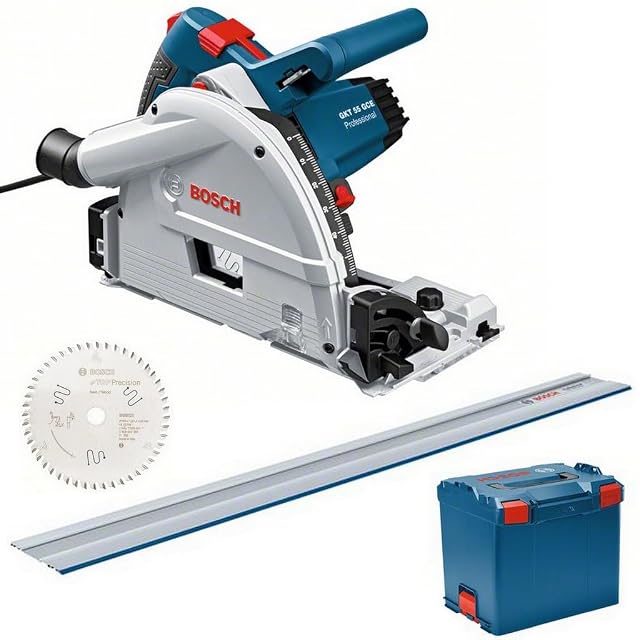
Bosch Professional GKT 55 GCE

For cutting: A buyer who wants a complete professional system in one purchase

Where it shines: Rail and case in the box — the comparison most listings avoid

Where it disappoints: The listing title is confused — it names a reciprocating saw that is not in this set

Read the full review →

What else the cut needs

Blades, inserts and spares from the same aisle, at the price we recorded. Check they fit the saw you pick before ordering: it depends on the bore and the part number, which the listing states.

The quick cut

Pairings that settle the choice

Saw against saw, where the comparison already exists in this guide or this aisle.

How this selection was built

The saws above are drawn from the catalog of this site. Specifications are the published ones, from the maker and from the Amazon product page; prices are the Keepa figure for the date below, and both shift. Ranking uses declared specifications, the balance of stated strengths and stated limits, and price. No machine here has cut wood for us, and the page claims nothing else.

Last checked on

Prices quoted in these summaries are dated readings. The live price is shown next to each product.

The tool we use ourselves

Chosen your machine? Now buy it at the right price.

Table saws and planers swing by a hundred dollars or more across the year, and the biggest "discounts" often land at prices the same model sold for six weeks earlier. UniverTrack tracks the real price history across retailers, spots fake reductions, and alerts you when it is genuinely the moment to buy.

Real price historyBuy-now alertsAI buying assistant
Try free for 14 days →
No commitment · Cancel in one click · 5 languages