Y-piece · 4 in all legs
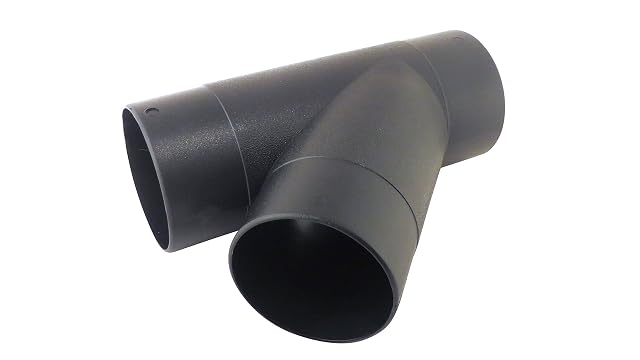
Taytools 73453 three-way Y, 4 in
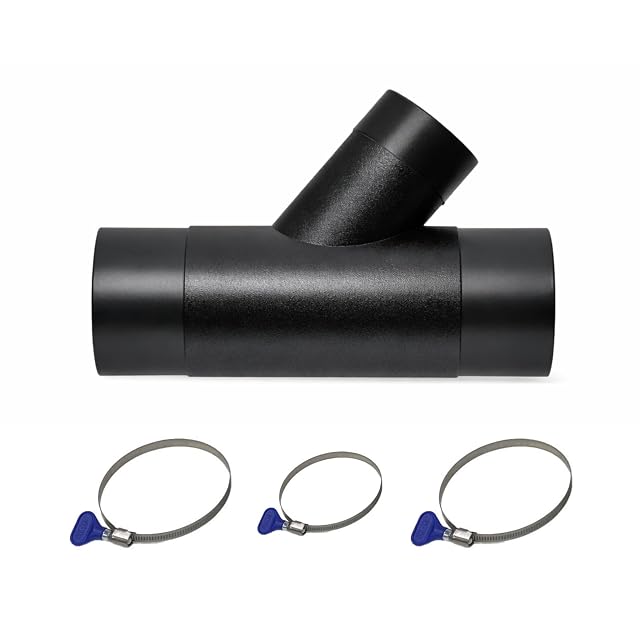
A true Y rather than a reducing one — three four-inch legs — and the only fitting here that publishes its wall thickness.
Every figure below names its source. Each one is a manufacturer
specification read off the listing itself. The judgments are ours.
Three legs, all four inches
Which makes this a Y and not a reducer.
The published 100 mm (3.94 in) Y-piece on this shelf has a 63 mm (2.48 in) side branch, and its page
says what that costs: a 100 mm (3.94 in) machine port cannot go on it.
That fitting splits a main duct to a machine and a hand tool. This one splits a
main duct to two machines.
Both are useful, neither substitutes for the other, and the difference cannot be
seen in a photograph — which is why the three published diameters here matter
more than they look.
An eighth of an inch of ABS
The only wall thickness published on either half of this shelf.
A fitting is a pressure part. A collector pulls a partial vacuum, and a thin
molding flexes inward at the throat — narrowing the bore under load and, on the
cheap ones, cracking at the seam.
Three point two millimeters does not. It is also the figure that distinguishes a
duct fitting from a packaging molding of the same shape.
Ten inches by eight
Published, which no other fitting on this shelf manages.
It sounds trivial until a Y has to go behind a machine against a wall. Two
hundred and fifty-four millimeters of length and two hundred and three of width
is a real object, and a duct run that is planned on paper needs the figure.
Why nominal is not a measurement
A four-inch fitting is not four inches anywhere on it.
The POWERTEC listings on this shelf publish the actual figures: a four-inch
nominal end measures 3-31/32 in across the outside and 3-39/64 in across the
inside — 100.8 mm (3.97 in) and 91.7 mm (3.61 in). The difference between those two is the wall, and
the difference between one maker’s outside and another’s inside is the leak.
That is what the shelf’s own intro means by the adaptors that never quite fit.
Nominal sizing is a naming convention; the join is decided by the sixty-fourths.
And it needs gates
Not in this box.
A branch with both legs open draws from both, so the idle machine becomes an
open inlet and the working one loses most of its air.
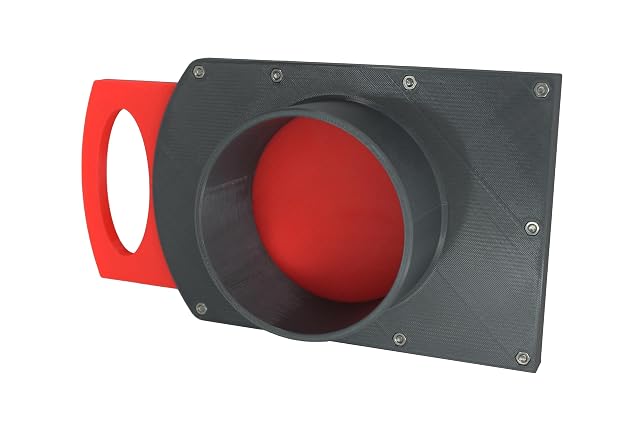
The published 100 mm (3.94 in) blast gate page on this shelf puts it in one line: without
gates, a branched system has no suction anywhere.
The Fulton six-pack here is the quantity a branched run actually needs. This is
the part that makes them necessary.
Availability
Read on the day this page was built: $20 at the American Amazon shop.
Read from Keepa on the day this page was last revised; stock and price both move without notice.
Prices quoted in this text were read on 2026-10-07. The live price is at the top of the page.