Skip to content

ROCKLER Dust Right stacking port adapter set, 3 piece

Five connections from three parts, color-coded, in glass-reinforced polypropylene — and they nest when they are not in use.

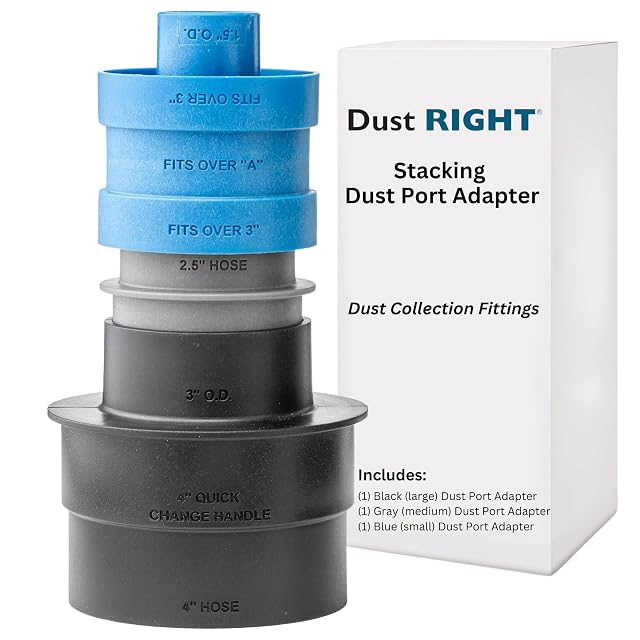
Rockler Dust Right stacking dust port adapters in three colors, product photograph

ROCKLER Dust Right stacking port adapter set, 3 piece

Five connections from three parts, color-coded, in glass-reinforced polypropylene — and they nest when they are not in use.

Range
Hoses up to 4 in connected to tool parts as small as 1-1/4 in — 102 mm down to 32 mm (1.26 in), with sizes between
Combinations
Three interchangeable adapters stated to combine in 5 different ways · Stated to reduce a 4 in hose or handle to 3 in, and to work singly or in pairs
Identification
Color coded: black large, grey medium, blue small — the only color-coded fitting on this shelf
Material
Glass-reinforced polypropylene · Stated free of sticky residue
Storage
The three stack inside one another when not in use
Quantity
3 adapters
Part number
Not published by the maker.
Amazon reference
B0BK9W5BZD
EAN
0733175612470
  • Five combinations from three parts, with the count published
  • Color coded, so the right one is found by eye in a drawer
  • Not one actual diameter is published — only nominal sizes

Best for: A shop vacuum that has to meet a sander, a router and a track saw in the same afternoon

≈ $21
Check price on Amazon

Specifications

Range
Hoses up to 4 in connected to tool parts as small as 1-1/4 in — 102 mm down to 32 mm (1.26 in), with sizes between
Combinations
Three interchangeable adapters stated to combine in 5 different ways · Stated to reduce a 4 in hose or handle to 3 in, and to work singly or in pairs
Identification
Color coded: black large, grey medium, blue small — the only color-coded fitting on this shelf
Material
Glass-reinforced polypropylene · Stated free of sticky residue
Storage
The three stack inside one another when not in use
Quantity
3 adapters
Part number
Not published by the maker.
Amazon reference
B0BK9W5BZD
EAN
0733175612470

Every figure below names its source. Each one is a manufacturer specification read off the listing itself. The judgments are ours.

Three parts, five steps

Each adapter is a step with a male end and a female end, so they chain: the output of one feeds the input of the next.

Three used singly and in pairs reach five reductions, from four inches down to an inch and a quarter.

The listing publishes the count. It does not publish the five sizes, which is the gap — a buyer knows there are five and not which five.

The POWERTEC fittings on this shelf publish actual diameters and no combinations. This publishes combinations and no diameters.

Black, grey, blue

Large, medium, small — and the only color coding on either half of this shelf.

A workshop accumulates adapters. They are all black, all round, all nearly the same size, and the right one is found by trying three.

Color is the cheapest possible fix, and the fact that they nest means the set stays together, which is the other half of the same problem.

Glass-filled polypropylene

The right plastic for a part that lives in a drawer.

Polypropylene flexes rather than snapping, and glass fiber adds the stiffness plain PP lacks — so the part survives a concrete floor and a hose twisted off cold.

ABS, which four fittings on this shelf are made of, is stiffer and more abrasion resistant inside a duct, and it cracks.

For a drawer part, this. For a part cemented into a wall run, that.

Why nominal is not a measurement

A four-inch fitting is not four inches anywhere on it.

The POWERTEC listings on this shelf publish the actual figures: a four-inch nominal end measures 3-31/32 in across the outside and 3-39/64 in across the inside — 100.8 mm (3.97 in) and 91.7 mm (3.61 in). The difference between those two is the wall, and the difference between one maker’s outside and another’s inside is the leak.

That is what the shelf’s own intro means by the adaptors that never quite fit. Nominal sizing is a naming convention; the join is decided by the sixty-fourths.

And no diameters at all

Four inches, three inches, an inch and a quarter — nominal, every one.

Which on the shelf whose intro names the adaptors that never quite fit is the one thing a fitting page should not leave out.

Availability

Read on the day this page was built: $21 at the American Amazon shop.

Read from Keepa on the day this page was last revised; stock and price both move without notice.

Prices quoted in this text were read on 2026-10-07. The live price is at the top of the page.
What comes up most often

Five combinations from three parts — how?

Each adapter is a step with a male end and a female end, so they chain. Used singly, each gives one reduction; used in pairs, the output of one feeds the input of the next, which is how three parts reach five steps between four inches and one and a quarter. The listing publishes the count and not the five sizes, which is the gap: a buyer knows there are five and not which five. The POWERTEC fittings on this shelf publish actual diameters and no combinations; this publishes combinations and no diameters.

Why is glass-reinforced polypropylene the better plastic here?

Because adapters get dropped and levered. Polypropylene is tough and flexes rather than snapping, and glass fiber in it adds the stiffness that plain PP lacks — so the part takes a knock on a concrete floor and a hose being twisted off in the cold. ABS, which four fittings on this shelf are made of, is stiffer and more abrasion resistant in a duct, and it cracks. For a part that lives in a drawer and is handled daily, this is the right choice; for a part cemented into a wall run, ABS is.

What does color coding actually save?

Time, in the drawer. A workshop accumulates adapters, and they are all black, all round and all nearly the same size — so the right one is found by trying three. Black, grey and blue for large, medium and small is the cheapest possible fix, and it is the only one on either half of this shelf. The fact that they also stack inside one another means the set stays together, which is the other half of the same problem.

All extraction fittings