Straight bits · six diameters
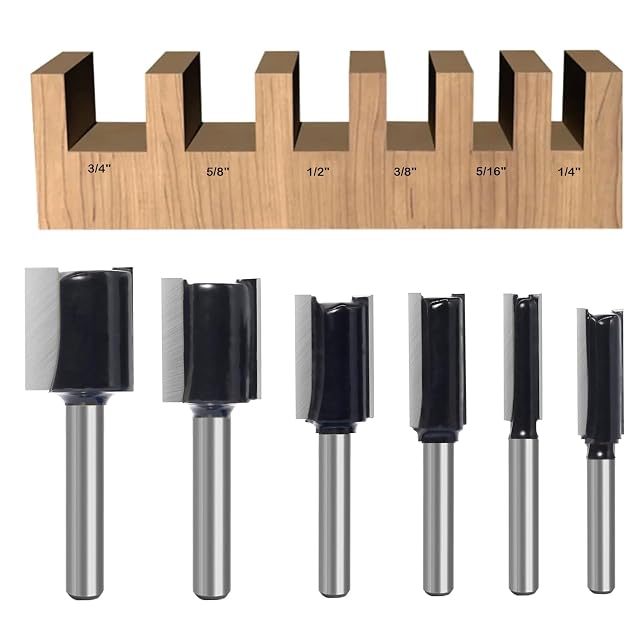
SICWOOD SWST040601US, six straight bits, 1/4 in shank
Six diameters, two flutes and a published cutting height — the only cut depth on the American half of this shelf.
Specifications
- Shank
- 1/4 in — 6.35 mm
- Cutting diameters
- Six, published: 3/4, 5/8, 1/2, 3/8, 5/16 and 1/4 in — 19, 15.9, 12.7, 9.5, 7.9 and 6.35 mm (0.25 in)
- Cutting height
- 13/16 in — 20.6 mm, published, the only cutting height on the American half of this shelf
- Flutes
- Two, stated to give a smooth planed finish at a medium feed rate
- Carbide grade
- C3 micrograin tungsten carbide, stated for a sharper and longer lasting edge
- Materials
- Chipboard, MDF, plywood and hardwood, stated abrasive
- Machines
- CNC, table-mounted and handheld routers
- Quantity
- 6 bits
- Part number
- SWST040601US
- Amazon reference
- B0CR5QDWS6
- EAN
- 0797430381440
Every figure below names its source. Each one is a manufacturer
specification read off the listing itself. The judgments are ours.
Six diameters, published
Three quarters, five eighths, a half, three eighths, five sixteenths, a quarter.
A straight bit set is bought for the diameters, and this is the only listing on
either half of this shelf that prints all of them.
Which matters because a groove is cut to fit something: 12.7 mm (0.50 in) for a 1/2 inch
ply back, 19 mm (0.75 in) for a shelf. A set whose contents are a photograph cannot be
chosen that way.
Thirteen sixteenths of cut
Twenty point six millimeters, published — the only cutting height on the American
half of this shelf.
It sets how deep a groove can be. Twenty millimeters in one pass, or sensibly two
of ten. A shelf trench in 25 mm stock cannot reach full depth at all.
The published Bosch flush trim bit here names the same limit in its cons: 20 mm (0.79 in)
working length limits the thickness you can trim in one pass.
Shank before everything
A router bit is held by its shank, and the collet that holds it has one size.
A quarter of an inch is 6.35 mm (0.25 in). Eight millimeters is eight. A 1/4 in bit drops
loose in an 8 mm (0.31 in) collet and an 8 mm (0.31 in) bit will not enter a 1/4 in one — and a
collet is a precision clamp, not a hole: there is no ring, no bush and no adapter
that makes either fit the other safely.
Which is why the two halves of this shelf cannot be mixed. Every American listing
here is 1/4 in; every European one is 8 mm (0.31 in). The published Spetool page on this
shelf states the rule in one line, and it is the most useful sentence on the
shelf.
C3 micrograin
A grade and a grain size, both published.
C3 is the American classification for a harder, more wear-resistant carbide, used
on wood and abrasive composites. C2 — which the Totowood set on this shelf
publishes — is softer and tougher, for where chipping is the risk.
Micrograin means small carbide particles: a keener edge that holds longer and
chips more readily.
Four of the seven American listings here name a grade. None of the seven
European ones does.
Two flutes
Each flute takes a bite per revolution, so two at a given feed take bigger bites
than three — rougher, faster, and less likely to burn because the gullet clears.
Three give a finer finish and want a slower feed.
The published 6 mm (0.24 in) straight bit on the European half of this shelf publishes
three edges and is credited for it. This publishes two and says what they are
for.
Availability
Read on the day this page was built: $17 at the American Amazon shop.
Read from Keepa on the day this page was last revised; stock and price both move without notice.
Prices quoted in this text were read on 2026-10-07. The live price is at the top of the page.