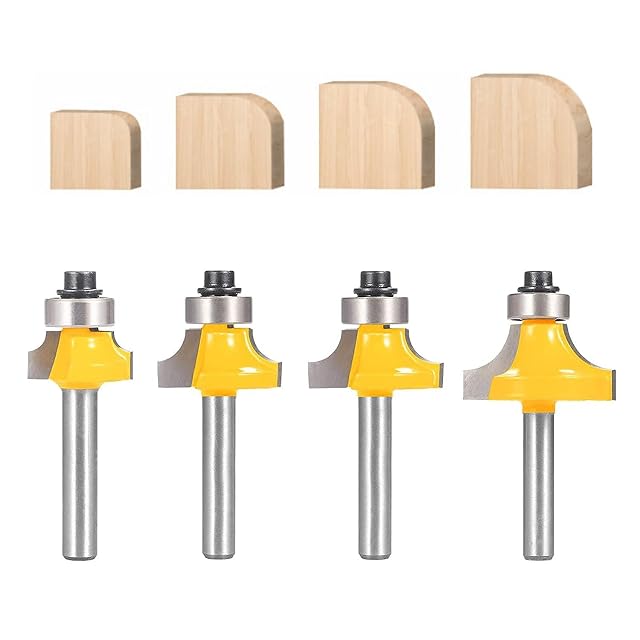
Roundover · four radii
Totowood yjd-4, four roundover bits, 1/4 in shank
Four radii with bearings, on a page that claims carbon steel, tungsten steel alloy and C2 carbide for the same cutters.
Every figure below names its source. Each one is a manufacturer
specification read off the listing itself. The judgments are ours.
Three materials, one cutter
The second bullet: high-quality carbon steel, high-quality tungsten steel alloy.
The fourth bullet: premium C2 carbide inserts.
Those are three different things. A plain steel cutter, an alloy body, and a
brazed carbide tip — and only the last is what a modern router bit cuts with.
The likeliest reading is a steel body with C2 carbide tips, which is how every
bit on this shelf is made. All three claims are above, and this page chooses
none.
Four radii, published twice
An eighth, three sixteenths, a quarter, five sixteenths — in the title and again
in the first bullet.
Three point two to seven point nine millimeters. For furniture the useful range
is roughly three to ten, so this set covers the four most used and misses the
largest a table edge usually wants.
The published roundover set on the European half of this shelf has seven, R2 to
R10, on an 8 mm (0.31 in) shank.
Shank before everything
A router bit is held by its shank, and the collet that holds it has one size.
A quarter of an inch is 6.35 mm (0.25 in). Eight millimeters is eight. A 1/4 in bit drops
loose in an 8 mm (0.31 in) collet and an 8 mm (0.31 in) bit will not enter a 1/4 in one — and a
collet is a precision clamp, not a hole: there is no ring, no bush and no adapter
that makes either fit the other safely.
Which is why the two halves of this shelf cannot be mixed. Every American listing
here is 1/4 in; every European one is 8 mm (0.31 in). The published Spetool page on this
shelf states the rule in one line, and it is the most useful sentence on the
shelf.
A bearing on each
Which makes the bit follow the edge instead of a fence.
The bearing rides on the uncut face below the cutter, so the depth is fixed by
the bearing diameter — and the bit follows a curve, which a fence cannot.
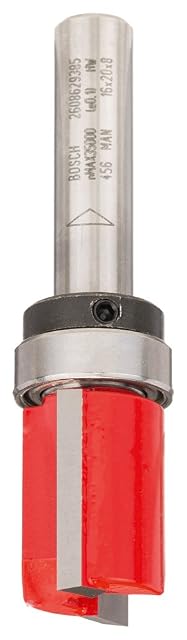
The published Bosch flush trim bit on this shelf is sold entirely on that
principle, and its page names the limit that applies here too: a bearing is a
wear part and it is not always replaceable.
C2, not C3
The softer, tougher grade.
C2 resists chipping and wears faster. C3 — which the SICWOOD straight bits on
this shelf publish — holds a keener edge for longer and chips more readily.
On a roundover bit running along an edge with a bearing taking the side load,
toughness is arguably the better trade. The listing does not make that argument;
it simply names the grade, which four of seven listings here do.
Availability
Read on the day this page was built: $11 at the American Amazon shop.
Read from Keepa on the day this page was last revised; stock and price both move without notice.
Prices quoted in this text were read on 2026-10-07. The live price is at the top of the page.