Skip to content

POWERTEC 70150 rectangular dust hood

The part that turns a hose into a mouth — with a published mouth size and four holes already in it.

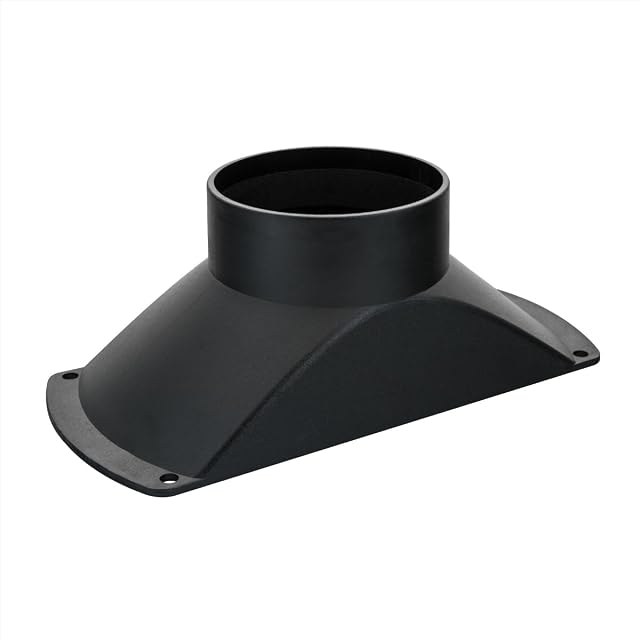
POWERTEC 70150 rectangular dust hood in black ABS, product photograph

POWERTEC 70150 rectangular dust hood

The part that turns a hose into a mouth — with a published mouth size and four holes already in it.

Mouth size
4-1/4 × 7 in, published — 108 × 178 mm (4.25 × 7.01 in)
Spigot
4 in nominal, measuring 3-31/32 in outer and 3-39/64 in inner — 100.8 and 91.7 mm (3.61 in) · For use with 4 in ID hose or an adapter
Mounting
Four pre-drilled holes, stated for quick mounting — the only pre-drilled fitting on this shelf
Material
Non-threaded all-black ABS
Stated use
Collecting dust from an assortment of systems, or placed on a nearby surface close to where dust is produced
Quantity
1 hood
Part number
70150
Amazon reference
B00M3JFNOO
EAN
0736815006011
  • Publishes the mouth size, which is the dimension a hood is chosen on
  • Four holes already drilled, so it screws to a machine or a fence without marking out
  • No depth published, so how far it stands off the work is unknown

Best for: Screwing behind a router table fence, a lathe bed or a disc sander, where a round hose will not sit

≈ $11
Check price on Amazon

Specifications

Mouth size
4-1/4 × 7 in, published — 108 × 178 mm (4.25 × 7.01 in)
Spigot
4 in nominal, measuring 3-31/32 in outer and 3-39/64 in inner — 100.8 and 91.7 mm (3.61 in) · For use with 4 in ID hose or an adapter
Mounting
Four pre-drilled holes, stated for quick mounting — the only pre-drilled fitting on this shelf
Material
Non-threaded all-black ABS
Stated use
Collecting dust from an assortment of systems, or placed on a nearby surface close to where dust is produced
Quantity
1 hood
Part number
70150
Amazon reference
B00M3JFNOO
EAN
0736815006011

Every figure below names its source. Each one is a manufacturer specification read off the listing itself. The judgments are ours.

Four and a quarter by seven

A hundred and eight by a hundred and seventy-eight millimeters of mouth, published.

That is a little more than twice the area of a bare four-inch hose, which is the whole argument for a hood: a round hundred-millimeter mouth pointed at a two-hundred-millimeter spray of chips catches what happens to come at it.

A rectangle spans the work. Behind a router fence, along a sanding table, under a lathe.

And the transition is where it loses

A rectangle narrowing to a round spigot has a corner at each side, and air slows in a corner.

So a hood never performs quite as well as its mouth area suggests, and the published pages on this shelf about hose drag make the same point about every change of section.

It is still far better than pointing a hose at the problem.

Four holes, already there

The only mounting provision published on either half of this shelf.

A hood that is not fixed is a dustpan — the point is to put the mouth where the dust is made and leave it there, and that means screws.

Pre-drilled matters because ABS splits when a bit grabs. The listing also offers the alternative, which is honest about how the part is often used: set it on a surface near the work.

Why nominal is not a measurement

A four-inch fitting is not four inches anywhere on it.

The POWERTEC listings on this shelf publish the actual figures: a four-inch nominal end measures 3-31/32 in across the outside and 3-39/64 in across the inside — 100.8 mm (3.97 in) and 91.7 mm (3.61 in). The difference between those two is the wall, and the difference between one maker’s outside and another’s inside is the leak.

That is what the shelf’s own intro means by the adaptors that never quite fit. Nominal sizing is a naming convention; the join is decided by the sixty-fourths.

No depth

The mouth is published. The spigot is published to the sixty-fourth.

How far the hood stands off the work is not, and on a hood that is the third dimension: a shallow hood has to sit close, a deep one gathers from further back.

Availability

Read on the day this page was built: $11 at the American Amazon shop.

Read from Keepa on the day this page was last revised; stock and price both move without notice.

Prices quoted in this text were read on 2026-10-07. The live price is at the top of the page.
What comes up most often

What is a hood for, against a bare hose?

Shape. A bare four-inch hose has a round mouth about a hundred millimeters across, and a hundred millimeters of mouth pointed at a two-hundred-millimeter spray of chips catches what happens to come at it. A rectangular mouth spans the work: behind a router fence, along a disc sander table, under a lathe. The trade is in the transition — a rectangle narrowing to a round spigot has a corner at each side where the air slows and the dust drops, so a hood never performs quite like its mouth area suggests.

Why do the four holes matter?

Because a hood that is not fixed is a dustpan. The whole point is to put the mouth where the dust is made and leave it there, and that means screws into a fence, a bracket or a machine guard. Four pre-drilled holes mean no marking out and no drilling into ABS, which splits readily when a bit grabs. It is the only fitting on either half of this shelf that publishes a mounting provision at all, and the listing also offers the alternative — set it on a surface near the work.

Four and a quarter by seven — is that big enough?

For a fence or a bench station, yes. A hundred and eight by a hundred and seventy-eight millimeters is a little more than twice the area of a four-inch round hose mouth, so it spans a router cutter, a sanding disc or a chisel station without being so large that the air velocity collapses. What it will not do is capture a planer or a table saw, which throw chips across a meter — those need the machine's own shroud and a four-inch duct, which is what the rest of this shelf is for.

All extraction fittings