Every figure below names its source. Each one is a manufacturer
specification read off the listing itself. The judgments are ours.
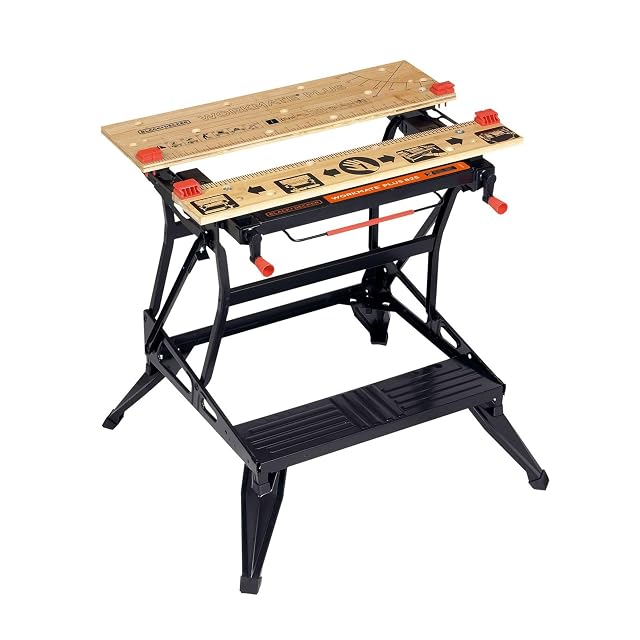
Eleven pounds
Five kilograms, published — the lightest bench on either half of this shelf.
Which rules out planing and anything that pushes sideways: the bench is lighter
than the board, so it goes where the push goes unless it is clamped to something
heavier.
The published Sjöbergs Smart Workstation page on this shelf is the same class at
10 kg (22 lb), and its cons say it in one line: at 10 kg (22 lb) it has no mass of its own — the
surface it sits on does the work.
What eleven pounds buys is that it comes to the work. A kitchen table, a balcony,
the back of a van.
Mass, rigidity, racking
A bench is judged on three things and only one of them is usually published.
Mass is what stops the bench moving when a plane is pushed along a board. Rigidity
is what stops the top flexing under a mallet. Racking is the sideways parallelogram
collapse that every four-legged frame wants to do, and it is resisted by stretchers
and by the top being bolted down rather than resting.
A load rating is not any of the three — it says what the bench will hold standing
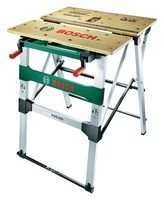
still. The published Bosch PWB 600 page on this shelf names the figure that
actually matters and its absence: no clamping capacity, which is a bench’s only
real specification.
Two scales and a protractor, printed on the top
The only printed scales on either half of this shelf.
Metric along one edge, imperial along the other, and a protractor — so a part is
measured without finding a tape, which on a bench used away from a workshop is
most of the problem.
What it does not give is accuracy. A printed scale on a working surface wears,
and the published Mr. Pen rules on the measuring shelf in this catalog publish
a thickness and a scale origin precisely because those decide whether a scale can
be trusted.
A convenience, then. Not an instrument.
Four bench dogs, and a top that clamps
Which is what separates this from a folding table.
Adjustable vise panels mean the top itself opens — the published Black & Decker
Workmate page on this shelf describes the same principle: the top itself is a
vice, the whole surface clamps.
Four dogs turn that into work holding rather than squeezing.
And no jaw opening
The published Bosch PWB 600 page on this shelf names it as the figure a bench
page must carry: no clamping capacity, which is a bench’s only real
specification.
The published Sjöbergs Smart Workstation publishes 110 millimeters and is
credited for it — a working capacity rather than a token one.
This page says fully adjustable.
On a bench whose entire function is that the top is a vice, that is the one
number missing.
Availability
Read on the day this page was built: $40 at the American Amazon shop.
Read from Keepa on the day this page was last revised; stock and price both move without notice.
Prices quoted in this text were read on 2026-10-07. The live price is at the top of the page.