Every figure below names its source. Each one is a manufacturer
specification read off the listing itself. The judgments are ours.
Three outlets, at thirteen amps
The only power on either half of this shelf, and the rating is the useful half of
it.
Three sockets at the back of a bench means a drill, a light and a charger plugged
in without an extension reel — and a reel on a workshop floor is a trip hazard and
the thing that eventually gets cut by whatever is being cut.
Thirteen amps per outlet says a router or a circular saw can be run from it. An
unspecified outlet might be rated for a lamp.
And an overhead light
Fluorescent, built in.
It is a consumable with a ballast behind it, which is the modern objection — but a
bench with its own light is a bench that does not need the ceiling fitting to be
in the right place.
An enamelled steel top
Which is honest about who this bench is for, and the listing says so: woodworkers,
mechanics, or anyone else in need of reliable organization.
Enamel on steel is hard, non-marring and wipes clean. It suits assembly,
finishing and mechanical work.
What it will not do is take a hand plane. There is nothing to clamp to, no dog
holes, and a steel top under a chisel that slips is a ruined chisel.
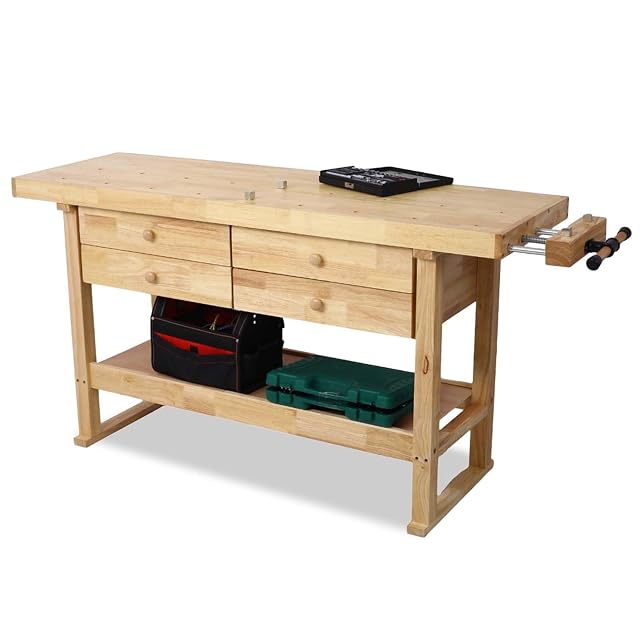
The published Sjöbergs bench on this shelf is the opposite end, and its page says
it plainly: a real bench — mass, a flat top and integrated vices.
Mass, rigidity, racking
A bench is judged on three things and only one of them is usually published.
Mass is what stops the bench moving when a plane is pushed along a board. Rigidity
is what stops the top flexing under a mallet. Racking is the sideways parallelogram
collapse that every four-legged frame wants to do, and it is resisted by stretchers
and by the top being bolted down rather than resting.
A load rating is not any of the three — it says what the bench will hold standing
still. The published Bosch PWB 600 page on this shelf names the figure that
actually matters and its absence: no clamping capacity, which is a bench’s only
real specification.
Two hundred and twenty pounds
The lowest capacity on this shelf. The Olympia publishes 250 on its top, the
HRVEOCEI 330, the WORX 300, the Pony 500.
A hundred kilograms on a 48 inch top is a gearbox or a stack of sheet goods,
which is most of what a bench carries.
What a low rating signals is a lighter frame — and a lighter frame is the racking
problem the shelf’s own intro names.
Sixty-two inches of height with a pegboard above it also puts the mass high up.
Availability
Read on the day this page was built: $151 at the American Amazon shop.
Read from Keepa on the day this page was last revised; stock and price both move without notice.
Prices quoted in this text were read on 2026-10-07. The live price is at the top of the page.
What comes up most often
Why do outlets on a bench matter?
Because the alternative is a lead across the floor. Three outlets at the back of a bench means a drill, a light and a charger are all plugged in without an extension reel, and an extension reel on a workshop floor is both a trip hazard and the thing that gets cut by whatever is being cut. Publishing thirteen amps per outlet is the useful part: it says a router or a circular saw can be run from it, where an unspecified outlet might be rated for a lamp. Nothing else on either half of this shelf has one.
Is an enamelled steel top a woodworking surface?
Not really, and the listing is honest about who it is for: woodworkers, mechanics, or anyone else in need of reliable organization. Enamel on steel is hard, non-marring and wipes clean, which suits assembly, finishing and mechanical work. What it will not do is take a hand plane — there is nothing to clamp to, no dog holes, and a steel top under a chisel that slips is a ruined chisel. The published Sjöbergs bench on this shelf is the other end of that spectrum, and its page says so: a real bench, mass, a flat top and integrated vices.
Two hundred and twenty pounds — is that enough?
For assembly, yes. For a bench, it is the lowest figure on this shelf — the Olympia publishes 250 on its top, the WORX 300, the Pony 500, the HRVEOCEI 330. A hundred kilograms on a 48 inch top is a gearbox or a stack of sheet goods, which is most of what gets put on a bench. What a low rating signals is a lighter frame, and a lighter frame is the racking problem the shelf's intro names. Sixty-two inches of height with a pegboard on top also means the mass is high up.