Skip to content

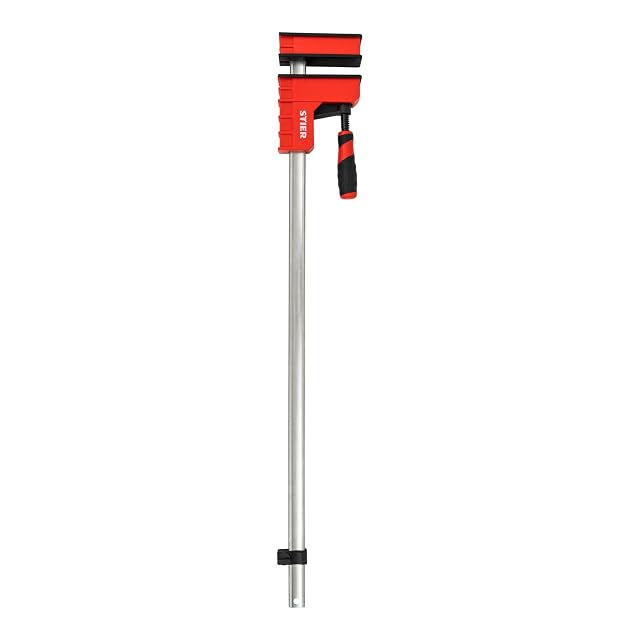
STIER 904870 body clamp, 800 mm

Sold singly, which is honest: the throat depth and not the capacity is what decides whether it can reach your joint.

Stier cast iron body clamp with parallel jaws, product photograph

STIER 904870 body clamp, 800 mm

Sold singly, which is honest: the throat depth and not the capacity is what decides whether it can reach your joint.

Capacity
800 mm (31.5 in)
Clamping force
6,000 N
Throat
95 mm (3.74 in)
Arms
Ductile cast iron with a steel frame
Jaws
Large parallel jaws with replaceable caps
Function
Sliding jaw reverses for spreading, without tools
Part number
904870
Amazon reference
B08KSS1VSG (identical on 5 markets)
EAN
4251709619673
  • 6,000 N through large parallel jaws, which keeps a carcase square as it closes
  • Replaceable caps, so the part that marks the timber is the part you replace
  • A 95 mm (3.74 in) throat is the real limit — it decides how far in from the edge you can clamp

Best for: Gluing up cabinet carcases where the joint is within 95 mm of the edge
Search Amazon for this model

Specifications

Capacity
800 mm (31.5 in)
Clamping force
6,000 N
Throat
95 mm (3.74 in)
Arms
Ductile cast iron with a steel frame
Jaws
Large parallel jaws with replaceable caps
Function
Sliding jaw reverses for spreading, without tools
Part number
904870
Amazon reference
B08KSS1VSG (identical on 5 markets)
EAN
4251709619673

Every figure below is a manufacturer specification read off the listing itself. The judgments are ours.

What the specification says

800 mm (31.5 in) capacity, 6,000 N of clamping force, a 95 mm (3.74 in) throat, arms in ductile cast iron over a steel frame, large parallel jaws with replaceable caps, and a sliding jaw that reverses without tools for spreading. Part number 904870.

Parallel jaws, and why they matter

The jaws stay square to the bar as pressure rises. A conventional F-clamp tilts its sliding jaw under load, which pushes the workpiece out of plane and racks the carcase — the fault you then spend an hour correcting while the glue cures. A body clamp is built around not doing that, and 6,000 N is enough force to make the difference visible.

Clamps close joints; cauls flatten panels

Worth repeating whenever a clamp appears on this site. Pressure along the joint line is what a clamp gives you. Keeping the surface flat across the width is what a pair of slightly curved cauls does, and no amount of extra clamping force substitutes for them.

What comes up most often

Why does throat depth matter more than capacity?

Because capacity tells you how far apart the jaws open and throat tells you how far in from the edge they can reach. A clamp with a meter of capacity and a shallow throat cannot press the middle of a wide panel at all. For carcase work the throat is the number that decides whether the clamp is usable on the joint in front of you.

How many do I need?

More than feels reasonable. Clamps go across a carcase every couple of hundred millimeters and alternate above and below a panel to balance the bending force. Buying singly, as this listing sells them, lets you build the set over time — but a single body clamp will not glue up a cabinet on its own.

All clamps & cauls