Skip to content

Timber Wolf 93-1/2 × 1/2 in, 4 TPI

The only band here sold on how little tension it needs — which on a light 14 inch frame is the figure that decides whether it tracks.

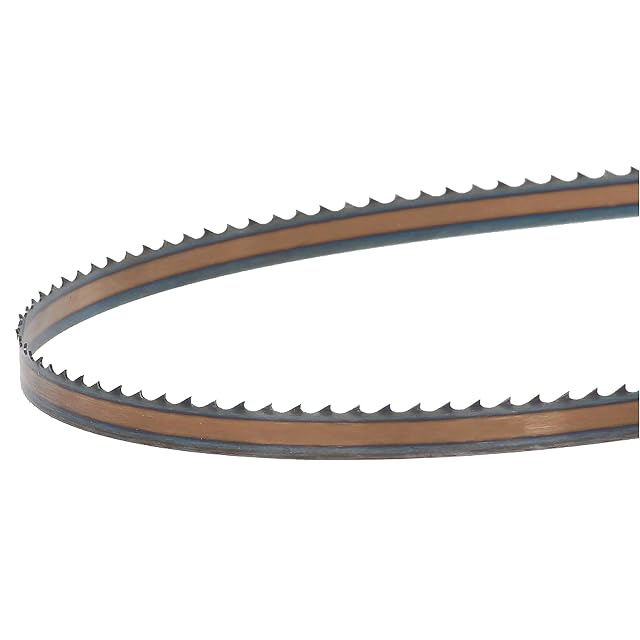
Timber Wolf 93-1/2 inch band saw blade, half inch wide, product photograph

Timber Wolf 93-1/2 × 1/2 in, 4 TPI

The only band here sold on how little tension it needs — which on a light 14 inch frame is the figure that decides whether it tracks.

Length
93-1/2 in, published — 2,375 mm (93.5 in)
Width
1/2 in, published — 12.7 mm (0.50 in)
Thickness
Not published by the maker. · A thin kerf is stated
Pitch
4 TPI — the coarsest pitch on the American half of this shelf apart from the sawmill band
Tooth form
Not published by the maker.
Steel
High silicon, low carbide steel, as the maker words it
Tension
Stated to run under low tension, which the maker states requires less horsepower — the only tension claim on this shelf
Quantity
1 blade
Intended use
Stated ideal for resawing thick stock · Stated to run cooler and last longer
Part number
144711
Amazon reference
B0036B4Q4Q
EAN
0669754935046
  • The only band on this shelf sold on the tension it needs
  • A thin kerf wastes less of the board on a resaw
  • No thickness, on a blade whose whole argument is tension

Best for: Resawing thick stock on a 14 inch saw that struggles to tension a half-inch band

≈ $37
Check price on Amazon

Specifications

Length
93-1/2 in, published — 2,375 mm (93.5 in)
Width
1/2 in, published — 12.7 mm (0.50 in)
Thickness
Not published by the maker. · A thin kerf is stated
Pitch
4 TPI — the coarsest pitch on the American half of this shelf apart from the sawmill band
Tooth form
Not published by the maker.
Steel
High silicon, low carbide steel, as the maker words it
Tension
Stated to run under low tension, which the maker states requires less horsepower — the only tension claim on this shelf
Quantity
1 blade
Intended use
Stated ideal for resawing thick stock · Stated to run cooler and last longer
Part number
144711
Amazon reference
B0036B4Q4Q
EAN
0669754935046

Every figure below names its source. Each one is a manufacturer specification read off the listing itself. The judgments are ours.

Low tension, which is the real problem

Most 14 inch band saws cannot properly tension a half-inch blade.

The frame flexes, the tension spring bottoms out, and the band runs slack — which arrives as a cut that bows away from the fence halfway down a resaw. Every forum thread about band saws is some version of this.

A band designed to track true at lower tension sidesteps it. And the maker adds the second half: less tension is less load on the bearings and the motor.

It is the only listing on either half of this shelf to make that argument. No figure accompanies it.

Four teeth to the inch

The coarsest pitch on the American half of this shelf apart from the sawmill band.

Deep stock needs big gullets. The sawdust has to travel from the top of a 150 mm (5.91 in) cut to the bottom without packing, and at 4 TPI there is room for it.

The cost is the face: the published Uddeholm blade on this shelf, also at 4 TPI, says it in one line — it will tear the face of thin ply.

Thin kerf

Which on a resaw is board saved, every cut, down the whole length.

A band saw kerf is already much thinner than a table saw’s. Narrowing it further is the difference between three veneers and two out of the same expensive plank.

What is not published is the kerf in thousandths, or the thickness it follows from. So this is a direction, not a number.

And no thickness

On a blade whose whole argument is tension.

Thickness is what sets tension: a thinner band needs less of it, and the AYAO on this shelf publishes 0.018 in for exactly that reason. This page makes the same case and leaves out the figure the case rests on.

Length first, everything else second

A band saw blade is a closed loop, and the loop has one length.

Too short and it will not reach round both wheels. Too long and the tension spring runs out of travel before the band is tight. There is no adjustment and no adapter: the number stamped on the saw is the number to buy.

Every listing on this shelf says so in its own words, and three of them say it twice. It is the only compatibility question that cannot be worked around.

Availability

Read on the day this page was built: $37 at the American Amazon shop.

Read from Keepa on the day this page was last revised; stock and price both move without notice.

Prices quoted in this text were read on 2026-10-07. The live price is at the top of the page.
What comes up most often

Why does low tension matter?

Because most 14 inch band saws cannot properly tension a half-inch blade. The frame flexes, the tension spring bottoms out, and the band runs slack — which shows up as a cut that bows away from the fence halfway down a resaw. A band designed to track true at lower tension sidesteps the whole problem, and the maker adds the second consequence: less tension means less load on the bearings and the motor. It is the only listing on either half of this shelf to make the argument, and no figure accompanies it.

What is a thin kerf worth on a resaw?

Board. Resawing a 150 mm (5.91 in) plank into two 70 mm (2.76 in) boards throws away whatever the kerf takes, every cut, down the whole length. A band saw kerf is already much thinner than a table saw's, and a thin-kerf band narrows it further. On figured or expensive timber that is the difference between three veneers and two out of the same plank. What is not published here is the kerf in thousandths, nor the thickness it follows from — so the claim is a direction rather than a number.

High silicon, low carbide — is that a real steel?

Silicon is a genuine alloying element in spring steels and it raises the elastic limit, which is precisely what a band that must run at low tension and flex millions of times needs. “Low carbide” is the unusual half of the phrase: carbide particles are what make a steel hold an edge, so fewer of them means a tooth that dulls sooner and a band that breaks later. That trade is consistent with everything else on this page — cooler, longer-lasting, low tension. This page reports the maker's words and does not verify the metallurgy.

All band saw blades