Reusable mask · carbon
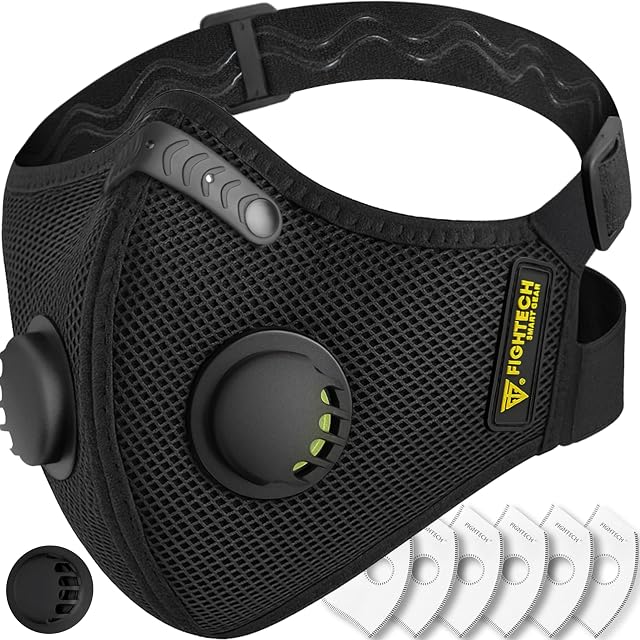
FIGHTECH Carbon filter dust mask, large
The only filtration efficiency on either half of this shelf, with the laboratory named — and no filter class.
Specifications
- Filter class
- Not published by the maker. · No N95, R95, P100 or FFP designation appears
- Filtration efficiency
- 99.941 per cent average, published, with particulate caught down to 0.1 micron · Stated tested at Nelson Laboratories, USA — the only efficiency figure and the only laboratory on either half of this shelf
- Filter type
- Active carbon, included, stated interchangeable and reusable along with the exhaust valves
- Stated limit
- Non-toxic dust, fumes, common airborne irritants and other non-oil-based particles · Stated for non-oil-based paint only
- Straps
- An adjustable upper strap with internal silicone grip lines, stated to prevent slipping
- Sizes
- The title says 2 sizes and names Large; a feature says it comes in 3 sizes
- Body
- Elastic material, adjustable, stated to fit most head types
- Part number
- 850025430944
- Amazon reference
- B0DZJ3QGBT
- EAN
- 0850025430944
Every figure below names its source. Each one is a manufacturer
specification read off the listing itself. The judgments are ours.
Ninety-nine point nine four one per cent
Published, to three decimal places, with particulate caught down to 0.1 micron,
and the laboratory named.
Nothing else on either half of this shelf publishes an efficiency figure at all.
What it means: on the test that laboratory ran, the filter stopped all but six
parts in ten thousand of the challenge aerosol.
The class letter is the specification
A respirator is bought on what its filter stops, and that is a class, not an
adjective.
In Europe the scale is FFP1, FFP2 and FFP3, and the published pages on this shelf
are chosen on it: FFP3 — the class hardwood dust warrants. In the United States
the equivalents are N95, R95 and P100, tested and approved under a federal
standard.
A listing that says carbon filter, dual filter or ten replacement filters has
named a construction and not a performance. None of the three American
respirators on this shelf publishes a class, and this site reports exactly what
each page carries.
A class letter is a defined test, a defined particle size, a defined flow rate
and a defined approval — and it travels. FFP3 means the same thing from every
maker on earth.
An efficiency percentage from one laboratory means what that test measured.
This page has the percentage and the laboratory and not the class. The published
FFP3 pages on this shelf have the class and no percentage.
Neither has both.
Two sizes, or three
The title: Dust Mask 2 Sizes - Large.
The fifth feature: comes in 3 sizes and can be adjusted to meet most head types.
A mask protects only if it seals, so the size is the most consequential figure on
the page — and the page gives two answers.
Non-oil-based
Stated, twice, and it is to the listing’s credit.
Oil-based aerosols — thinned spray paint, oil mist, some lubricants — degrade a
medium that handles dry dust perfectly well. That is exactly why the American
class system has an N for non-oil and a P for oil-proof.
For woodworking, the N end is the right end: sawdust is dry.
For spraying a solvent finish it is not — and the two respirators beside this one
on this shelf are both sold for spraying, and neither names a class.
Availability
Read on the day this page was built: $21 at the American Amazon shop.
Read from Keepa on the day this page was last revised; stock and price both move without notice.
Prices quoted in this text were read on 2026-10-07. The live price is at the top of the page.