Skip to content

Hiltex 10108, 24-piece set, 1/4 in shank

The only YG8 carbide on this shelf, in the only case with a label in every slot.

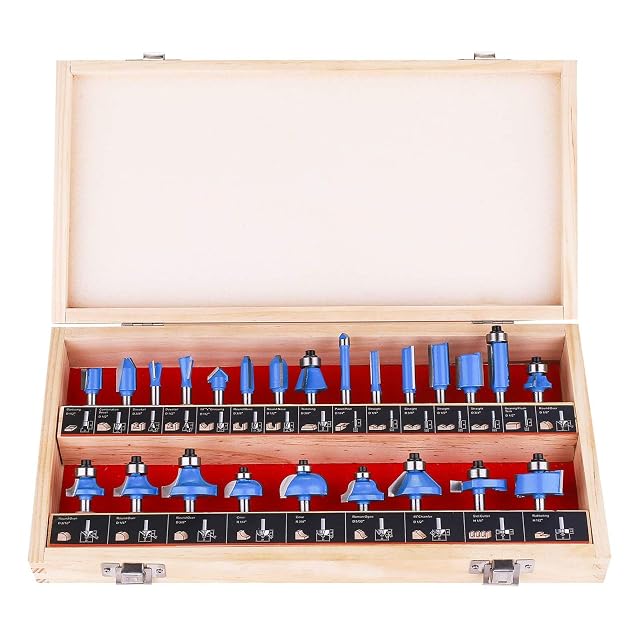
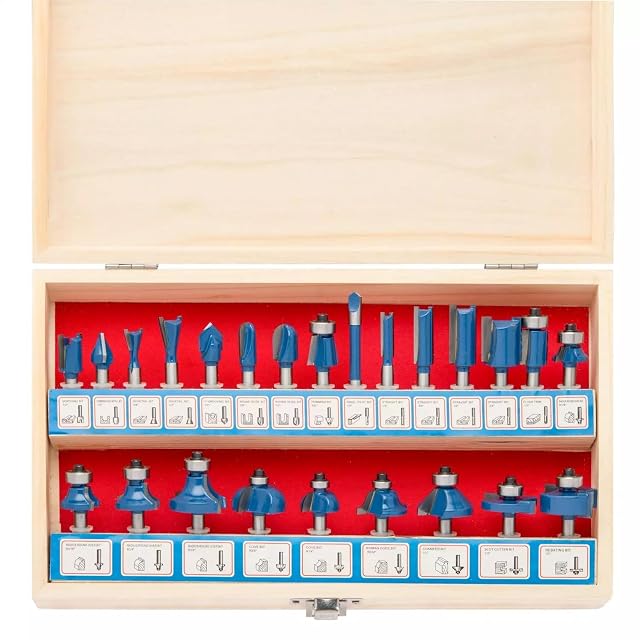
Hiltex 10108 twenty-four piece tungsten carbide router bit set, product photograph

Hiltex 10108, 24-piece set, 1/4 in shank

The only YG8 carbide on this shelf, in the only case with a label in every slot.

Shank
1/4 in — 6.35 mm, stated universal
Quantity
24 bits · None is named or dimensioned
Carbide grade
Machined YG8 tungsten carbide, stated heat resistant — the only YG8 on either half of this shelf
Body
Hardened solid alloy steel with a powder-coated finish
Guides
Select bits have ball-bearing rollers, stated for better alignment · Which bits is not published
Case
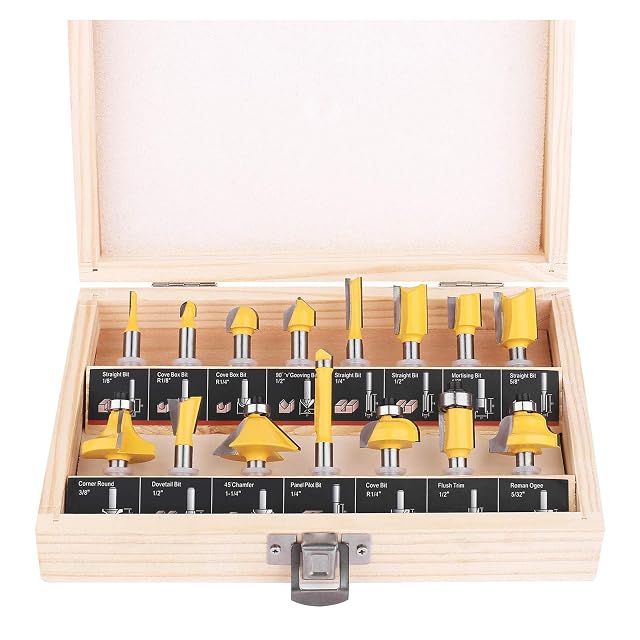
A storage box with labeled slots for each bit — the only labeled case on either half of this shelf
Uses
Edging, trimming, veining and grooving
Part number
10108
Amazon reference
B07GTF69PG
EAN
0816914022546
  • A labeled slot for every bit, which is what makes a 24-piece set usable
  • Names YG8, a specific carbide grade rather than a classification band
  • Not one of the twenty-four bits is named or dimensioned

Best for: A 24-piece set that will still be identifiable in three years, because the case says what each bit is

≈ $39
Check price on Amazon

Specifications

Shank
1/4 in — 6.35 mm, stated universal
Quantity
24 bits · None is named or dimensioned
Carbide grade
Machined YG8 tungsten carbide, stated heat resistant — the only YG8 on either half of this shelf
Body
Hardened solid alloy steel with a powder-coated finish
Guides
Select bits have ball-bearing rollers, stated for better alignment · Which bits is not published
Case
A storage box with labeled slots for each bit — the only labeled case on either half of this shelf
Uses
Edging, trimming, veining and grooving
Part number
10108
Amazon reference
B07GTF69PG
EAN
0816914022546

Every figure below names its source. Each one is a manufacturer specification read off the listing itself. The judgments are ours.

A label in every slot

The only labeled case on either half of this shelf, and it is the reason to prefer this set.

A 24-piece set is unusable without one. Router bits are short, dark and similar, and a 1/4 inch roundover is indistinguishable from a 5/16 in a tray — so the set goes back in the wrong order and within a year nothing can be found.

A slot with a label keeps a set a set.

The published Rockler adapter set in this catalog solves the same problem with color, and its page says the same thing in its own words.

YG8

A specific grade, which is more than a classification band.

YG8 is a Chinese designation — roughly eight per cent cobalt binder in tungsten carbide, which puts it among the tougher, more impact-resistant grades. It is not directly comparable with the C2 and C3 bands the other listings here publish; the rough correspondence is that it sits nearer C2.

Four listings on this shelf name a grade, and three different systems appear in those four. This is the only YG8.

Shank before everything

A router bit is held by its shank, and the collet that holds it has one size.

A quarter of an inch is 6.35 mm (0.25 in). Eight millimeters is eight. A 1/4 in bit drops loose in an 8 mm (0.31 in) collet and an 8 mm (0.31 in) bit will not enter a 1/4 in one — and a collet is a precision clamp, not a hole: there is no ring, no bush and no adapter that makes either fit the other safely.

Which is why the two halves of this shelf cannot be mixed. Every American listing here is 1/4 in; every European one is 8 mm (0.31 in). The published Spetool page on this shelf states the rule in one line, and it is the most useful sentence on the shelf.

Select bits have bearings

Which bits is not published.

It is true of every 24-piece set — flush trim, roundover, cove and rebate bits are bearing guided; straight, V-groove and dovetail bits are not. Because the contents are not listed, neither is the subset.

So the number of bearing-guided profiles, which is what decides whether curves can be worked at all, is unknown until the box is opened.

Powder coated

On the body, which is the half of a router bit that rusts.

A bit lives in a drawer in an unheated shop, and a bare steel body spots within a winter. Powder coating is the cheap fix, and the published Akylin slot cutter on the European half of this shelf is credited for the same thing: a rust-inhibiting coating on the body, which matters on a tool that sits in a drawer.

Availability

Read on the day this page was built: $44 at the American Amazon shop.

Read from Keepa on the day this page was last revised; stock and price both move without notice.

Prices quoted in this text were read on 2026-10-07. The live price is at the top of the page.
What comes up most often

What is YG8?

A Chinese carbide grade designation — roughly eight per cent cobalt binder in tungsten carbide, which places it among the tougher, more impact-resistant grades. It is not directly comparable with the C2 and C3 classifications the other listings on this shelf publish, because those are American classification bands rather than compositions; the rough correspondence is that YG8 sits nearer C2 than C3. What matters is that a specific grade is named at all. Across both halves of this shelf, four listings name a grade and three different systems appear.

Why does a labeled case matter?

Because a 24-piece set is unusable without one. Router bits are short, dark and similar, and the difference between a 1/4 inch roundover and a 5/16 is invisible in a tray — so a set returns to its box in the wrong order and, within a year, nobody can find anything. A slot with a label on it keeps the set a set. It is the only one on either half of this shelf, and the published Rockler adapter set in this catalog solves the same problem a different way, with color.

Which bits have bearings?

Not published. The listing says select bits also have ball-bearing rollers, which is true of every 24-piece set — flush trim, roundover, cove and rebate bits are bearing guided, and straight, V-groove and dovetail bits are not. Because the contents are not listed, neither is the subset. For a buyer the practical consequence is that the number of bearing-guided profiles, which is what determines whether curves can be worked at all, is unknown until the box is opened.

All router bits