Skip to content

KOWOOD 15-piece set, 1/4 in shank

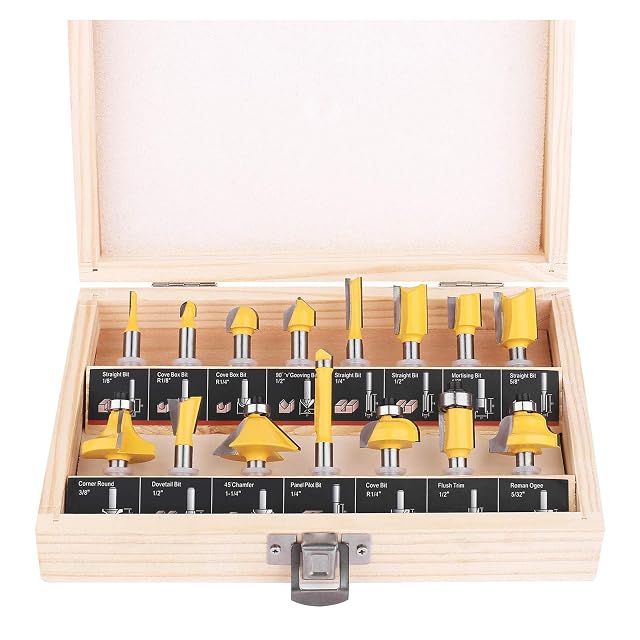
Fifteen bits in a wooden case, on five bullets shared word for word with the maker's 24-piece set.

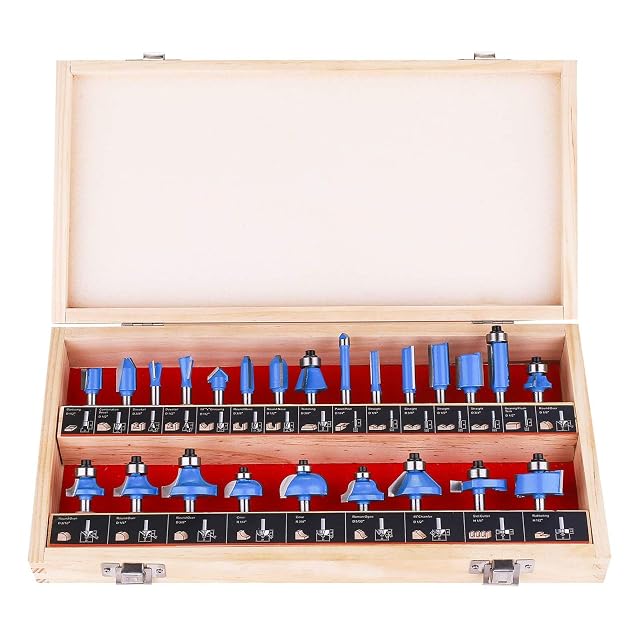
KOWOOD fifteen piece router bit set in a wooden case, product photograph

KOWOOD 15-piece set, 1/4 in shank

Fifteen bits in a wooden case, on five bullets shared word for word with the maker's 24-piece set.

Shank
1/4 in — 6.35 mm, stated to give greater stability and less vibration
Quantity
15 bits · None is named or dimensioned
Carbide grade
Not published by the maker. · An alloy blade on a hardened steel body is stated
Geometry
An anti-kickback design, stated
Case
A wooden case, stated to protect the bits between jobs
Materials
Wood, MDF, particle board, plywood and compact panel · Stated explicitly not for ferrous metal or non-wood
Shared text
The five published features are identical, word for word, to the maker's 24-piece set on this shelf
Part number
SUPTMAX
Amazon reference
B07V5ZCV3M
EAN
0778695709637
  • A wooden case rather than a blow-molded tray
  • States what it is not for, which almost nothing on this shelf does
  • Not one of the fifteen bits is named or dimensioned

Best for: A new router owner finding out which profiles they actually need

≈ $27
Check price on Amazon

Specifications

Shank
1/4 in — 6.35 mm, stated to give greater stability and less vibration
Quantity
15 bits · None is named or dimensioned
Carbide grade
Not published by the maker. · An alloy blade on a hardened steel body is stated
Geometry
An anti-kickback design, stated
Case
A wooden case, stated to protect the bits between jobs
Materials
Wood, MDF, particle board, plywood and compact panel · Stated explicitly not for ferrous metal or non-wood
Shared text
The five published features are identical, word for word, to the maker's 24-piece set on this shelf
Part number
SUPTMAX
Amazon reference
B07V5ZCV3M
EAN
0778695709637

Every figure below names its source. Each one is a manufacturer specification read off the listing itself. The judgments are ours.

Fifteen bits, none named

A wooden case, a mention of tongue and groove, and fifteen.

That is the contents list.

The published ENT 12-piece set on the European half of this shelf has the same gap, and its page makes the honest case for buying one regardless: a useful way to discover which profiles you actually need, and sets are priced by quantity — the profiles you never use subsidize the four you do.

That argument holds here. The gap is still a gap.

The same five bullets as the 24-piece

Word for word, in the same order, with the same punctuation. Only the count in the last line changes.

So nothing on either page distinguishes the two sets except a number, and neither names a bit.

The only decision available is fifteen or twenty-four.

Shank before everything

A router bit is held by its shank, and the collet that holds it has one size.

A quarter of an inch is 6.35 mm (0.25 in). Eight millimeters is eight. A 1/4 in bit drops loose in an 8 mm (0.31 in) collet and an 8 mm (0.31 in) bit will not enter a 1/4 in one — and a collet is a precision clamp, not a hole: there is no ring, no bush and no adapter that makes either fit the other safely.

Which is why the two halves of this shelf cannot be mixed. Every American listing here is 1/4 in; every European one is 8 mm (0.31 in). The published Spetool page on this shelf states the rule in one line, and it is the most useful sentence on the shelf.

Anti-kickback

The only geometry claim on either half of this shelf, and it is a real one.

The steel behind each carbide tip is left standing almost level with the cutting edge, so the chip thickness is limited by the body rather than by how hard the wood is pushed.

Which is what stops a bit grabbing and snatching the work out of the hands. It is standard on better bits and worth having named.

And it says what it will not cut

Stated: do not cut ferrous metal and non wood.

Across fourteen listings on this shelf, two state a limit of any kind. The other is the published dovetail cutter on the European half, whose page records the opposite problem — its maker names stainless, carbon steel, cast iron and tool steel, and not timber.

Availability

Read on the day this page was built: $27 at the American Amazon shop.

Read from Keepa on the day this page was last revised; stock and price both move without notice.

Prices quoted in this text were read on 2026-10-07. The live price is at the top of the page.
What comes up most often

What is in it?

Not published. Fifteen bits, a wooden case, and a mention of tongue and groove in the third feature — that is the whole contents list. The published ENT 12-piece set on the European half of this shelf has the same gap and its page makes the honest case for buying one anyway: a useful way to discover which profiles you actually need, and sets are priced by quantity, so the profiles you never use subsidize the four you do. That argument holds here. It does not make the missing list less of a gap.

What is an anti-kickback design?

A body shaped so that the cutter cannot take too big a bite. The steel behind each carbide tip is left standing almost level with the cutting edge, so the chip thickness is limited by the body rather than by how hard the wood is pushed — which is what stops a bit grabbing and snatching the work out of the hands. It is a real and worthwhile geometry, it is standard on better bits, and it is the only geometry claim on either half of this shelf.

Why does the shared text matter?

Because it means the page describes a range rather than a product. The maker's 24-piece set on this shelf publishes the same five features in the same order with the same punctuation — only the count in the last line changes. So nothing on either page distinguishes the two except a number, and neither names a single bit. Two listings, one text, and the only decision a buyer can make is fifteen or twenty-four.

All router bits