Rules · sliding stops
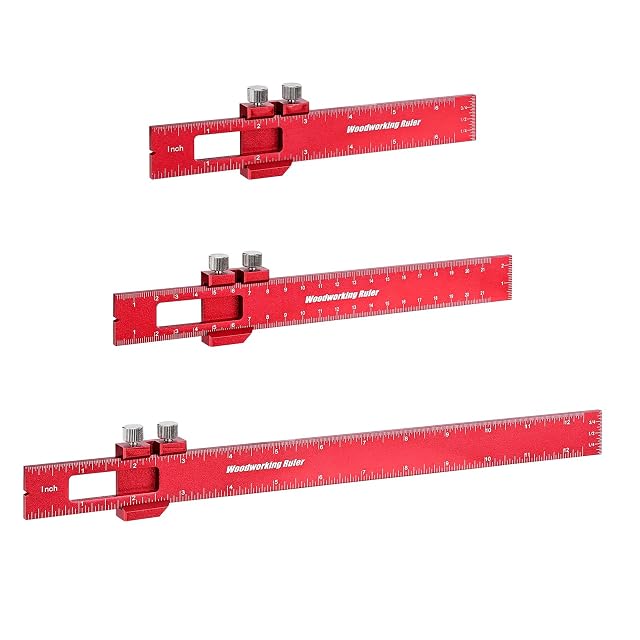
DRAXZOR 3-piece rule set with stops, 6, 8, 12 in
Three rules with stops on them — which is a marking gauge wearing a rule, and the only one on this shelf.
Specifications
- Lengths
- Three: 6, 8 and 12 in — 152, 203 and 305 mm (12 in)
- Stops
- A sliding stop block on each rule, stated to glide smoothly and lock securely — the only rules with stops on either half of this shelf
- Graduations
- Laser-etched, inches on one face and millimeters on the other
- Scale origin
- Not published by the maker.
- Thickness
- Not published by the maker.
- Material
- Aluminum alloy, CNC machined and anodized, stated rust and corrosion resistant
- Quantity
- 3 rules
- Part number
- Not published by the maker.
- Amazon reference
- B0F8HQ1833
- EAN
- 0767738879529
Every figure below names its source. Each one is a manufacturer
specification read off the listing itself. The judgments are ours.
A stop on every rule
Which makes these something other than rules.
Measuring 42 mm (1.65 in) twenty times means reading the scale twenty times and being
wrong once. Setting a stop at 42 mm (1.65 in) means butting it against the edge twenty
times and getting the same answer.
That is exactly the argument the published Stubai double gauge on this shelf
makes for its two beams: two dimensions stay set through a whole batch of
joints.
A rule with a stop is the cheap version, and it works on any face the rule can
lie on.
Three lengths, three stops
Six, eight and twelve inches — so the stop is available at whatever scale the
work is.
A six-inch rule with a stop sets a router bit height. A twelve-inch one sets a
fence offset across a carcase side. The same stop on one rule would do neither
well.
Anodized aluminum
Light, and it will not rust in an unheated shop.
It is also soft. A marking knife run along an aluminum edge nicks it, and a
nicked edge marks a wavering line from then on.
The Mr. Pen rules on this shelf are stainless, which is the opposite trade. For
measuring, aluminum is fine. For a knife fence, steel.
And a stop that clamps on an anodized face will eventually wear through the
anodizing, which is where aluminum starts to corrode.
Where the scale starts, and how thick the rule is.
Both are on the Mr. Pen listing here and neither is on this one. The first
decides whether the rule can measure from an edge; the second whether it lies
flat.
What this set has instead is three locking stops. They are complementary tools
rather than competing ones: one set measures, the other repeats.
Availability
Read on the day this page was built: $13 at the American Amazon shop.
Read from Keepa on the day this page was last revised; stock and price both move without notice.
Prices quoted in this text were read on 2026-10-07. The live price is at the top of the page.