Half face · CE · dual filter
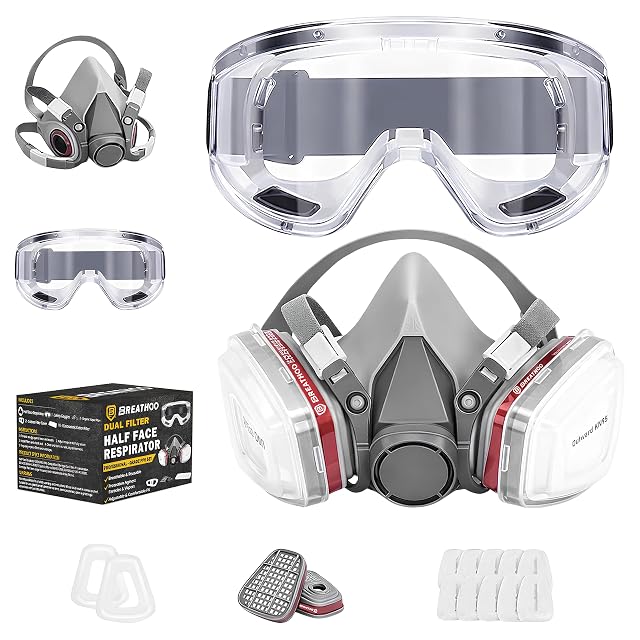
BREATHOO AirGuard half-face respirator with goggles, M
The only respirator on this shelf to publish a certification mark — and it is a mark, not a class.
Specifications
- Filter class
- Not published by the maker. · No FFP, N95 or P100 designation appears
- Certification
- CE certified, stated for both the mask and the goggles — the only certification mark on either half of this shelf · CE is a conformity marking, not a filter class
- Filtration efficiency
- Not published by the maker.
- Filters
- A dual filter structure, stated to support comfortable airflow, with components replaceable when needed · No medium and no rating given
- Eye protection
- Anti-fog safety goggles included
- Fit
- Adjustable head straps and a soft sealing surface, stated for different face shapes · Size M, from the title
- Stated uses
- Woodworking, sanding, spray painting, grinding, renovation, construction and maintenance
- Part number
- Not published by the maker.
- Amazon reference
- B0GQVV4PF8
- EAN
- 0199874781433
Every figure below names its source. Each one is a manufacturer
specification read off the listing itself. The judgments are ours.
CE certified
The only certification mark on either half of this shelf, and it is a mark rather
than a class.
CE says the maker declares the product meets the applicable European
requirements. For a respirator that means EN 140 for the face piece and EN 143 or
EN 14387 for the filters.
The class — FFP3, or P3 on a cartridge — is a separate designation, and it is the
one that says what the filter stops.
This page publishes the mark. Both facts are above.
The class letter is the specification
A respirator is bought on what its filter stops, and that is a class, not an
adjective.
In Europe the scale is FFP1, FFP2 and FFP3, and the published pages on this shelf
are chosen on it: FFP3 — the class hardwood dust warrants. In the United States
the equivalents are N95, R95 and P100, tested and approved under a federal
standard.
A listing that says carbon filter, dual filter or ten replacement filters has
named a construction and not a performance. None of the three American
respirators on this shelf publishes a class, and this site reports exactly what
each page carries.
A dual filter
Which lowers breathing resistance, and that is the specification that decides
whether a mask is worn.
Two filters share the airflow, so each sees half the velocity and the wearer
pulls less.
The published JSP FFP3 page on this shelf makes the identical argument for an
exhaust valve: a valve makes an hour in a mask far more bearable, which is why it
gets worn.
A worn mask protects. A correct mask on a bench does not.
Anti-fog goggles
Which matters as much as anything else on this page.
Goggles that fog get pushed up onto the forehead, and goggles on a forehead stop
nothing. Over a respirator it is worse, because exhaled air is warm and wet and
goes straight up the inside of the lens.
The published over-glasses page on this shelf names the pair that settles it:
anti-fog inside and scratch resistant outside, the two coatings that decide
whether they get worn.
This publishes the first.
Size M
Published, which the other two respirators on this shelf do not manage — one gives
two sizes in its title and three in a feature, and the other gives none.
On a product whose whole function is a seal against a face, the size is the
specification.
Availability
Read on the day this page was built: $30 at the American Amazon shop.
Read from Keepa on the day this page was last revised; stock and price both move without notice.
Prices quoted in this text were read on 2026-10-07. The live price is at the top of the page.