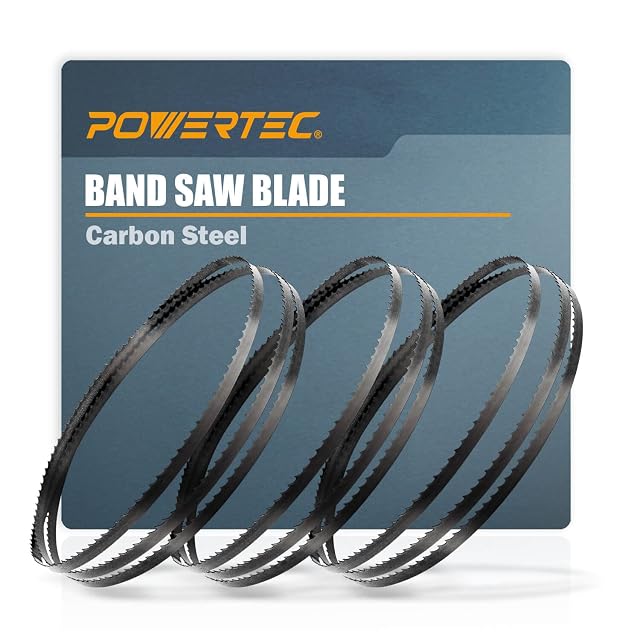
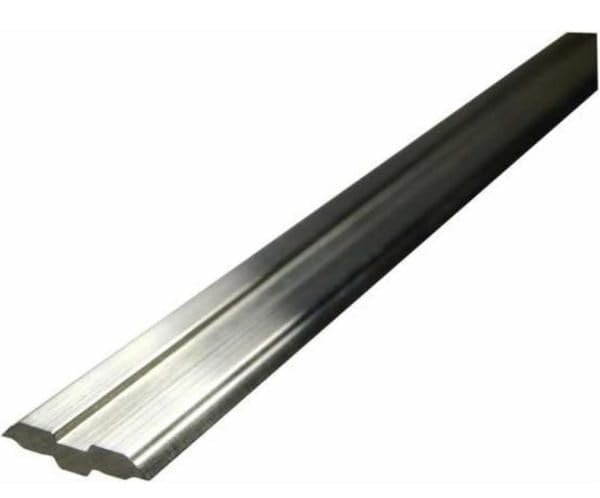
Assortment of three · 62 in
POWERTEC 13601 assortment, 62 in, 3 blades
The benchtop length, with the scroll blade kept in — three widths for the smallest class of band saw on the market.
Specifications
- Length
- 62 in, published — 1,575 mm (62 in)
- Width
- Three: 3/8 in (9.5 mm), 1/4 in (6.4 mm) and 1/8 in (3.2 mm)
- Thickness
- Not published by the maker.
- Pitch
- 6 TPI on the 3/8 in and the 1/4 in; 14 TPI on the 1/8 in
- Tooth form
- Not published by the maker. · Stated an optimal geometric tooth arrangement
- Steel
- High grade carbon steel, stated, with a weld stated heat resistant
- Quantity
- 3 blades
- Intended machine
- 9 in saws taking a 62 in band — POWERTEC, Ryobi, WEN, Grizzly, Skil and Sears Craftsman are named · The maker asks the length to be confirmed before ordering
- Part number
- 13601
- Amazon reference
- B09F2YK3Z8
- EAN
- 0843441111399
Every figure below names its source. Each one is a manufacturer
specification read off the listing itself. The judgments are ours.
Three eighths, a quarter, an eighth
The widest blade in this pack is 3/8 inch, and that is the wheel talking.
A 9 inch wheel bends a band hard on every revolution, and the back edge of a wide
band is where that work goes. A 1/2 inch band on a 9 inch wheel fatigues fast
and is awkward to tension on a light frame.
So this set stops at 3/8. The same maker’s 93-1/2 and 105 inch sets, for 14 inch
saws, both include a 1/2 inch.
That difference is the whole distinction between the two classes of saw,
expressed as a blade.
An eighth of an inch at 14 TPI, which is where a small saw is actually good.
A light frame and a narrow band turn a tight radius without complaint, and the
fine pitch suits the thin stock a 9 inch saw is used on.
The maker’s 105 inch set, for a bigger saw, drops this blade. This one keeps it,
and it is the better-balanced pack of the two.
Length first, everything else second
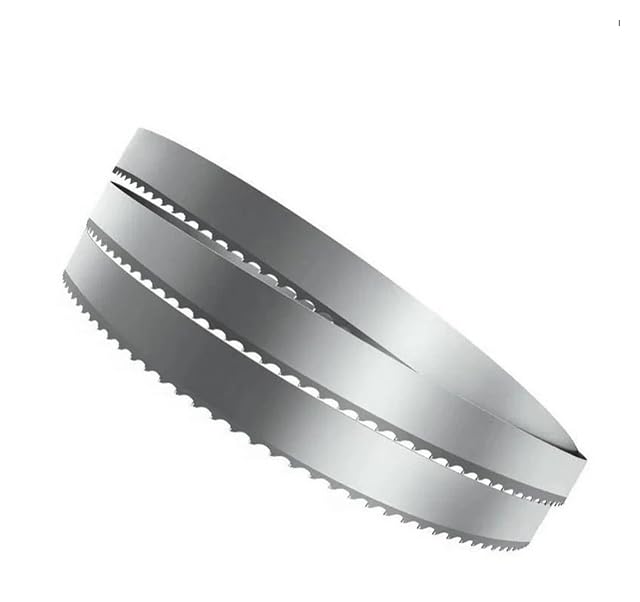
A band saw blade is a closed loop, and the loop has one length.
Too short and it will not reach round both wheels. Too long and the tension
spring runs out of travel before the band is tight. There is no adjustment and
no adapter: the number stamped on the saw is the number to buy.
Every listing on this shelf says so in its own words, and three of them say it
twice. It is the only compatibility question that cannot be worked around.
Six brands, and a request
POWERTEC, Ryobi, WEN, Grizzly, Skil, Sears Craftsman — all 9 inch saws taking a
62 inch band.
And then: please confirm your bandsaw blade size before ordering.
Three of the four POWERTEC listings on this shelf end with that sentence. It is
the right sentence, and it is the one thing on the page that no brand list can
replace.
Availability
Read on the day this page was built: $25 at the American Amazon shop.
Read from Keepa on the day this page was last revised; stock and price both move without notice.
Prices quoted in this text were read on 2026-10-07. The live price is at the top of the page.